




On this page13 sections
- Overview
- Getting there from KL: flights and KLIA terminals
- Brisbane Airport to the city
- Where to stay in Brisbane
- Things to do in Brisbane
- What to eat in Brisbane
- Halal food and prayer spaces in Brisbane
- Getting around Brisbane
- A 4-day Brisbane itinerary
- Money, SIM and practical tips
- Day trips: Gold Coast, rainforest and islands
- Before you go
- FAQ
Brisbane is Queensland's laid-back capital, a subtropical river city of parklands, ferries and open-air dining, with koalas in the suburbs and the Gold Coast a cheap train ride away. Malaysians get a lot out of it: a non-stop Malaysia Airlines flight from KLIA, dry sunny winters that feel nothing like KL's humidity, a long-established Muslim community and, at the time of writing, 50 cent public transport. This guide covers the Australian ETA, Airtrain and taxi costs in ringgit, halal food and mosques, where to stay and a realistic budget.
Getting there from KL: flights and KLIA terminals
Malaysia Airlines is alone on the non-stop route at the time of writing, flying from KLIA Terminal 1 in about eight hours. The usual evening flight leaves KL at 8.40pm and lands at 6.45am; the return departs Brisbane at 8am and reaches KL around 2.10pm. From 25 October 2026 it goes daily on the A330-900neo, with a 9am departure (landing 7.10pm) on Mondays, Wednesdays and Sundays, and a 12.15am return from Brisbane on Mondays, Tuesdays and Thursdays.
Batik Air flies daily from KLIA Terminal 1 with a stop in Denpasar, Bali, about ten hours in all. AirAsia X ended KL to Gold Coast flights in December 2024, so there is no low-cost non-stop into south-east Queensland for now.
Our KL fare scan (updated 21 September 2026) found one-way fares from about RM 925 with one connection, Philippine Airlines being the cheapest carrier at the time of writing, and a median fare of about RM 1,580. Connections through Denpasar, Batik Air's route, started at around RM 1,390 one-way, and Malaysia Airlines non-stop fares also appeared, above the cheapest one-stop prices.
Queensland has no daylight saving, so Brisbane is always two hours ahead of Malaysia.
Brisbane Airport to the city
Brisbane Airport (BNE) is about 20 minutes' drive from the CBD outside peak hours. Costs are indicative, at around RM 2.87 per Australian dollar.
- Airtrain: the station is up on Level 3 of the International Terminal. Trains reach Central, Roma Street, Fortitude Valley and South Brisbane in about 20 minutes, every 15 minutes at peak and 30 minutes off-peak, from just after 5am on weekdays (6am at weekends) to around 10pm. Adults pay AUD 23.30 (about RM 67), 15 percent less online, or AUD 17 each (RM 49) when two or more adults book and travel together, online or at the station. Kids aged 14 and under go free with a paying adult on a paper or online ticket. Visa, Mastercard and go card taps work at the gates.
- Taxi: from the Level 2 arrivals road, about AUD 67 to AUD 82 (RM 190 to RM 235) to the city, plus a AUD 4.86 airport fee and tolls.
- Uber and DiDi: from Level 2, exit at the end of the building behind The Coffee Club and follow the signs down the ramp to the rideshare zone; the AUD 4.86 fee applies here too.
- Con-x-ion: shared door-to-door shuttles to Brisbane, Gold Coast and Sunshine Coast addresses.
- Bus 590: from the Skygate centre (you first have to get there from the terminal) to Toombul Interchange for 50 cents, cheapest and slowest.
Where to stay in Brisbane
Short-stay visitors are best off in the inner city, though cheap transit makes the south side workable.
- CBD: beside the Queen Street Mall and the Airtrain stops at Central and Roma Street, with halal kebab and Middle Eastern takeaways nearby.
- South Bank and West End: across the river by the parklands, Streets Beach and museums. Apartment hotels suit families, and the West End Mosque is close.
- Fortitude Valley and New Farm: restaurants, rooftop bars and loud weekend nights in the Valley, leafy calm in New Farm next door. Good for couples.
- Southside (Sunnybank, Eight Mile Plains, Holland Park): the heart of Brisbane's Asian community, near the Kuraby and Holland Park mosques. Serviced apartments are often cheaper and the Brisbane Metro reaches Eight Mile Plains, but trips into town take longer.
In late September 2026, Amaboxly's hotel scan found the cheapest nights at three- and four-star inner-city hotels for about RM 260 to RM 360 on sample dates between November 2026 and June 2027. Rates rise in school holidays and during the Ekka and Brisbane Festival.
Things to do in Brisbane
Brisbane is an outdoor city, so keep museums for the hottest or wettest hours.
- South Bank Parklands and Streets Beach: the old Expo 88 site opposite the CBD, with a man-made lagoon beach patrolled by lifeguards daily, lawns and barbecue areas.
- Lone Pine Koala Sanctuary: open since 1927 and described as the oldest and largest of its kind. Koala holding ended in July 2024, but you still get close, and kangaroos in the open reserve eat from your hand.
- CityCat ferries: river catamarans that double as a 50 cent sightseeing cruise.
- Mount Coot-tha Lookout: the classic panorama over the city and its surrounds, best late in the day.
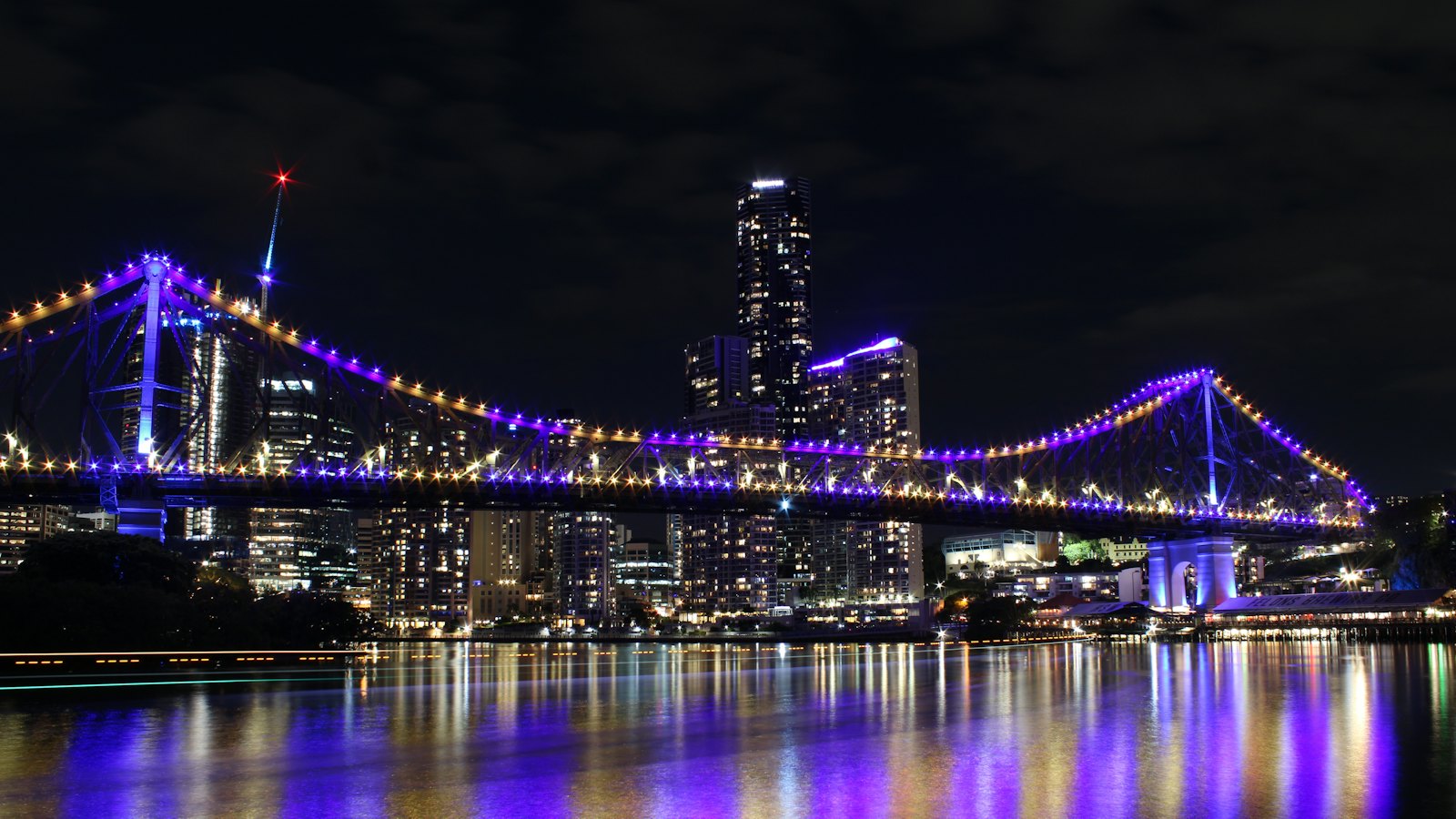
- Kangaroo Point and Howard Smith Wharves: cliff-top parkland facing the towers, and a riverside dining strip beneath the Story Bridge, both at their best after dark.
- Cultural Centre: the Queensland Museum and the Gallery of Modern Art beside South Bank.
- Eat Street Northshore: a Hamilton night market with food stalls and live music, open 4pm to 10pm Friday and Saturday and 4pm to 9pm Sunday, with a small entry charge.
What to eat in Brisbane
Brisbane eats casually and often outdoors: brunch cafes, food trucks, river views and weekend markets. Very little is halal, so read the next section before ordering.
- Moreton Bay bugs: a flat slipper lobster named after the bay, grilled or with prawns and chips; try them at the seafood spots in bayside Manly or Sandgate.
- Lamingtons: chocolate-dipped sponge squares rolled in coconut, at bakeries and cafes.
- Native flavours: macadamias are native here, and modern menus use finger lime, lemon myrtle and Davidson's plum.
- Meat pies and sausage rolls: the everyday bakery snack; most are not halal, so ask before buying.
- Brunch: smashed avocado on toast and a flat white, especially in cafe-heavy Paddington and the other inner suburbs.
Sunnybank is the Asian food suburb, with Market Square and the Mains Road strips full of Chinese, Korean, Japanese and Vietnamese restaurants. Fortitude Valley has Chinatown, West End mixes Greek and Vietnamese, and Inala is known for pho.
Halal food and prayer spaces in Brisbane
Muslims are about 1.8 percent of Brisbane residents (2021 census), so halal food is available but concentrated in certain cuisines and suburbs.
Zabihah currently lists close to 200 halal restaurants in Brisbane, a mix of fast-food and chicken chains, Turkish kebab shops, and Indian, Middle Eastern and Lebanese restaurants. In the CBD several sit on Albert Street and around the Queen Street Mall. Halal Malaysian cooking is hard to find, so do not count on a nasi lemak fix.
There is no single JAKIM-style body here; several independent Islamic organisations issue certificates, so look for a current one and ask when unsure. A pork-free cafe or a Malaysian-Chinese restaurant in Sunnybank is not automatically halal, and many places serve alcohol.
- Holland Park Mosque: the city's historic mosque, first built in 1908 and since redeveloped.
- Kuraby Mosque (Masjid al-Farooq): on the southside, close to Sunnybank.
- West End Mosque: the closest to South Bank, handy for Jumaat if you stay in the inner city.
- Also Darra, Lutwyche and Algester, among more than 20 across greater Brisbane.
At the airport, prayer rooms are on Level 3 of the International Terminal airside (temporarily opposite gate 78) and Level 2 of the Domestic Terminal. Muslim Pro gives prayer times and qibla, and serviced apartments with kitchens make self-catering easy.
Getting around Brisbane
At the time of writing, every bus, train, ferry and tram trip in south-east Queensland costs a flat 50 cents (about RM 1.40), whatever the distance. Only the Airtrain is excluded; even the Gold Coast line and its G:link tram count.
- Paying: no cash on board. Tap a contactless Visa, Mastercard or phone on and off with the same card, one card per person, or buy a go card at the airport station (AUD 35 for adults, including a AUD 10 deposit). Under-fives ride free.
- Brisbane Metro: bus rapid transit on routes M1 and M2 through the CBD to Eight Mile Plains and the University of Queensland, every five to ten minutes at peak.
- Trains: Queensland Rail lines fan out from Central and Roma Street to the suburbs and both coasts.
- Ferries: CityCats and small cross-river ferries stop at South Bank, the CBD, New Farm and more.
- Rideshare and taxis: Grab does not operate in Australia. Use Uber, DiDi, Black and White Cabs or 13cabs.
- Car hire: driving is on the left, as at home, and a car suits Tamborine Mountain or Australia Zoo. Check Queensland's rules on Malaysian licences first.
A 4-day Brisbane itinerary
- Day 1: Land on the early flight, drop your bags and stroll South Bank Parklands, with a swim at Streets Beach if it is warm. Catch sunset at Kangaroo Point and dine by the river at Howard Smith Wharves or in the CBD.
- Day 2: Koalas and kangaroos at Lone Pine in the morning, then the Queensland Museum or Gallery of Modern Art. Ride a CityCat at golden hour and, from Friday to Sunday, end at Eat Street Northshore.
- Day 3: Gold Coast by train and tram for Surfers Paradise beach or a theme park, back after dark. Families with small children may want two days.
- Day 4: Mount Coot-tha Lookout in the morning, Jumaat at West End or Holland Park if it is Friday, then the Queen Street Mall. Keep tax invoices for the GST refund.
Five or six days leaves room for Moreton Island, Tamborine Mountain or the Sunshine Coast. For the 8am flight home, spend the last night in the city and take an early Airtrain or a taxi; check the first train time, as weekend services start later.
Money, SIM and practical tips
- Currency: Australian dollars. AUD 1 is about RM 2.87 at the time of writing, so a AUD 20 lunch costs roughly RM 57.
- Paying: contactless Visa and Mastercard are accepted almost everywhere, including transit. A low-fee multi-currency card saves ringgit. DuitNow QR cannot be used, as PayNet's cross-border QR does not cover Australia.
- Data: a travel eSIM bought before departure and a local prepaid SIM both do the job.
- Power: Type I sockets with two slanted flat pins and an earth pin, so bring an adapter.
- Tipping: not expected.
- GST refund: spend AUD 300 or more (GST included) at one business in your final 60 days, keep the original paper invoice, and claim at the airport TRS facility at least 30 minutes before departure, goods in hand.
- Food: declare everything edible on the Incoming Passenger Card. Home-made meals and cakes are generally refused, and hiding food can cost you a fine.
- Sun and surf: UV is present all year and can be high even on cool, clear winter days, so wear sunscreen, and swim between the red and yellow flags.
- Safety: Brisbane is generally safe; take normal care in Fortitude Valley late on weekends.
Day trips: Gold Coast, rainforest and islands
For many Malaysian families the Gold Coast is the highlight, and from Brisbane it costs next to nothing at the time of writing. Gold Coast line trains run from the central stations to Helensvale, where the G:link tram continues to Surfers Paradise and Broadbeach, all on the 50 cent fare. Sea World, Warner Bros. Movie World, Dreamworld and Wet'n'Wild lie in the coast's northern half, away from the tram line, so plan a bus, shuttle or hire car, especially with toddlers. Airtrain services also continue from the airport to the Gold Coast, with combined Airtrain and tram tickets to Surfers Paradise.
Inland, Tamborine Mountain and the Scenic Rim offer rainforest walks, waterfalls and mountain air, best by car or tour. North of the city, the Sunshine Coast adds more beaches and Australia Zoo, owned by Terri Irwin.
Moreton Island is about 75 minutes by ferry and mostly national park, with giant sand dunes and whale watching in season, so take food and water unless staying at the resort. Book everything early around Australian school holidays.
Before you go
- Best time to go
- Brisbane is most pleasant from April to October, when days are warm, dry and sunny, without summer's heavy humidity and storms. Mid-winter (June to August) suits many Malaysians best: an average July day reaches about 22°C with little rain and far less humidity than KL, though evenings call for a light jacket. Brisbane Festival fills September with shows and outdoor events (3 to 25 September in 2027), and the Ekka show fills the Bowen Hills showgrounds each August. December to February is hot, sticky and the wettest stretch, with frequent afternoon storms, and it coincides with Malaysia's December school holidays (starting 5 December 2026 in most states) and Australia's long summer break. Expect peak fares and packed Gold Coast parks then, so book well ahead.
- Visa for Malaysians
- Malaysians travelling on a Malaysian passport need an approved ETA (subclass 601, Electronic Travel Authority) for Australia, as of September 2026, obtained in the official Australian ETA app for AUD 20 (about RM 57). The app reads your passport chip and takes a selfie, so switch on NFC and location services first. Most applications are decided immediately, but Home Affairs suggests waiting for the grant before making travel arrangements. The ETA lasts a year, or until your passport expires if sooner, and covers any number of visits of up to three months each for holidays, family or business meetings, never paid work. The ETA is linked to the passport you apply with, so a new passport means a new ETA. Each child needs a separate application, you must apply from outside Australia, and applications go only through the official app, so ignore websites offering to lodge one. Fill in the Incoming Passenger Card handed out on the plane, and check immi.homeaffairs.gov.au for changes shortly before you go.
- Honest budget guide
- Day-to-day spending in Brisbane runs from about RM 300 for a careful traveller to RM 700 for a comfortable one, per person and excluding flights. Flights: our KL fare scan, at the time of writing, found one-way tickets from around RM 925 with a connection and a median near RM 1,580, with non-stop Malaysia Airlines fares higher, so returns tend to cost RM 1,900 to RM 3,500. Hotels: our hotel scan found three- and four-star inner-city rooms from roughly RM 260 to RM 360 a night on sample dates; RM 400 to RM 600 is fairer for mid-range otherwise. Food: RM 120 to RM 250 daily. Transport: small change at 50 cents a ride, plus about RM 67 per Airtrain trip. Five days and four nights, two people sharing a mid-range room, comes to around RM 3,700 to RM 6,500 each with flights. These numbers are indicative only.
Frequently asked questions
Do Malaysians need a visa to visit Brisbane?
You need an ETA (Electronic Travel Authority, subclass 601) rather than a full visa. It is applied for in the official Australian ETA app for AUD 20 (about RM 57), in most cases approved immediately, and valid for a year of multiple visits of up to three months each. Children need their own application.
Is there a direct flight from KL to Brisbane?
Yes, on Malaysia Airlines from KLIA Terminal 1, roughly eight hours non-stop, and daily from 25 October 2026. One-stop itineraries were cheaper in our fare scan, from about RM 925 one-way at the time of writing, with the non-stop fares costing more. Batik Air also flies daily from KLIA via Bali, about ten hours in total.
Is Brisbane Muslim-friendly?
Reasonably, with some meal planning. Muslims are a small minority, yet there are more than 20 mosques across greater Brisbane, from historic Holland Park to the West End Mosque near South Bank, and prayer rooms in both airport terminals. Kebab shops and Middle Eastern, Lebanese and Indian restaurants are the likeliest halal options. Look for a current certificate, because a pork-free kitchen can still be non-halal.
How many days in Brisbane is enough?
Three or four days suits the city itself: South Bank, a koala sanctuary, a CityCat ride, Mount Coot-tha and a market evening. Allow two or three more for the Gold Coast theme parks, Moreton Island or the Sunshine Coast. A full week covers Brisbane plus the Gold Coast without rushing.
What is the best month to visit Brisbane?
Anywhere from April to October works, with June to August giving dry, sunny days of about 22°C and far less humidity than KL. September brings Brisbane Festival. December to February is hot and stormy, and with school holidays in both countries it is also the busiest and priciest period.
What does a 5-day Brisbane trip cost from Malaysia?
Allow about RM 3,700 to RM 6,500 each for five days and four nights, including return flights and a shared mid-range room. Roughly RM 1,900 to RM 3,500 goes on airfares, RM 800 to RM 1,200 on your half of the hotel and RM 120 to RM 250 a day on food, while 50 cent transit barely registers. All figures are indicative.
Can I use Grab in Brisbane?
No. Grab only runs in Southeast Asia, so the app will not work in Australia. Brisbane's main rideshare apps are Uber and DiDi, and at the airport they use a signposted pick-up zone with a AUD 4.86 airport fee on top. Taxis are plentiful, though with 50 cent fares public transport is usually the better deal.
Can I bring Malaysian food into Australia?
Think twice before packing it. Australia enforces very strict biosecurity, and every food item must be declared on the Incoming Passenger Card. Home-made dishes and cakes are generally refused, and fresh fruit is restricted. It is simpler to travel light and buy groceries in Brisbane. Failing to declare food can bring a fine.
Jom pergi
Ready to go Brisbane? Compare available flights and hotels for your dates. Check baggage, cancellation terms and the final total on the booking provider before paying.






