




On this page12 sections
Kuching is the gentlest introduction to Borneo a Malaysian can get: under two hours from KLIA, no passport, ringgit in your wallet and your usual phone plan still working. Yet it feels properly different from the Peninsula. Sarawak runs its own immigration counter, breakfast means Sarawak laksa, and a short drive from the waterfront you can watch semi-wild orangutans at Semenggoh, while a road-and-boat trip reaches the proboscis monkeys of Bako. The city itself is compact, green and unhurried, with a riverside promenade, old shophouses and a fondness for cat statues. Below: flights and our KL fare scan, the MyKad check on arrival, halal food and mosques, transport and what a long weekend costs.
Getting there from KL: flights, terminals and fares
Kuching is a plane-only trip from the Peninsula. No road, railway or passenger ferry crosses the South China Sea, so the ETS and express buses that serve Penang or Ipoh cannot help here. Scheduled gate-to-gate time is a little under two hours (about 1 hour 50 minutes), and Sarawak runs on the same clock as KL.
Four airlines fly non-stop between KLIA and Kuching at the time of writing:
- AirAsia, out of KLIA Terminal 2.
- Malaysia Airlines, out of Terminal 1.
- Batik Air, also Terminal 1, and it flies to Kuching from Subang as well, handy for Petaling Jaya and Shah Alam.
- AirBorneo, Sarawak's state-owned airline, twice daily from Terminal 1 since July 2026.
Amaboxly's own scan of KL departures, refreshed on 22 September 2026, priced 19 dated one-way fares. The lowest was about RM 183 on a direct AirAsia flight, the median sat near RM 202 and the highest reached roughly RM 359, with Malaysia Airlines also appearing on a non-stop service. Expect higher prices over Gawai, festive seasons and school breaks.
Heading further into Borneo afterwards? Express buses from Kuching Sentral run on to Sibu, Bintulu and Miri, and across the border to Pontianak (Indonesia needs a passport).
Kuching International Airport to the city
Kuching International Airport (KCH) sits about 11 km south of the centre, usually 20 to 30 minutes by road. First, though, comes the step that surprises first-timers: every flight from outside Sarawak, KLIA included, arrives into an immigration counter, so keep your MyKad out.
Ways into town (prices indicative):
- E-hailing: Grab, Maxim and AirAsia MOVE all collect at arrivals and are the usual choice, typically around RM 20 or a little more to the waterfront, higher in rain or at peak times.
- Coupon taxi: prepay a fixed fare at the arrivals counter, around RM 30 to the centre on the last published rate (2024).
- BAS.MY buses: routes Q14 and Q15 stop at the arrivals hall about hourly, with cheap fares and QR payment. Best for light packers.
- Free electric bus: Kuching Metro route 103 calls at the airport roughly every 90 minutes and costs nothing.
- Car hire: local firms have terminal desks or deliver to the airport, from roughly RM 70 to RM 150 a day.
With prams and big suitcases, e-hailing or the coupon taxi is simplest. School-run traffic in the early morning and mid-afternoon can stretch this short drive to nearly an hour, so pad your time when flying home.
Where to stay in Kuching
Kuching is small, so most visitors sleep near the river, but each district has a distinct feel.
- Waterfront and old town: Main Bazaar, Carpenter Street and India Street sit just behind the promenade, a short stroll from the museums, the Darul Hana Bridge and the tambang jetties. The easiest base for first visits and short breaks.
- Padungan: Kuching's Chinatown, running east from the waterfront, with many of the bigger hotels nearby plus cafes and late-night spots. Good for couples, but much of the food here is non-halal, so Muslim travellers should choose carefully.
- Petra Jaya and the north bank: the Malay side of town, with the state government complex, big mosques and plenty of halal eateries. Hotels are fewer and you will need Grab or a tambang to reach the old town, but Muslim families get halal food on the doorstep.
- Santubong and Damai: beach resorts under Mount Santubong, roughly 35 km north, about 40 minutes or more by car. Relaxing for families and ideal on festival weekends, though you need a car for nearly everything.
Things to do in Kuching
Riverside sights fill one day; the wildlife needs early starts.
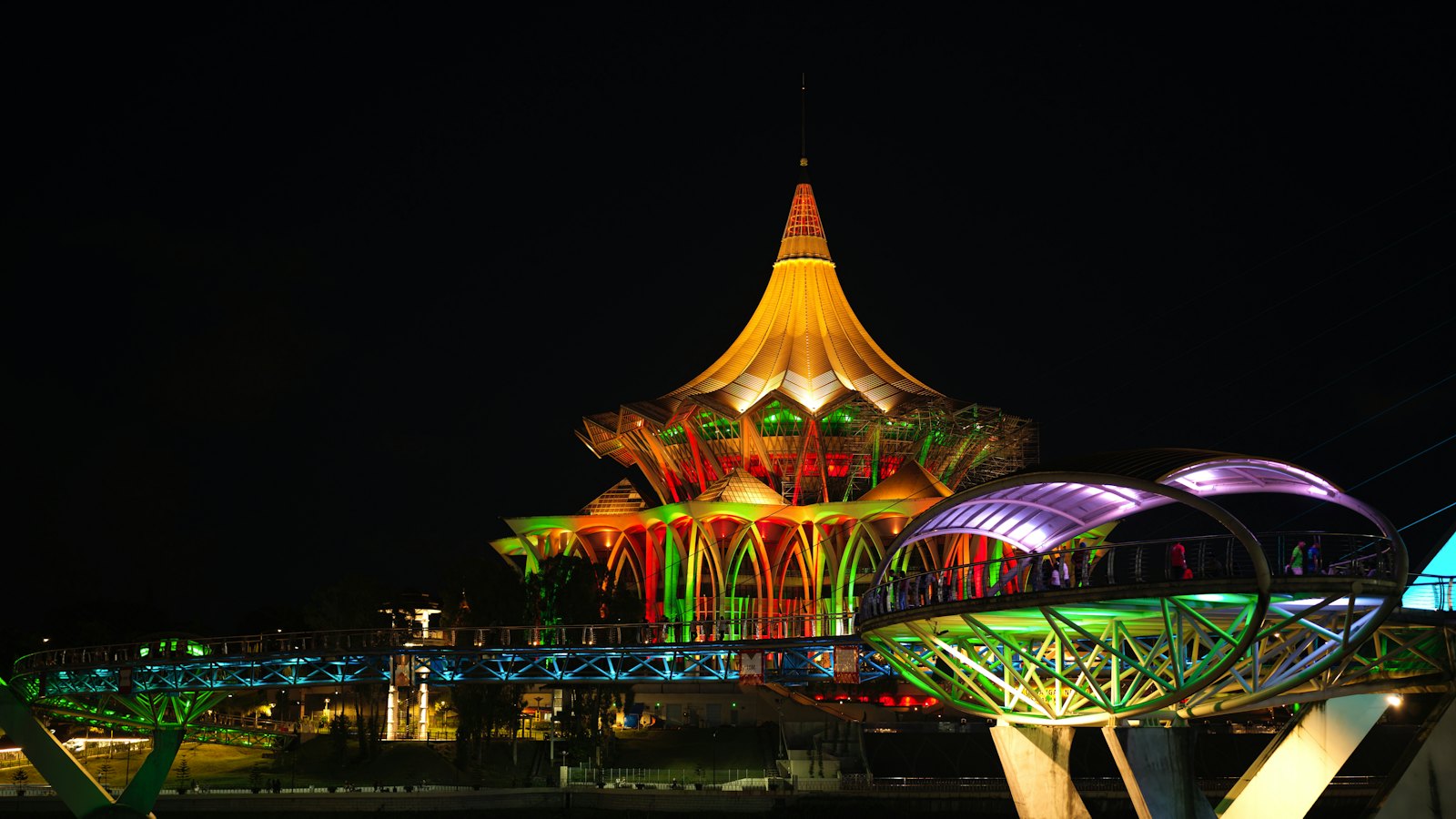
- Kuching Waterfront: about two kilometres of promenade facing the Astana and Fort Margherita. Arrive near sunset, then cross the curving Darul Hana Bridge to the golden-roofed State Legislative Assembly.
- Tambang crossing: little wooden boats shuttle across the Sarawak River for about RM 1; leave the exact fare on the plate.
- Borneo Cultures Museum: opened in March 2022 and billed as Malaysia's largest museum, a clear, air-conditioned introduction to Sarawak's many communities.
- Semenggoh Wildlife Centre: 24 km out, semi-wild orangutans roam this reserve and often show up at the morning and afternoon feeds. Sightings are never guaranteed, especially in fruiting season.
- Bako National Park: Sarawak's oldest park, named an ASEAN Heritage Park in September 2025 and reached only by a short boat ride from Kampung Bako, with timings set by the tide. Its 18 colour-coded trails lead to proboscis monkeys, pitcher plants and sea cliffs.
- Sarawak Cultural Village: longhouses and traditional homes at Santubong with dance shows, and the stage for the Rainforest World Music Festival.
- Main Bazaar and Carpenter Street: 19th-century shophouses selling handicrafts, pua kumbu weaving and pepper, near the Tua Pek Kong temple and Chinese History Museum.
- Cat Museum: in the North City Hall on Bukit Siol, a cheerful feline collection children love.
- Satok weekend market: Saturday afternoon to Sunday midday, full of fruit, jungle produce, wild honey and snacks.
What to eat in Kuching
Sarawak food is its own cuisine, and plenty of Malaysians plan their Kuching days around meals. Most dishes below come in halal and non-halal versions, so check the stall first.
- Sarawak laksa: a sambal belacan and tamarind broth softened with coconut milk, over rice vermicelli with prawns, shredded chicken and omelette strips. It is a breakfast dish, and famous shops often sell out before lunch. Malay coffee shops serve halal bowls with a thicker gravy.
- Kolo mee: springy egg noodles in a light dressing rather than dark soy. The Chinese classic uses char siu, while halal stalls top it with chicken or beef.
- Mee Jawa and nasi aruk: Sarawak Malay favourites, a thick yellow noodle dish and a smoky fried rice made with barely any oil.
- Manok pansoh: Iban chicken cooked in bamboo with lemongrass and tapioca leaves; some places need notice.
- Midin and umai: a crunchy jungle fern fried with garlic or belacan, and a Melanau raw fish salad cured in lime.
- Kek lapis Sarawak: the boldly patterned layer cake every relative expects you to bring home.
For seafood, the rooftop Top Spot food court in Padungan is a local favourite, but ask prices before ordering. Kubah Ria by the Satok Bridge and the Open Air Market near the city mosque are cheaper and more casual.
Halal food and prayer spaces
Kuching is not Muslim-majority, but Malays form about a third of its population, so halal food is easy once you know the pattern.
Malay coffee shops, mamak restaurants and Muslim-run stalls are everywhere, especially in Petra Jaya, Satok and around the Kuching City Mosque, and the big fast-food chains run halal outlets. Chinese coffee shops differ: many serve pork and some cook with wine, so treat them as non-halal unless a certificate is displayed. A "no pork no lard" sign is not certification. Look for a JAKIM certificate or one from JAIS, Sarawak's state religious department, and scan premises or products in the JAKIM-endorsed Verify Halal app. Muslim-run shops sell halal Sarawak laksa and kolo mee too.
For prayers:
- Kuching City Mosque: the former state mosque, near the Open Air Market in the city centre.
- Indian Mosque (Masjid India): a riverside floating mosque opened in 2019, replacing the one Indian Muslim traders built in 1871 off India Street and Gambir Street, where the old building still stands.
- Masjid Jamek Petra Jaya: a large air-conditioned mosque on the north bank, a favourite for Friday prayers.
As elsewhere in Malaysia, the airport and larger malls normally provide a surau; ask at an information counter if you cannot spot the sign. One detail catches Peninsular visitors out: Kuching lies much further east on the same clock, so prayers come about half an hour earlier than in KL (Maghrib around 6.35pm against 7.08pm in late September 2026). Check the Kuching zone in JAKIM's e-Solat or Muslim Pro.
Getting around Kuching
The old town is compact and pleasant on foot, with shaded paths along the river. Beyond it, most visitors mix e-hailing with the odd bus or boat.
- Grab and Maxim: both work well citywide and are how most visitors move. Drivers will go to Semenggoh, the Bako jetty or Santubong, but a car back can be scarce, so agree a waiting fee or return trip.
- BAS.MY Kuching: the national stage-bus scheme arrived in March 2025, serving suburbs, the airport and nearby towns such as Bau and Serian, with cheap fares and QR payment.
- Free city bus: Kuching Metro's electric route 103 runs from the Open Air Market past the museums, Kuching Sentral and the airport to Semenggoh, and was free at the time of writing. It is infrequent, so check timings in the Kuching Metro app.
- Taxis: cabs are metered but drivers seldom switch the meter on, so settle the fare before you set off.
- Tambang: river boats at about RM 1, the fastest link between the waterfront and the north bank.
- Car hire: sensible for Santubong, Bako and day trips, from roughly RM 70 a day with local firms. Signage is sparse, so lean on Waze or Google Maps.
An autonomous rapid transit (ART) network is under construction, but its first stretch, on the Samarahan side of the Blue Line, is only due to begin pilot runs around the end of 2026.
Sample itinerary: 4 days in Kuching
Four days covers the city, the wildlife and some Sarawak culture without rushing. Keep afternoons flexible for showers.
- Day 1: Land, clear the MyKad check and drop your bags. Wander Main Bazaar, Carpenter Street and India Street, walk the waterfront at sunset, cross the Darul Hana Bridge and ride a tambang back. Dinner at Kubah Ria.
- Day 2: Head out early for the morning feed at Semenggoh, return for a late laksa brunch and spend the hot hours in the Borneo Cultures Museum. Finish at the Cat Museum on Bukit Siol and a seafood dinner in Padungan.
- Day 3: A full day at Bako National Park. Catch an early boat, pack water, a raincoat and dry clothes, and take one of the shorter coastal trails where proboscis monkeys feed.
- Day 4: Morning at the Sarawak Cultural Village in Santubong, or the Satok market on a weekend. Pick up kek lapis and Sarawak pepper, then reach the airport early for the exit check.
With a fifth day, add the Damai beach, a trip to Kuching Wetlands National Park or an overnight longhouse stay.
Money, SIM and practical tips
Most things work exactly as at home.
- Money: it is ringgit, so nothing to exchange. Cards work in malls, hotels and most restaurants, and DuitNow QR works here as at home wherever a shop displays the code, but keep small notes for markets, tambang boats and old coffee shops.
- SIM and data: your Malaysian plan works as usual with no roaming. Coverage is strong in the city and patchy in national parks.
- Plugs: the same three-pin Type G sockets as at home. Tipping is not expected.
- Keep your IC on you: the Immigration Department asks domestic passengers leaving Sarawak for an identity document, a valid pass and a boarding pass.
- Sundays and holidays: Kuching has a large Christian community and some shops close on Sundays, while Gawai (1 and 2 June) is a Sarawak public holiday.
- Safety: the city is relaxed, but bag snatching by motorcyclists is the most common crime, and Main Bazaar has a reputation for it. Carry bags away from the traffic side.
- Fare tricks: some taxi drivers skip the meter, and a few e-hailing drivers ask you to cancel and pay cash. Politely refuse.
- Rain and daylight: Kuching is among Malaysia's wettest cities, so pack an umbrella in any month. The clock matches KL, but the sun rises and sets around half an hour earlier.
Before you go
- Best time to go
- June to August is usually the best time to visit Kuching, as it is the driest stretch of the year and brings Gawai and the Rainforest World Music Festival. Expect heat, humidity and rain in every month. The wettest spell is the northeast monsoon from November to February, when heavy downpours can disrupt boat trips to Bako and outings to Santubong. Gawai Dayak on 1 and 2 June brings open houses and cultural events across Sarawak, and the Rainforest World Music Festival at the Sarawak Cultural Village usually fills the Santubong resorts in late June (the 2026 edition ran 26 to 28 June; watch the festival's official site for 2027 dates). Seats and rooms get pricey when Malaysian schools break and around the big festivals, so lock in those trips well ahead. Outside school holidays, long weekends and festival weeks, fares and rooms are usually easier on the wallet.
- Visa for Malaysians
- As of September 2026, Malaysians need no passport or visa for Kuching, but Sarawak controls its own immigration, so you must clear an immigration counter on arrival using your MyKad. Every flight from outside Sarawak, including KLIA and Subang departures, lands into this check. Officers check your MyKad (a Malaysian passport also works) and grant a social visit pass (IMM.114) that comfortably covers a holiday; working, studying or settling in Sarawak needs separate approval. Children should carry their MyKid or birth certificate. Keep your IC with you for the whole trip, because the Immigration Department requires domestic passengers leaving Sarawak to show an identity document, a valid pass and a boarding pass. Rules can change, so confirm the latest on the official Immigration Department of Malaysia website (imi.gov.my) and with your airline before you fly.
- Honest budget guide
- Plan on roughly RM 150 to RM 350 per person per day in Kuching, excluding flights and sharing a room. Amaboxly's KL scan, at the time of writing, found one-way fares starting near RM 183 (AirAsia, non-stop), with a median near RM 202 and a top price around RM 359, so a return works out at roughly RM 370 to RM 720, or about RM 400 at the median. Guesthouses and simple hotels charge around RM 80 to RM 150 a room per night; comfortable waterfront-area hotels about RM 180 to RM 350. RM 40 to RM 80 a day feeds you well, from laksa breakfasts to a seafood dinner. Budget RM 20 to RM 60 daily for Grab, more for Bako boats or a hire car, plus park fees. Four days usually totals RM 1,200 to RM 2,000 a head, airfare included. Treat every figure here as indicative.
Frequently asked questions
Do Malaysians need a passport to go to Kuching?
No. Your MyKad is enough, and there is no visa. Because Sarawak controls its own immigration, you still pass a counter on arrival and receive a social visit pass that comfortably covers a holiday. Children can use a MyKid or birth certificate. Your IC is checked again when you fly out. Confirm current rules on the Immigration Department's official website first.
Is there a direct flight from KL to Kuching?
Yes, and there are four carriers to choose from. Malaysia Airlines, Batik Air and Sarawak's own AirBorneo leave from KLIA Terminal 1, while AirAsia uses Terminal 2, and Batik Air adds Subang departures too. Gate to gate it takes a little under two hours. Amaboxly's KL scan found one-way fares from about RM 183, with a median near RM 202.
Can I go from KL to Kuching by bus, train or ferry?
No. No road, rail or passenger ferry links Peninsular Malaysia with Sarawak, so you have to fly. Once in Borneo, express buses from Kuching Sentral reach Sibu, Bintulu, Miri and Pontianak in Indonesia (a passport is needed for Indonesia), useful if you are stringing several Borneo stops together.
Is Kuching Muslim-friendly?
Yes. Malays make up about a third of Kuching's population, so halal food, mosques and surau are easy to find, especially in Petra Jaya, Satok and around the Kuching City Mosque. Many Chinese coffee shops serve pork, so look for a JAKIM or JAIS halal certificate rather than a no-pork sign. Muslim-run shops serve halal Sarawak laksa and kolo mee. Remember that prayer times are earlier than in KL.
Can I use Grab in Kuching?
Yes. Grab and Maxim both operate in Kuching and at the airport, and they are the easiest way to get around. For trips out to Semenggoh, the Bako jetty or Santubong, a car back can be hard to find, so arrange a return trip or a waiting fee with your driver. Always pay through the app rather than agreeing to cancel and pay cash.
How many days in Kuching is enough?
Three to four days suits most Malaysian visitors: a day for the waterfront and old town, a morning at Semenggoh, a full day at Bako and time for Santubong or the museums. Add a day or two for Damai beach, a longhouse stay or a trip deeper into Sarawak.
What is the best month to visit Kuching?
June to August is usually best, since it is the driest part of the year and includes Gawai on 1 and 2 June and the Rainforest World Music Festival, usually held in late June. November to February is the wettest period, when rough weather can affect boat trips to Bako. For lower prices, travel outside school holidays and major festivals.
What budget should I set for four days in Kuching?
Allow about RM 1,200 to RM 2,000 each for a comfortable four days, with return airfare from KL and a shared room. That covers a return seat of roughly RM 370 to RM 720, a mid-range hotel, RM 40 to RM 80 a day on food, Grab rides, park fees and the Bako boat. Backpackers spend less. Indicative only.
Jom pergi
Ready to go Kuching? Compare available flights and hotels for your dates. Check baggage, cancellation terms and the final total on the booking provider before paying.






