




On this page12 sections
- Overview
- Getting there from KL: direct flights and KLIA terminals
- Da Nang Airport to the city: Grab, taxi and bus
- Where to stay in Da Nang
- Things to do in Da Nang and nearby
- What to eat in Da Nang
- Halal food and prayer spaces in Da Nang
- Getting around Da Nang: Grab, taxis and buses
- Sample itinerary: 4 days in Da Nang
- Money, SIM and practical tips
- Before you go
- FAQ
Da Nang is one of the easiest Vietnam trips for Malaysians: under three hours from KLIA, no visa for stays of up to 30 days, a long sandy beach on one side of the city and Ba Na Hills, home of the Golden Bridge, about 40 km inland. Hoi An's lantern-lit old town sits down the coast and, since a 2025 merger, is officially part of the same city. Below: who flies non-stop, the short hop from the airport, where to stay, halal food and prayer spaces (expect a surau rather than a mosque), Grab, and what the trip costs in ringgit.
Getting there from KL: direct flights and KLIA terminals
Three airlines fly non-stop from Kuala Lumpur to Da Nang at the time of writing (late September 2026):
- AirAsia: three flights a day from KLIA Terminal 2.
- Malaysia Airlines: most days, from KLIA Terminal 1.
- Batik Air Malaysia: several times a week, also from Terminal 1.
Scheduled flying time is about 2 hours 35 minutes to 2 hours 50 minutes, and Da Nang is one hour behind Malaysia, so AirAsia's 9.15am departure lands before 11am local time. Timetables change, so check the airline's own site before you book.
In Amaboxly's own KL fare scan (refreshed 28 September 2026), the cheapest one-way seat was about RM 284 on an AirAsia non-stop for late October and late November dates, and the typical fare sat near RM 326. The dearest non-stop result, around RM 494, was on 10 December, in the school holidays. One-stop routings began at about RM 367 via Phu Quoc (Sun PhuQuoc Airways) and RM 430 via Ho Chi Minh City (Vietjet), so connecting rarely pays. Basic AirAsia fares exclude checked bags, so add some if you plan to shop.
Da Nang Airport to the city: Grab, taxi and bus
Da Nang International Airport (DAD) sits inside the city, only 3 to 5 km from the centre. Prices are indicative, at about 6,350 dong to RM 1.
- Grab: Grab's airport page puts a car to the centre at roughly 70,000 to 120,000 dong (RM 11 to RM 19), 10 to 15 minutes, from the marked GrabCar lanes outside international arrivals.
- Taxi: the stand is just outside arrivals, with staff to help and a route fare chart by pillar 2. The airport lists Mai Linh, Tien Sa, Vinasun and the electric Xanh SM among its firms.
- Bus 12: from pillars 7 and 8 outside Terminal 2 into the west-bank centre, for 8,000 dong (about RM 1.30), 5.30am to 7pm.
- Bus 06: crosses the Dragon Bridge and follows the beach road, handy for My Khe hotels, for 15,000 to 22,000 dong depending on distance.
- Hai Van Bus to Hoi An: a coach to the Cua Dai car park for 120,000 dong (about RM 19), 7.30am to 4pm. The airport gives no journey time; the drive takes 45 to 60 minutes by car, so allow longer by bus.
- Grab to Hoi An: roughly 300,000 to 600,000 dong (about RM 50 to RM 95), depending on the time and car size. The app shows the price before you book.
Buses can mean a 5 to 30 minute wait, so families with big suitcases usually prefer Grab.
Where to stay in Da Nang
The Han River splits Da Nang in two: the older commercial centre on the west bank, the beach on the east.
- My Khe Beach and An Thuong: the natural base for a first trip and for families, with a wide beach, hotels at every price and plenty of cafes, including a few Indian restaurants.
- Han River (both banks): walkable to the Dragon Bridge, the night markets and the promenade, ten minutes by car from the sand. On the east bank, Tran Hung Dao Street has the surau used by the small local Muslim community and the fireworks grandstand. Weekend nights are noisy.
- Downtown Hai Chau: around Han Market and Con Market, with the cheapest rooms and the most local eating, though every beach trip means a Grab.
- Son Tra Peninsula and Non Nuoc: self-contained resorts, jungle-backed on Son Tra or on the long southern beach towards the Marble Mountains. Ideal for a honeymoon or a slow family break, less so for exploring.
A popular split is three nights in Da Nang and one or two in Hoi An, to see the old town after the day-trippers leave.
Things to do in Da Nang and nearby
Mix beach mornings, a mountain day, a Hoi An day and river evenings.
- Ba Na Hills and the Golden Bridge: a cable car climbs to a hilltop resort about 40 km west, where giant stone-look hands hold up the Golden Bridge beside a mock French Village. The listed adult cable car ticket is 1,000,000 dong (about RM 157); packages that add the lunch buffet cost more. Go early on a weekday.
- My Khe Beach: a broad sweep of sand across the river from the centre, at its best early in the morning before the heat builds.
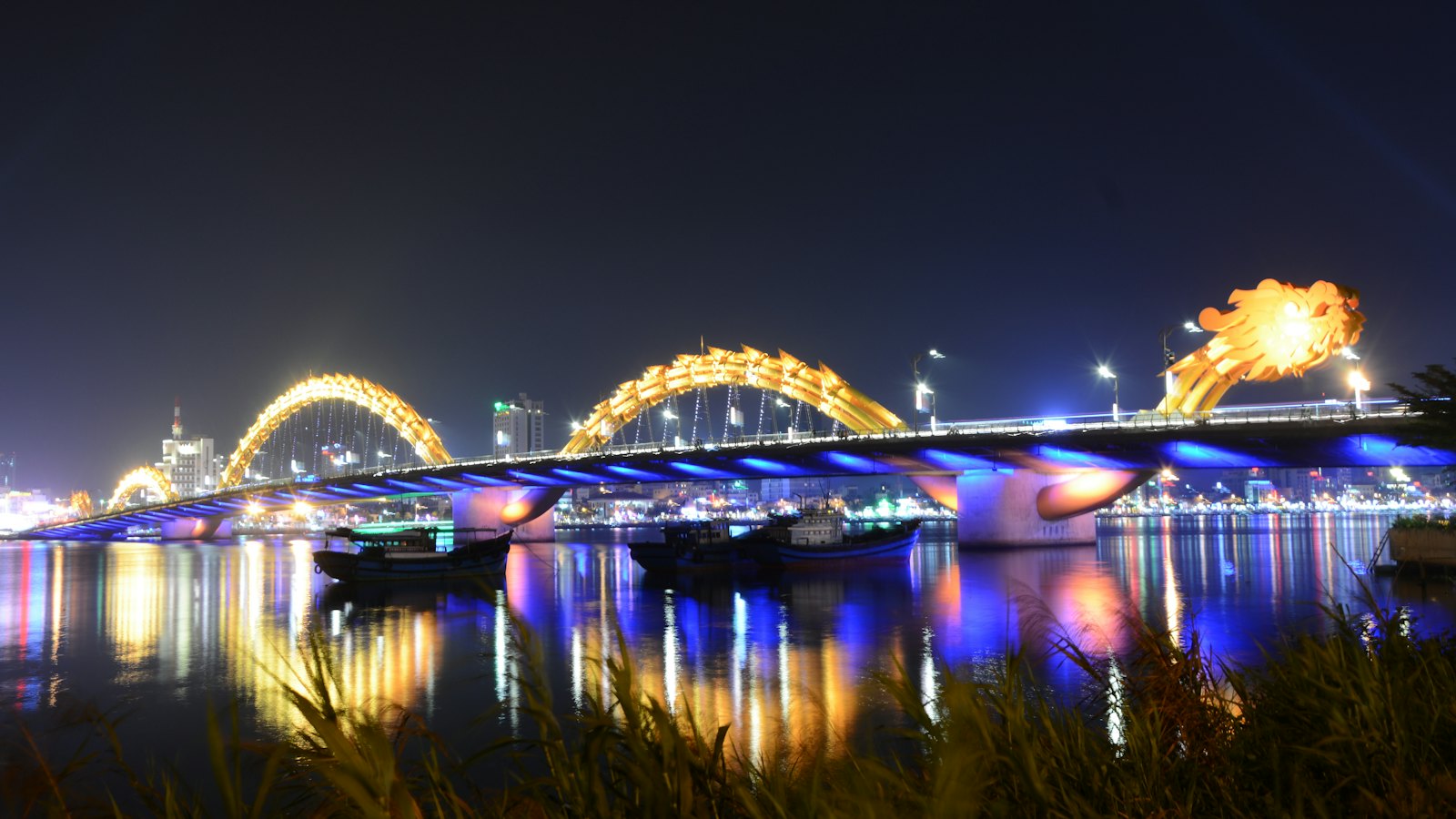
- Dragon Bridge: breathes fire and then water at 9pm on Saturday and Sunday nights.
- Marble Mountains: limestone hills full of cave shrines on the road to Hoi An. Entry is 40,000 dong (about RM 6), with the lift extra.
- Linh Ung Pagoda on Son Tra: free, with a 67-metre Goddess of Mercy statue facing the sea. The peninsula is nicknamed Monkey Mountain for its rare red-shanked douc langurs.
- Markets: Han Market for coffee, snacks and souvenirs by day (haggle politely); Son Tra and Helio night markets after dark.
- Hoi An: the old trading port 28 km south, best in the evening when the lanterns come on. The old town ticket is 120,000 dong (about RM 19).
- My Son Sanctuary: overgrown Hindu temples of the Cham kings, inland from Hoi An, for 150,000 dong (about RM 24).
- Hue: the old imperial capital, about two and a half hours north by train, or by car over the Hai Van Pass.
What to eat in Da Nang
Central Vietnamese cooking is spicier than the south's, and seafood rules the coast. Several signature dishes use pork or pork stock, so Muslim readers should see the halal section first.
- Mi Quang: the regional noodle, wide turmeric-tinted rice noodles in a shallow pool of broth with shrimp, chicken or quail eggs, peanuts and a crunchy rice cracker. Pork versions are common.
- Bun cha ca: rice vermicelli with slices of fish cake, a Da Nang classic.
- Bun mam: vermicelli with a powerful fermented fish sauce, an acquired taste.
- Seafood: crab, prawns, squid, clams and snails, grilled or steamed at beach restaurants. Agree the price by weight before anything is cooked.
- Ca phe sua da: strong iced coffee with condensed milk, around 20,000 to 35,000 dong (RM 3 to RM 5.50) at a neighbourhood cafe.
Local food is cheap: market stalls typically charge roughly 20,000 to 50,000 dong (RM 3 to RM 8) a dish. The chillies are small but fierce. Vegetarian restaurants, signed "quan chay", are common and most serve no meat at all.
Halal food and prayer spaces in Da Nang
Da Nang's Muslim community is tiny and the city has no purpose-built mosque, so eating halal takes planning. No local dish is halal by default, beef noodles included.
- Prayer room in town: the community uses a surau upstairs at Halal Food Karim, a halal restaurant at 186 Tran Hung Dao Street on the east bank. Friday prayers are reported to start around midday; confirm the time locally before you go.
- Airport: the airport lists a prayer room in Terminal 2, airside on the second floor, so you can pray after immigration before flying home.
- Ba Na Hills: guides place separate prayer rooms for men and women on the fifth floor of the Arapang building in the French Village. Below them is Bharata, the resort's halal-certified Indian restaurant and, by most accounts, the only halal option on the hill.
- Restaurants: most halal and Muslim-friendly places are Indian or Middle Eastern, with a few Malay-style and halal Vietnamese kitchens, spread between the beach side (My Khe, An Thuong, Son Tra) and the west-bank centre. Some display certificates, some are Muslim-owned without one, and some are merely pork-free and may serve alcohol.
Look for a certificate, ask who runs the kitchen and read recent Google Maps reviews. Seafood and vegetarian places are the usual fallback, but ask about broths and sauces. Muslim Pro covers prayer times and qibla.
Getting around Da Nang: Grab, taxis and buses
Da Nang's roads are wide and its traffic lighter than in Vietnam's two biggest cities. There is no metro, so ride-hailing does most of the work.
- Grab: works with your usual Malaysian Grab account, for cars and motorbikes. A GrabCar hop between the beach and the west bank is roughly 50,000 to 100,000 dong (RM 8 to RM 16), with surges on rainy evenings, holidays and fireworks nights.
- Xanh SM: the electric taxi firm, listed by the airport, is worth comparing when Grab surges.
- Taxis: stick to Mai Linh, Vinasun or Tien Sa with the meter on. For long trips such as Ba Na Hills or Hue, fix the full return price first.
- Buses: most Danabus city routes charge about 8,000 dong a ride, so carry small notes, though longer routes such as the 06 from the airport cost up to 22,000. Route 03 runs from Man Thien Street to Ba Na Hills.
- Scooters: rentals run roughly 110,000 to 200,000 dong a day (RM 17 to RM 32), but check your licence and insurance cover first.
Ba Na Hills by Grab is roughly 400,000 to 570,000 dong each way (RM 60 to RM 90) and takes 45 to 55 minutes.
Sample itinerary: 4 days in Da Nang
Four days suits a first visit. Swap days around the weather.
- Day 1: Land on a morning flight and Grab to your hotel. Afternoon on My Khe Beach, then the Han River promenade; on a Saturday or Sunday, stay for the Dragon Bridge fire show and eat at Son Tra Night Market.
- Day 2: Ba Na Hills from opening time, ahead of the tour groups on the Golden Bridge. Pray in the Arapang building, lunch at the halal buffet and ride the cable car down in the late afternoon.
- Day 3: Marble Mountains in the cool of the morning, then south to Hoi An for the old town, the river and the lanterns after dark. Grab back late, or stay the night.
- Day 4: An early drive up Son Tra to Linh Ung Pagoda, then Han Market for coffee and gifts before the airport. On a Friday, check the prayer time at the Tran Hung Dao Street surau and go there first.
With a fifth day, add My Son, the Hai Van Pass or Hue.
Money, SIM and practical tips
- Currency: Vietnamese dong. In late September 2026 RM 10 bought roughly 63,500 dong, so read 100,000 dong as about RM 16. Menus often write "50k" for 50,000 dong.
- Cash or card: hotels, malls and Grab take Visa and Mastercard, but markets, street stalls, buses and small cafes want cash. Bring some dong from home or withdraw from a bank ATM once you arrive.
- DuitNow QR: not an option at the time of writing. PayNet's cross-border QR list covers Singapore, Indonesia, Thailand and Cambodia, and Vietnam is not on it.
- SIM and eSIM: set up a tourist eSIM before flying, or buy a local SIM at the counters inside the Terminal 2 arrivals area.
- Power: 220V with mostly two-pin sockets, so pack an adapter for Malaysian three-pin plugs.
- Tipping: not expected, though rounding up for good service is appreciated.
- Safety: Da Nang is calmer than Hanoi or Ho Chi Minh City. The usual traps are drivers who quote a cheap return fare to Ba Na Hills or Hue and demand far more at the end, and seafood sold by weight without a price agreed.
- Emergencies: 113 for police, 114 for fire, 115 for an ambulance.
Before you go
- Best time to go
- February to May is the most dependable time for Da Nang, with dry, sunny days before the peak heat arrives. June to August is hotter, with afternoons in the mid-30s, but still beach season. In 2026 the Da Nang International Fireworks Festival (DIFF) held six competition nights on the Han River between 30 May and 11 July, filling riverside hotels, so book early if 2027 follows suit. September to December is the wet season, with October and November the rainiest months and tropical storms most likely. Tet falls on 6 February 2027, the same day as Chinese New Year, bringing closures and higher fares. Malaysian year-end school holidays (4 or 5 December to 31 December 2026, depending on the state) also push up KL fares.
- Visa for Malaysians
- Malaysians need no visa for Da Nang as of September 2026: your passport alone covers stays of up to 30 days in Vietnam. The Embassy of Malaysia in Hanoi sets out the 30-day rule. A longer stay needs an e-visa, issued for up to 90 days (single entry US$25, multiple entry US$50) through the official portal evisa.gov.vn; ignore copycat agent sites. New in 2026: every foreign arrival at a Vietnamese airport, Da Nang included, must file a pre-arrival declaration, either on prearrival.immigration.gov.vn (it accepts an arrival date of today or the next two days) or on arrival by QR code or paper form, and show the resulting QR code at immigration. To be safe, travel with at least six months left on your passport and keep your return booking handy. Confirm the latest rules on evisa.gov.vn and the Malaysian embassy's website before you fly.
- Honest budget guide
- Plan on roughly RM 80 to RM 320 a day for each traveller once you land in Da Nang, excluding flights. Flights: our KL fare scan found one-way non-stop fares from about RM 284 on AirAsia at the time of writing, typically around RM 326, so a return is usually RM 570 to RM 700 before checked bags. A basic guesthouse double costs roughly 150,000 to 250,000 dong (RM 24 to RM 40) a night and a mid-range hotel 500,000 to 900,000 dong (RM 80 to RM 140), more for a beachfront resort. Allow RM 20 to RM 80 a day for food, RM 10 to RM 40 for Grab and about RM 157 for Ba Na Hills entry. Four days and three nights, mid-range and sharing a room, comes to about RM 1,200 to RM 1,800 per person with flights. All figures are indicative.
Frequently asked questions
Do Malaysians need a visa to visit Da Nang?
No. As of September 2026, Malaysian passport holders get up to 30 days visa-free in Vietnam. You must still file the pre-arrival declaration, online at prearrival.immigration.gov.vn (up to two days before your arrival date) or on arrival, and show its QR code at immigration. Longer stays need an e-visa from evisa.gov.vn.
Is there a direct flight from KL to Da Nang?
Yes. AirAsia flies non-stop three times a day from KLIA Terminal 2, Malaysia Airlines most days from Terminal 1, and Batik Air Malaysia several times a week, also from Terminal 1. The flight takes around 2 hours 40 minutes. At the time of writing our fare scan showed one-way fares from about RM 284 on AirAsia.
Is there a mosque in Da Nang?
Not a purpose-built one. The small local Muslim community prays in a surau above Halal Food Karim, 186 Tran Hung Dao Street, with Friday prayers reported around midday (confirm locally). The airport has a prayer room airside in Terminal 2, and Ba Na Hills has separate prayer rooms for men and women. Halal restaurants are mostly Indian and Middle Eastern; check certification before ordering.
How many days in Da Nang is enough?
Four days works well for a first visit: one for the beach, river and bridges, a full day at Ba Na Hills, one for the Marble Mountains and Hoi An, and a last morning for Son Tra and Han Market. Add a fifth day for Hue, My Son or a night in Hoi An.
What is the best month to visit Da Nang?
March and April are the safest choices, with dry weather and heat that is still comfortable. February and May are also good, and June to August suits beach lovers who can handle the heat. Avoid October and November if you can: they are the wettest months and the likeliest to bring storms.
How much should I budget for 4 days in Da Nang?
A mid-range trip of four days and three nights costs roughly RM 1,200 to RM 1,800 per person including return flights, assuming a shared beach hotel room, casual meals, Grab rides and one Ba Na Hills ticket. Backpackers can spend much less. Carry some dong for markets and street food. All figures are indicative.
Can I use Grab in Da Nang?
Yes. Grab works in Da Nang with your Malaysian account, for cars and motorbikes, and a car from the airport to the city centre costs roughly 70,000 to 120,000 dong (RM 11 to RM 19). Xanh SM, the electric taxi firm listed by the airport, is a handy alternative, and linking a credit card saves handling cash.
How do I get from Da Nang to Hoi An?
Hoi An is about 28 km south, 45 to 60 minutes by car. Grab is the easiest door-to-door option at roughly 300,000 to 600,000 dong (about RM 50 to RM 95), depending on the time and car size. The Hai Van Bus runs from Da Nang airport to Hoi An's Cua Dai car park for 120,000 dong (about RM 19) between 7.30am and 4pm.
Jom pergi
Ready to go Da Nang? Compare available flights and hotels for your dates. Check baggage, cancellation terms and the final total on the booking provider before paying.






