




On this page12 sections
- Overview
- Getting there from KL: flights and routings
- Siem Reap-Angkor Airport to the city
- Where to stay in Siem Reap
- Things to do in Siem Reap
- What to eat in Siem Reap
- Halal food and prayer spaces in Siem Reap
- Getting around Siem Reap
- Sample itinerary: 4 days in Siem Reap
- Money, SIM and practical tips
- Before you go
- FAQ
Siem Reap is the riverside Cambodian town that serves as the gateway to Angkor, the temple ruins of the old Khmer capitals. For Malaysians it is one of the easiest big trips in the region: no visa, a non-stop flight of about two hours from KLIA, prices in US dollars that stretch a long way, and a Muslim community with its own mosque and kitchens. Below: current flights and our KL fare scan, the long ride in from the new airport, the Angkor Pass, halal meals, and what four days cost in ringgit.
Getting there from KL: flights and routings
At the time of writing, the non-stop flights between Kuala Lumpur and Siem Reap are operated by AirAsia Cambodia into the new Siem Reap-Angkor International Airport (SAI), which lists Kuala Lumpur among its routes. AirAsia group flights normally use KLIA Terminal 2, not Terminal 1, but check your booking. Expect about two hours in the air. Cambodia is one hour behind Malaysia.
Amaboxly's own KL fare scan, last updated on 21 September 2026, put the cheapest non-stop one-way ticket at about RM 311 with AirAsia Cambodia, a typical fare around RM 358 and the dearest sampled date near RM 518. The RM 311 price appeared on dates from December to the following August. One-stop routings cost far more: about RM 728 via Phnom Penh with Cambodia Airways and about RM 979 via Bangkok with THAI and Bangkok Airways. Fares change daily.
If the non-stop is full, fly to Phnom Penh and continue by domestic flight, or by road: about four to five hours by minibus or six to eight by bus. Overland from Bangkok is off the table: land crossings with Thailand were still suspended after the 2025 border clashes at the time of writing.
Siem Reap-Angkor Airport to the city
The airport opened in October 2023 about 50 km east of town, so allow roughly an hour by expressway. Prices are indicative, at about RM 4.07 to US$1.
- Official shuttle bus: US$8 (about RM 33) per seat, with around ten departures a day from the counter on the left outside arrivals, the last at 10 pm. It runs to the operator's station on 7 Makara Road, and the tuk-tuk from there to hotels close to the station is free; for the trip back, a hotel pick-up by tuk-tuk costs US$2. Pay in cash, by ABA QR or by card at the station, or book online.
- Grab: a signed Grab pick-up point sits about 60 metres from the international exit, and the app shows the fare before you confirm.
- Private car or van: roughly US$35 to US$40 (RM 145 to RM 165) through your hotel or a transfer company, with a driver waiting with a name board.
- Taxi: taxis wait at the marked pick-up bays on the arrivals roadway. Agree the fare before you set off.
Cars pay a US$4 round-trip expressway toll under the official 2026 rates, so ask whether your quote includes it.
Where to stay in Siem Reap
The town is compact and everything is a short tuk-tuk ride apart, so choose by mood. Budget rooms cost roughly US$5 to US$30 a night and mid-range hotels US$30 to US$100 (up to about RM 410).
- Old Market and Pub Street: among the restaurants, massage shops and bars, with plenty of hostels. Good for first-timers; light sleepers should stay a few streets back.
- Wat Bo Road and the east bank: across the river, leafier and quieter, with boutique hotels down side lanes. Suits couples.
- West of Sivatha Boulevard, near the Angkor Night Market: mid-range hotels a short walk from the main mosque and the Muslim-run eateries beside it. The practical pick for Muslim families.
- National Road 6, west of the centre: most of the big hotels with large pools and room for tour coaches. Good for families with small children and group tours, though you will need a tuk-tuk or Grab to go anywhere.
Book early for December, January and Khmer New Year in mid-April.
Things to do in Siem Reap
Every foreign visitor needs an Angkor Pass. Official prices at the time of writing: US$37 (about RM 150) for one day, US$62 (RM 252) for any three days within a week and US$72 (RM 293) for seven days within a month. Buy online from Angkor Enterprise or at the official ticket centre, never from touts: 3-day and 7-day passes carry your photo. Children under 12 enter free (carry their passport as proof of age) but may not climb Angkor Wat's top tower, and everyone needs shoulders and knees covered up there.
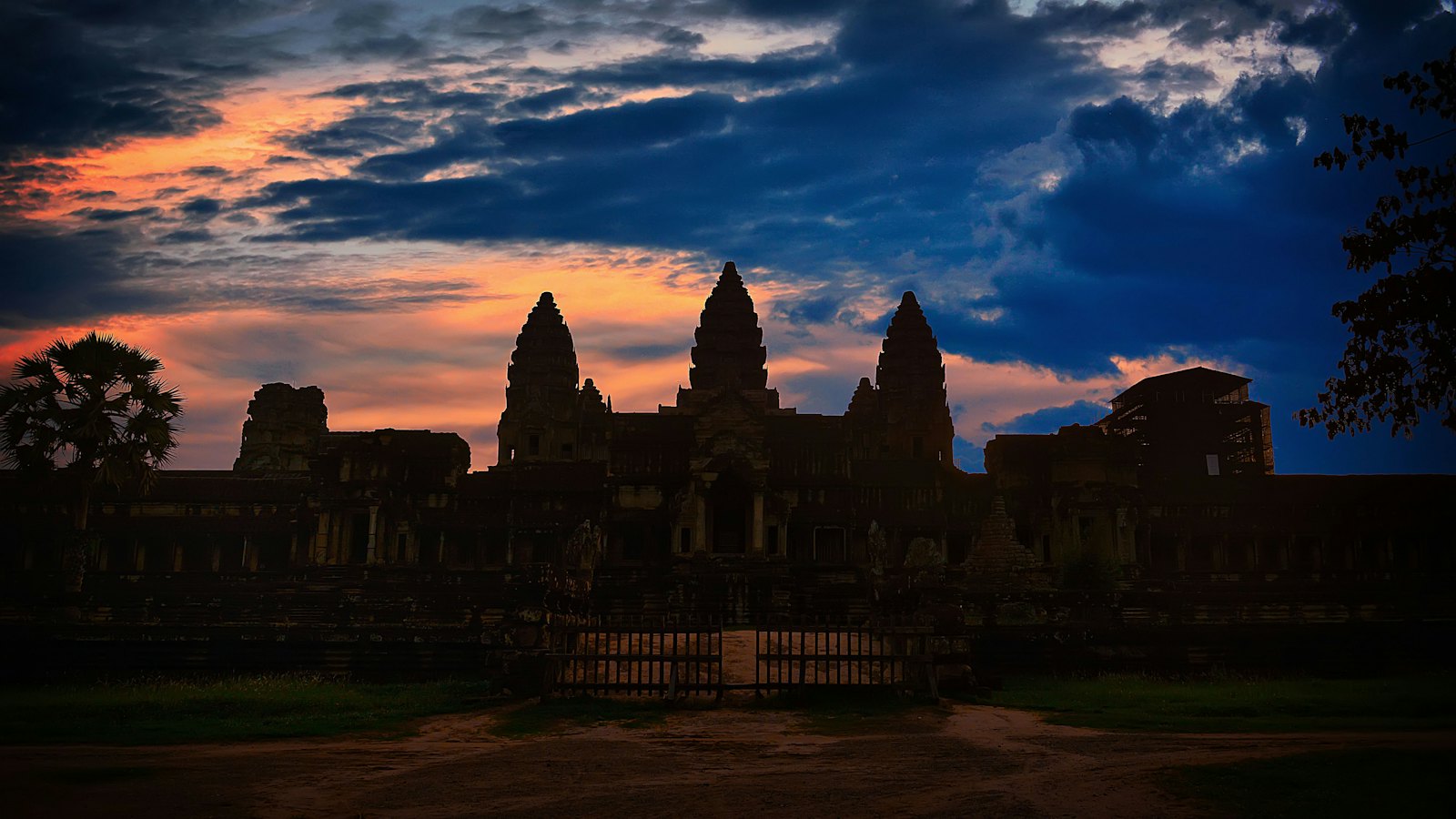
- Angkor Wat at sunrise: the park opens at 5 am, and the reflection shot is from the ponds by the western approach.
- Angkor Thom and the Bayon: the walled royal city, with the Bayon's calm stone faces at its heart.
- Ta Prohm: the temple gripped by giant tree roots, famous from the Tomb Raider film. Go early or late.
- Banteay Srei and Kbal Spean: a small pink sandstone temple about 37 km north, often paired with the riverbed carvings of Kbal Spean (separate US$5 ticket).
- Beng Mealea: a collapsed, forest-swallowed temple east of the main park, with its own US$10 ticket.
- Tonle Sap and Kampong Phluk: stilt houses and flooded forest on the great lake, most striking in the wet season. Boat fees are extra.
- Phare, the Cambodian Circus: evening shows of acrobatics, theatre and live music by young Cambodian performers.
- Old Market and night markets: krama scarves, silk and pepper. Bargain politely.
What to eat in Siem Reap
Khmer cooking is gentler than Thai, built on black pepper, lemongrass, lime and fish sauce, with chillies on the side. Pork and fish sauce are common, so Muslim travellers should read the halal notes below before ordering.
- Fish amok: a steamed coconut curry that sets almost like a mousse, served in a banana-leaf cup. Chicken versions exist too.
- Lok lak: quick-fried beef cubes with a lime and black pepper dip, often topped with a fried egg.
- Nom banh chok: rice noodles under a green, fish-based curry gravy with fresh herbs, a street breakfast.
- Kuy teav and bai sach chrouk: the classic breakfasts, noodle soup and grilled pork on rice, both usually pork-based.
- Kampot pepper: the prized pepper of the south coast, superb with crab and an easy gift to take home.
- Fruit shakes and coconuts: sold from carts everywhere.
A plate at a local stall often costs under US$5 (about RM 20), while sit-down restaurants in the tourist centre charge roughly US$5 to US$10 (RM 20 to RM 41) a main.
Halal food and prayer spaces in Siem Reap
Cambodia's Muslims, mostly Cham and people of Malay descent, were about 2% of the population in the 2019 census, and Siem Reap's community is small. Plan meals ahead.
- Certified vs Muslim-owned: do not count on seeing a halal certificate. The halal places on maps are mostly Muslim-run kitchens, from Cham family places to kebab and Turkish cafes, so ask the owner about the meat.
- Where to look: the main cluster surrounds the mosque just west of Sivatha Boulevard (listed on maps as Al-Nikmatul), about ten minutes on foot from Pub Street. Nearby map listings include Muslim Family Kitchen, a halal backpacker restaurant and a halal kebab and falafel cafe. Check recent reviews, as small places come and go.
- Maps also show a second mosque on the east bank, beside Wat Bo Road.
- Elsewhere: assume ordinary Khmer restaurants and the food stalls at the temples are not halal, so pack snacks for temple days or return to town for lunch.
We could not confirm a prayer room at the Siem Reap-Angkor airport, so pray at KLIA before boarding or at the mosque in town, and ask there about Friday prayer times. Muslim Pro covers prayer times and qibla. Some Cham go to Kelantan each year to study the Quran and many orthodox Cham speak Malay, so a few words of Malay can help.
Getting around Siem Reap
There is no metro, city bus or transit card; visitors use tuk-tuks, apps, bicycles and hired cars.
- Tuk-tuks and remorques: a short trip in town is about US$1.25 (5,000 riel, roughly RM 5) for the whole cart, more at night or in rain. Agree the fare before you climb in.
- Grab: works in Siem Reap for tuk-tuks and cars, shows the price upfront and takes cards. PassApp, the local rival, is often slightly cheaper but cash only, and TADA runs electric tuk-tuks on its own app.
- Temple days: a tuk-tuk driver costs roughly US$15 to US$20 a day for the main temples and US$20 to US$30 for outlying ones like Banteay Srei, plus a little extra for sunrise. A car with driver and licensed English-speaking guide is about US$45 to US$50 a day.
- Bicycles: about US$1 to US$8 a day, fine for the small circuit if you start early.
- E-bikes and scooters: roughly US$6 to US$15 a day. Wear a helmet, as police stop riders without one.
A tuk-tuk seats three or four adults, so bigger families should hire a car.
Sample itinerary: 4 days in Siem Reap
Keep temples to the cooler hours and use the middle of each day for lunch and a rest.
- Day 1: Fly from KLIA and take the shuttle or a Grab into town. If you land in time, buy a pass that starts the next day after 4.45 pm: Angkor Enterprise says it also lets you in that evening for sunset. Dinner near the Al-Nikmatul mosque, then the Old Market and night market.
- Day 2: The small circuit by tuk-tuk. Sunrise at Angkor Wat and its galleries, then Angkor Thom via the South Gate to the Bayon, the Baphuon and the Terrace of the Elephants. Rest at midday and finish at Ta Prohm in the late afternoon.
- Day 3: Leave early for Banteay Srei and Kbal Spean, stopping at Preah Khan on the grand circuit on the way back. Evening show at Phare.
- Day 4: A morning boat trip to Kampong Phluk, or a slow breakfast and a Khmer massage. Buy pepper and krama scarves, then head to the airport about three hours before your flight, given the 50 km drive.
Money, SIM and practical tips
- Currency: Cambodia uses both the riel and the US dollar. At the time of writing US$1 is about RM 4.07 and 1,000 riel is almost exactly RM 1. Shops round at 4,000 riel to the dollar and give change in riel.
- Cash: bring crisp, untorn US dollar notes. Worn bills are often refused, coins are not accepted and fakes circulate. ATMs are plentiful, though some charge about US$5 a withdrawal.
- Cards and DuitNow QR: hotels, bigger restaurants and the Angkor ticket office take cards. PayNet lists Cambodia as a DuitNow cross-border QR market through the local Bakong KHQR network, so some Malaysian bank and e-wallet apps can pay at KHQR codes. Test yours first.
- SIM and eSIM: sellers wait outside the airport entrance, and in 2025 packs started around US$5 for 30GB over two weeks (passport needed). A travel eSIM from KL also works.
- Plugs: 230V, Types A, C and G. Your three-pin plug fits some sockets, but many take only two-pin plugs, so a universal adapter is worth packing.
- Tipping: optional; a few dollars for a good guide or driver is welcome.
- Safety: pick tuk-tuks with side grills against bag snatchers, never leave a drink unattended in bars, stay on marked paths at rural temples where old landmines may remain and ignore street orphanage collectors.
Before you go
- Best time to go
- The best time to visit Siem Reap is November to February, the cool dry season, when temple mornings are pleasant and skies mostly clear. Highs then sit around 31 to 33°C, with nights of 20 to 22°C. March to May is hot, peaking in April at about 36°C. The rains run from May to October, heaviest in September, usually as afternoon bursts; the moats fill and the park is greener and quieter. December and January are peak season, with higher room rates and crowded sunrises, and the Malaysian year-end school holidays add demand from KL. Khmer New Year in mid-April brings celebrations and serious heat, and the Water Festival falls in late October or November.
- Visa for Malaysians
- As of September 2026, Malaysians holding an ordinary passport can visit Cambodia visa-free for up to 30 days, under the ASEAN exemption listed by Cambodia's Ministry of Foreign Affairs. There is no visa fee. Air arrivals must complete the Cambodia e-Arrival form, which combines the immigration card, customs declaration and health questions; the General Department of Immigration says it is free and can be submitted within the seven days before arrival, including arrival day. Use only the official site, arrival.gov.kh. Make sure your passport has six months or more left on it when you land and has no damage, and expect fingerprints at immigration. Rules can change at short notice, so confirm on arrival.gov.kh and mfaic.gov.kh before you fly.
- Honest budget guide
- Expect to spend roughly RM 200 to RM 450 a day per person in Siem Reap, not counting flights and the Angkor Pass. Flights: at the time of writing, Amaboxly's scan starts at about RM 311 one-way and typically sits near RM 358, putting a return at about RM 620 to RM 800. A budget guesthouse room runs about US$15 to US$30 (RM 60 to RM 120) a night and a mid-range hotel with a pool US$40 to US$90 (RM 160 to RM 370). Food is RM 40 to RM 80 a day at local and Muslim-run eateries. Tuk-tuks and a temple driver add RM 60 to RM 120 a day. The 3-day Angkor Pass is US$62 (about RM 252). A typical four-day, three-night trip for one person comes to roughly RM 1,700 to RM 2,800. All figures are indicative.
Frequently asked questions
Do Malaysians need a visa for Siem Reap?
No. As of September 2026, a Malaysian passport lets you spend up to 30 days in Cambodia on each visit, visa-free. You still fill in the free Cambodia e-Arrival form on arrival.gov.kh in the seven days before you land, and you should carry a passport with six months or more before expiry. Confirm on the official sites before flying.
Is there a direct flight from KL to Siem Reap?
Yes. At the time of writing, AirAsia Cambodia flies non-stop from KLIA to Siem Reap-Angkor International Airport in about two hours, and AirAsia group flights normally use KLIA Terminal 2. The cheapest one-way ticket in our fare scan was about RM 311, with most sampled dates near RM 358. One-stop routings cost over twice as much.
Is Siem Reap Muslim-friendly?
Reasonably, if you plan ahead. The town has a mosque just west of Sivatha Boulevard with several Muslim-run eateries close by, plus a second mosque on the east bank. Do not expect halal certificates, and Khmer cooking uses pork and fish sauce widely, so stick to Muslim-run places, pack snacks for temple days and use Muslim Pro for prayer times.
How many days in Siem Reap is enough?
Three full days suit most first-timers: one for Angkor Wat, Angkor Thom and Ta Prohm, one for Banteay Srei and the grand circuit, and one for Tonle Sap, the markets or a slower day. That lines up neatly with the 3-day Angkor Pass (US$62, usable on any three days within a week). Temple fans can add Beng Mealea and Koh Ker over five days.
What is the best month to visit Siem Reap?
December and January offer the most comfortable weather, with dry skies and highs around 31°C, but they are also the busiest and priciest months. November and February are a good compromise. If you do not mind afternoon rain, the wet season from May to October brings greener scenery, full moats and quieter temples. Avoid April unless you cope well with heat.
How much does a 4-day trip to Siem Reap cost?
Budget roughly RM 1,700 to RM 2,800 per person for four days and three nights. That covers a return flight from KL (about RM 620 to RM 800 on our current scan), the 3-day Angkor Pass at US$62, a budget or mid-range hotel, halal meals and tuk-tuk hire. Carry part of it in clean US dollar notes. Figures are indicative.
Can I use Grab in Siem Reap?
Yes. Grab works in Siem Reap for both tuk-tuks and cars, and the airport has a signed Grab pick-up point in the arrivals area. The app shows the fare before you book and lets you pay by card. PassApp, a local app, is also popular and can be slightly cheaper, but you pay the driver in cash.
Should I bring US dollars or ringgit to Siem Reap?
Bring US dollars in clean, untorn notes, plus a debit card for ATMs. Tourist prices are usually quoted in dollars, and small change comes back in riel at about 4,000 riel to the dollar. Ringgit is of little use for daily spending. Some Malaysian bank and e-wallet apps can also pay at Cambodian KHQR codes through DuitNow cross-border QR; check yours supports Cambodia.
Jom pergi
Ready to go Siem Reap? Compare available flights and hotels for your dates. Check baggage, cancellation terms and the final total on the booking provider before paying.






