




On this page13 sections
- Overview
- Getting there from KL: flights and KLIA terminals
- Changi Airport to the city
- Where to stay in Singapore
- Things to do in Singapore
- What to eat: hawker centres and local dishes
- Halal food, mosques and prayer spaces
- Getting around: MRT, buses, Grab and taxis
- A four-day Singapore itinerary
- Money, SIM and practical tips
- By road or rail: going without a flight
- Before you go
- FAQ
Singapore is the overseas trip many Malaysians take first and then keep repeating: about an hour from KLIA, the same time zone, no visa and the same three-pin plugs. What changes is the price and the rules. Written for travellers leaving KL, this guide covers our own fare scan (non-stop one-way seats from about RM 121 at the time of writing), the cheapest ways out of Changi, bases near a mosque or the malls, MUIS-certified versus Muslim-owned food, the overland options, and what a trip costs when one Singapore dollar is roughly RM 3.20.
Getting there from KL: flights and KLIA terminals
By seat count, KL to Singapore was the world's third-busiest international air route in 2025, according to OAG, so flights are frequent and fares competitive. Non-stop choices at the time of writing:
- KLIA Terminal 1: Malaysia Airlines, Singapore Airlines and Batik Air Malaysia, plus Ethiopian Airlines, which sells seats between KL and Singapore on its Addis Ababa flights.
- KLIA Terminal 2: AirAsia and Scoot. AirAsia lands at Changi Terminal 4, which has no MRT station; free shuttle buses link it to the other terminals.
- Terminals do change, so confirm yours on the e-ticket before you set off for KLIA.
Jetstar Asia shut down on 31 July 2025, so older posts that list it are out of date. Flying time is roughly an hour, and the clocks are the same on both sides.
Our KL fare scan, refreshed on 28 September 2026, turned up non-stop one-way seats from around RM 121 with Scoot, for a date in late February 2027. The median across the sample sat near RM 175 and the priciest date near RM 269, with AirAsia and Ethiopian fares also in the mix. Fares move daily, so treat these as a guide.
Changi Airport to the city
Changi is on the island's eastern tip, around 30 minutes from the centre by road. Prices are indicative, at about RM 3.20 to S$1.
- MRT: from the station under Terminals 2 and 3, ride two stops (via Expo) to Tanah Merah and change to the East West Line towards Tuas Link. Card fares top out at S$2.57, under RM 9. First train 5.31am (Monday to Saturday), last connection towards Tuas Link 11.18pm.
- Bus: services 24, 27, 34, 36, 53, 110 and 858 leave from the basement bus bays of Terminals 1 to 3. Cheapest, but slow with luggage, and drivers give no change.
- Taxi: about S$25 to S$45 (RM 80 to RM 145) on the meter, plus an airport surcharge of S$8 from 5pm to midnight (S$6 otherwise), 25 percent extra at peak hours and 50 percent from midnight to 6am.
- Ride-hailing: Grab, Gojek, Zig, TADA, Ryde and Geolah collect from the signed pick-up points at each terminal.
- Ground Transport Concierge: a flat S$70 (about RM 225) per trip within Singapore for four seats or S$75 for six, with surcharges for a few far-flung addresses.
- Heading to Johor instead: Transtar TS1 (to Larkin) and WTS9 (to Taman Ungku Tun Aminah) leave from the Terminal 1 coach bays, cost S$11 (about RM 35) and take around two hours.
Where to stay in Singapore
Distances are short and trains are quick, so choose a base for its feel and its nearest station.
- Bugis and Kampong Glam: the easy pick for Muslim travellers, steps from the Sultan Mosque and the halal restaurants of Arab Street, with Bugis station on both the East West and Downtown lines.
- Marina Bay and City Hall: for first-timers who want Gardens by the Bay and the Merlion within walking distance. The priciest area, and dearer still over Formula 1 weekend in October.
- Orchard Road: for shoppers and families who like a mall with a food court underneath. Masjid Al-Falah, the only mosque in the Orchard district, is close by for Friday prayers.
- Chinatown and Little India: shophouse streets with the best-value rooms, capsule hotels and hostels, and hawker centres on the doorstep. Little India has Masjid Abdul Gafoor on Dunlop Street and Masjid Angullia on Serangoon Road.
Planning a Universal Studios day? HarbourFront, beside the crossing to Sentosa, saves time, while hotels on Sentosa itself charge resort rates.
Things to do in Singapore
Many of the headline sights are free, which offsets the room rate.
- Gardens by the Bay: the Supertree Grove is free outside a few ticketed events such as Christmas Wonderland, and Garden Rhapsody lights it up every night at 7.45pm and 8.45pm. The cooled Flower Dome and Cloud Forest are ticketed.
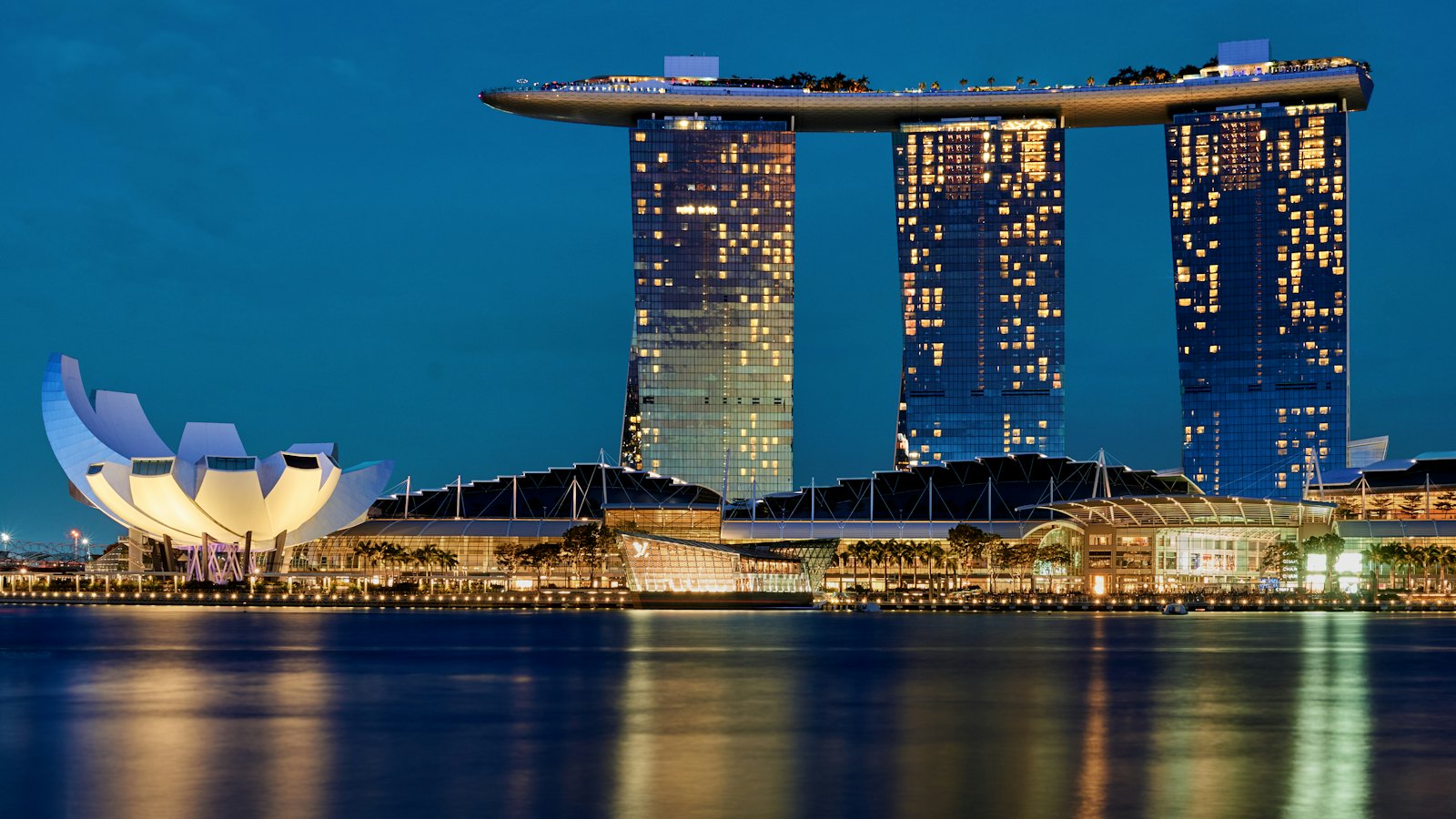
- Marina Bay: the Merlion, Helix Bridge and Marina Bay Sands in one easy walk, ending with the nightly Spectra light and water show at the Event Plaza on the waterfront.
- Kampong Glam: the gold-domed Sultan Mosque, carpet and fabric shops along Arab Street, and the murals of Haji Lane.
- Sentosa: Universal Studios Singapore, the beaches and the Singapore Oceanarium, the enlarged successor to the S.E.A. Aquarium since July 2025.
- Jewel Changi: the 40-metre Rain Vortex, billed as the world's tallest indoor waterfall, with an evening light show. It is landside, so open to all.
- Chinatown and Little India: temples, spice shops and gold jewellers, all walkable from the MRT.
- Mandai: the zoo, Night Safari and Bird Paradise, a full day with children.
- Orchard Road: ION Orchard and a long line of malls. Designer prices are not always lower than in KL or on Amaboxly, so compare before paying.
What to eat: hawker centres and local dishes
Hawker culture joined UNESCO's heritage list in December 2020, and the food centres are where Singapore eats best for least. Dishes look familiar, but recipes differ enough to keep the KL versus Singapore debate going.
- Hainanese chicken rice: rice cooked in stock, with a chilli and ginger dip.
- Katong laksa: rich coconut broth with short-cut noodles you eat with a spoon.
- Chilli crab or black pepper crab: a sit-down splurge, usually priced by weight.
- Nasi lemak, satay, mee rebus, roti prata and murtabak: the Malay and Indian-Muslim favourites.
- Kaya toast, soft-boiled eggs and kopi for breakfast.
Try Maxwell Food Centre or Chinatown Complex, Lau Pa Sat in the financial district, Old Airport Road in the east, Tekka Centre in Little India and the food centre at Geylang Serai Market. A hawker plate costs well under a casual restaurant meal, which averages about S$15 (RM 48). Many Chinese stalls cook with pork or lard, so check the halal section. And clear your own tray: repeat offenders can be fined S$300.
Halal food, mosques and prayer spaces
Halal food is easy to find, but labels work differently from home.
- MUIS-certified: the Islamic Religious Council of Singapore certifies restaurants, food-court stalls, bakeries and quick-service outlets, and they display the certificate. You can look up certified eating places on the MUIS halal portal.
- Muslim-owned: many Malay and Indian-Muslim stalls are run by Muslims without certification. Plenty of Malaysians eat there; it is a personal call.
- 'No pork, no lard': not the same thing as halal.
The easiest areas are Kampong Glam (Arab Street and Bussorah Street); Geylang Serai near Paya Lebar, the Malay heartland, with its market and the Ramadan bazaar and light-up before Hari Raya; and Tekka Centre in Little India.
Of more than 70 mosques, the central ones include the Sultan Mosque at 3 Muscat Street near Bugis, whose grounds welcome visitors of all faiths, Masjid Jamae in Chinatown, Masjid Abdul Gafoor and Masjid Angullia in Little India, and Masjid Al-Falah in the Orchard area. Do not count on a surau in every mall the way you might at home, so plan prayers around mosques or your hotel. Changi's prayer rooms, with ablution areas and open 24 hours, sit in the departure transit areas of all four terminals, not on the public side, so after landing you will need a mosque or your hotel instead. Muslim Pro handles prayer times and qibla.
Getting around: MRT, buses, Grab and taxis
Between the MRT, buses and walking, you will rarely need anything else.
- Tap to pay: SimplyGo accepts foreign-issued contactless Visa, Mastercard and American Express cards at MRT gates and on buses, so a Malaysian card works. Visa and Mastercard carry a S$0.60 admin fee per day of use, and your bank may add its own overseas charge. EZ-Link cards and the Singapore Tourist Pass, with unlimited rides for one, two or three days, are the alternatives.
- Fares: distance-based adult card fares of S$1.28 to S$2.57, about RM 4 to RM 8 a ride. Cash costs more.
- Ride-hailing: your Malaysian Grab app and account work as normal. Gojek, TADA, Ryde, Zig and Geolah are worth checking when Grab surges.
- Taxis: metered, with a starting fare of roughly S$4 to S$5 at the time of writing, plus peak, late-night and airport surcharges.
- Walking: safe at night and often sheltered, though afternoon heat and storms make short rides tempting.
For Sentosa, walk the Boardwalk from VivoCity at HarbourFront MRT or ride the Sentosa Express.
A four-day Singapore itinerary
A first visit from KL fits well into a long weekend plus one day.
- Day 1: Fly in, see the Rain Vortex at Jewel, then take the MRT to your hotel. Once the midday heat eases, walk Marina Bay from the Merlion to Marina Bay Sands and catch the 7.45pm Garden Rhapsody at the Supertrees.
- Day 2: Zuhur at the Sultan Mosque, lunch around Arab Street, a wander down Haji Lane, then Bugis. Ride the MRT to Little India for Tekka Centre, and spend the evening on Orchard Road.
- Day 3: A full Sentosa day: the Boardwalk from VivoCity, then Universal Studios or the Singapore Oceanarium, and the beach at sunset.
- Day 4: Chinatown in the morning for Masjid Jamae, the temples and the shophouse streets, lunch at Geylang Serai on the way east, then Changi. Aim to reach the airport at least two hours before departure, earlier on Fridays and public holidays.
Only three days? Swap Orchard Road on day 2 for Chinatown. A fifth day suits Mandai. Going home overland? The final section covers the train, the coach and the RTS Link.
Money, SIM and practical tips
- Currency: the Singapore dollar (SGD), worth about RM 3.20 at the time of writing, so triple the price and add a little.
- Paying: cards and contactless work almost everywhere, including many hawker stalls, but carry small notes for older ones. Singapore is on PayNet's DuitNow cross-border QR list, so supported apps (Maybank, CIMB, Touch 'n Go eWallet, Boost and others) can scan compatible codes at participating merchants.
- Data: a roaming add-on from your Malaysian telco or a travel eSIM is simplest for a short stay.
- Power: Type G sockets at 230V, identical to Malaysia, so no adapter.
- Tipping: not expected. A '++' after menu prices means service charge and GST are added on top.
- Water: safe to drink from the tap.
- Rules: no littering, return your tray, and do not pack a vape: e-cigarettes are banned outright in Singapore. Cigarettes carry no duty-free allowance, so declare any you bring.
- Scams: the SG Arrival Card is free through ICA and the MyICA app, so skip sites that charge for it. Crime is low; still, mind your phone in crowds.
By road or rail: going without a flight
Flying is quickest, yet many Malaysians still go overland, especially from the southern states.
- ETS: since 12 December 2025, ETS trains have linked KL Sentral and JB Sentral in about 4 hours 20 minutes, four times a day. KTMB's Shuttle Tebrau then crosses from JB Sentral to Woodlands.
- RTS Link: the Bukit Chagar to Woodlands North line, about 90 percent built in April 2026, is due to open at the start of 2027 with a crossing of around five minutes. Fares had not been announced at the time of writing.
- Coach: usually five hours or more from KL, and much longer when the Causeway or Second Link backs up on Friday nights and holidays.
- Driving: Malaysian-registered cars need an Autopass card and Vehicle Entry Permit approval from Singapore's Land Transport Authority, sorted at least two weeks before the trip, plus valid road tax and insurance.
You still need your passport and an SG Arrival Card. With non-stop fares from about RM 121, flying often wins on both time and price.
Before you go
- Best time to go
- February to early March is the most comfortable time for Singapore, when the dry phase of the northeast monsoon brings less rain and a steady breeze. The heat hardly varies: days reach 31 to 33°C and nights seldom dip below 23°C. November to January is the wettest stretch, with long heavy downpours; April to May and October to November bring afternoon thunderstorms; June to September has occasional squalls between dawn and midday. Events lift hotel rates: the Formula 1 Singapore Grand Prix (race day 11 October 2026), Deepavali in Little India (8 November 2026), Orchard Road's Christmas lights and the Geylang Serai Ramadan bazaar. School holidays for KL and Selangor run from 5 to 31 December 2026, crowding weekend flights and the Causeway, so go midweek if you can.
- Visa for Malaysians
- Malaysians travelling on their passport need no visa for Singapore as of September 2026 and are usually given a visit pass of up to 30 days on arrival. The passport must be valid for six months or more, and it is required even when crossing by land. Before arriving, every traveller completes the SG Arrival Card with its electronic health declaration, no earlier than three days ahead (the arrival day counts as one). It is free through the ICA website and the MyICA app, and ICA warns against paid agent sites. Your passport is not stamped: the visit pass is an electronic e-Pass, which you can look up on ICA's e-Pass enquiry page. At Changi, foreign visitors aged six and up may use the automated lanes without enrolling. Bring proof of onward travel and funds. Rules can change, so confirm on ica.gov.sg, the Immigration and Checkpoints Authority site, before you fly.
- Honest budget guide
- Expect roughly RM 300 to RM 900 per person per day on the ground, from hostels and hawker meals up to a shared mid-range hotel. Airfare is the small part: our scan showed non-stop one-way fares from about RM 121 at the time of writing, with a median around RM 175. Per night, allow about S$40 to S$70 (RM 130 to RM 225) for a hostel bed, S$130 to S$220 (RM 415 to RM 700) for a budget hotel and S$250 to S$400 (RM 800 to RM 1,280) for mid-range. Eating mostly at hawker centres runs about S$25 to S$50 (RM 80 to RM 160) a day, and transport S$6 to S$12 (RM 20 to RM 40). Three nights with flights: near RM 1,300 per person on a budget, RM 2,200 to RM 3,000 mid-range. All figures are indicative.
Frequently asked questions
Do Malaysians need a visa to visit Singapore?
No visa is needed. Malaysian passport holders are normally given a visit pass of up to 30 days (rules as of September 2026). Your passport must be valid for six months or more, and the free SG Arrival Card has to be submitted within three days before you arrive, through the ICA website or MyICA app. There is no passport stamp, as the visit pass is issued electronically as an e-Pass.
Is there a direct flight from KL to Singapore?
Yes, many every day. From KLIA Terminal 1 you can go non-stop with Malaysia Airlines, Singapore Airlines, Batik Air Malaysia or Ethiopian Airlines, while AirAsia and Scoot use Terminal 2. It is about an hour in the air. In our fare scan at the time of writing, one-way seats started near RM 121 and the median was around RM 175.
Is Singapore Muslim-friendly?
Yes. MUIS certifies halal restaurants, food-court stalls and fast-food outlets, and many Malay and Indian-Muslim hawker stalls are Muslim-owned. Kampong Glam, Geylang Serai and Little India make halal eating simple, and there are more than 70 mosques, including the Sultan Mosque near Bugis. Do not expect a prayer room in every mall, so plan prayers around mosques or your hotel.
How many days in Singapore is enough?
Three days covers Marina Bay, Gardens by the Bay, Kampong Glam, Chinatown, Little India and a look at Orchard Road. Add a fourth for Sentosa or Universal Studios, and a fifth for the zoo, Night Safari or Bird Paradise at Mandai.
What is the best month to visit Singapore?
February is usually the driest and most comfortable month, with early March close behind. November to January is the wettest period. Daytime highs sit around 31 to 33°C all year, so rain and crowds matter more than heat. For lower hotel rates, avoid Formula 1 weekend in October and the December school holidays.
How much money do I need for 3 days in Singapore?
On a budget you can manage roughly RM 300 to RM 400 a day on the ground with hostels, hawker meals and the MRT. Sharing a mid-range hotel room, expect around RM 700 to RM 900 a day each. Add flights, which our fare scan put at about RM 121 one-way and up at the time of writing. All figures are indicative.
Can I use Grab in Singapore?
Yes. Grab works in Singapore with the same app and account you use in Malaysia, and it collects from marked points at every Changi terminal. Gojek, TADA, Ryde, Zig and Geolah also operate, so compare prices at busy times. On most routes the MRT is cheaper.
Can I pay with my Malaysian card or DuitNow QR in Singapore?
Mostly, yes. Contactless Visa, Mastercard and American Express cards are widely accepted and also work at MRT gates and on buses, where foreign Visa and Mastercard cards pay a S$0.60 admin fee per day of use. Singapore is on PayNet's DuitNow cross-border QR list, so supported apps such as Touch 'n Go eWallet, Boost, Maybank and CIMB can pay where a compatible QR code is shown. Keep some Singapore dollars for older hawker stalls.
Jom pergi
Ready to go Singapore? Compare available flights and hotels for your dates. Check baggage, cancellation terms and the final total on the booking provider before paying.






