




On this page12 sections
Petra rewards an early start and sturdy shoes. The ancient Nabataean city unfolds through the narrow Siq before opening onto the Treasury, but that famous view is only the beginning. Trails continue past tombs, temples and weathered cliffs to the Monastery and high viewpoints. For Malaysians, the practical challenge is reaching this remote corner of Jordan comfortably: there is no airport in Petra, flights from KL require at least one stop, and Amman is about three hours away by road. This guide covers the route from KLIA, visa and Jordan Pass rules, Muslim-friendly travel, realistic costs and a manageable Petra itinerary.
Getting There
Petra has no airport. Fly from Kuala Lumpur International Airport to Queen Alia International Airport (AMM), south of Amman, then continue roughly three hours by road to Wadi Musa, the town beside Petra.
There is no direct flight from KLIA to Amman as of September 2026, so plan for at least one stop. Common connecting choices seen at the time of writing include Etihad through Abu Dhabi, Oman Air through Muscat, Air Arabia through Sharjah, Gulf Air, Qatar Airways through Doha, and itineraries combining Malaysia Airlines with Qatar Airways or Royal Jordanian. Total travel time is commonly about 13 to 18 hours, but a long connection can push it beyond 20 hours.
At the time of writing, one-way fares from Kuala Lumpur to Amman start from RM 1,017 on Etihad via Abu Dhabi for 24 October 2026. The median one-way fare is RM 1,540. Other stopover prices found include Muscat from RM 1,371, Bangkok from RM 1,491, Sharjah from RM 1,538 and Doha from RM 1,701. These are snapshots, not fixed fares.
Most full-service international departures use KLIA Terminal 1, while some connecting itineraries may begin at Terminal 2. Check every segment before leaving home, particularly if separate tickets require a terminal change.
Queen Alia Airport to Petra
Queen Alia Airport is a long way from Wadi Musa, on the far side of Jordan. There is no rail connection, and public transport generally requires travelling through Amman first. For conversions below, JOD 1 is roughly RM 5.75, and all prices are indicative.
- Private transfer or airport taxi: The simplest option after a long flight. Expect roughly JOD 85 to JOD 120 (RM 490 to RM 690) per vehicle and about three hours, depending on traffic and stops. Agree on the fare before departure or use the official airport taxi desk. Splitting the vehicle among three or four people makes this much more reasonable.
- Rental car: Useful if Petra is part of a wider Jordan road trip. The drive normally takes around three hours via the Desert Highway. Allow approximately JOD 25 to JOD 45 (RM 145 to RM 260) a day for a basic car, before fuel and insurance. Avoid an unfamiliar night drive if you arrive tired.
- Bus through Amman: Take an airport bus or taxi into Amman, stay overnight if necessary, then board a scheduled JETT coach to Petra. Combined transport is roughly JOD 15 to JOD 30 (RM 85 to RM 175), excluding accommodation, and the full journey can consume much of a day.
- Local minibus through Amman: Usually the cheapest route, but departures can depend on demand and luggage space is limited. It suits flexible travellers more than families with fixed Petra entry plans.
Where to stay around Petra
Wadi Musa climbs steeply away from Petra's visitor entrance. A room described as being near Petra may still involve a tiring uphill return, so check its actual position and access before booking.
- Near the Petra Visitor Centre: Best for first-time visitors, families and anyone planning to enter at opening time. You can walk to the gate and avoid arranging transport after a long day. Rooms tend to cost more, and the immediate area feels geared towards visitors.
- Central Wadi Musa: A practical choice for local restaurants, bakeries, pharmacies and better-value rooms. Some properties are walkable from Petra, but the slope back from the archaeological site can be demanding. A short taxi ride commonly costs a few dinars.
- Upper Wadi Musa: Often quieter and less expensive, with broad views across the surrounding mountains. It works well for travellers with a car or accommodation that provides a shuttle. Walking to and from Petra is inconvenient.
- Little Petra area: Suitable for a peaceful desert stay and travellers exploring Siq al-Barid. It is outside central Wadi Musa, so confirm transport to Petra's main entrance before booking.
Budget rooms generally start around RM 120 to RM 220 a night, while comfortable mid-range accommodation is commonly RM 250 to RM 450. Winter nights can be cold, so check that heating is included.
What to see and do in Petra
A standard Petra ticket or Jordan Pass covers the main archaeological area, but distances are substantial. Start early, carry water and wear shoes with grip. Shade becomes limited once you leave the Siq.
- The Siq: Walk through the narrow sandstone gorge that forms Petra's dramatic main approach. Look for channels that once carried water into the city.
- The Treasury: Arrive early for softer light and fewer tour groups. The facade is viewed from ground level along the main route.
- Street of Facades: Continue beyond the Treasury to rock-cut tombs lining the widening valley.
- High Place of Sacrifice: A steep trail leading to a ceremonial platform and expansive mountain views. Allow several hours for the climb and descent.
- Royal Tombs: Explore the monumental facades opposite the main route, especially rewarding in late-afternoon light.
- Colonnaded Street and Great Temple: These remains show Petra as an inhabited city rather than a single famous monument.
- The Monastery: Reach Ad Deir by climbing many uneven steps from the Basin area. It is larger than the Treasury and deserves unhurried time.
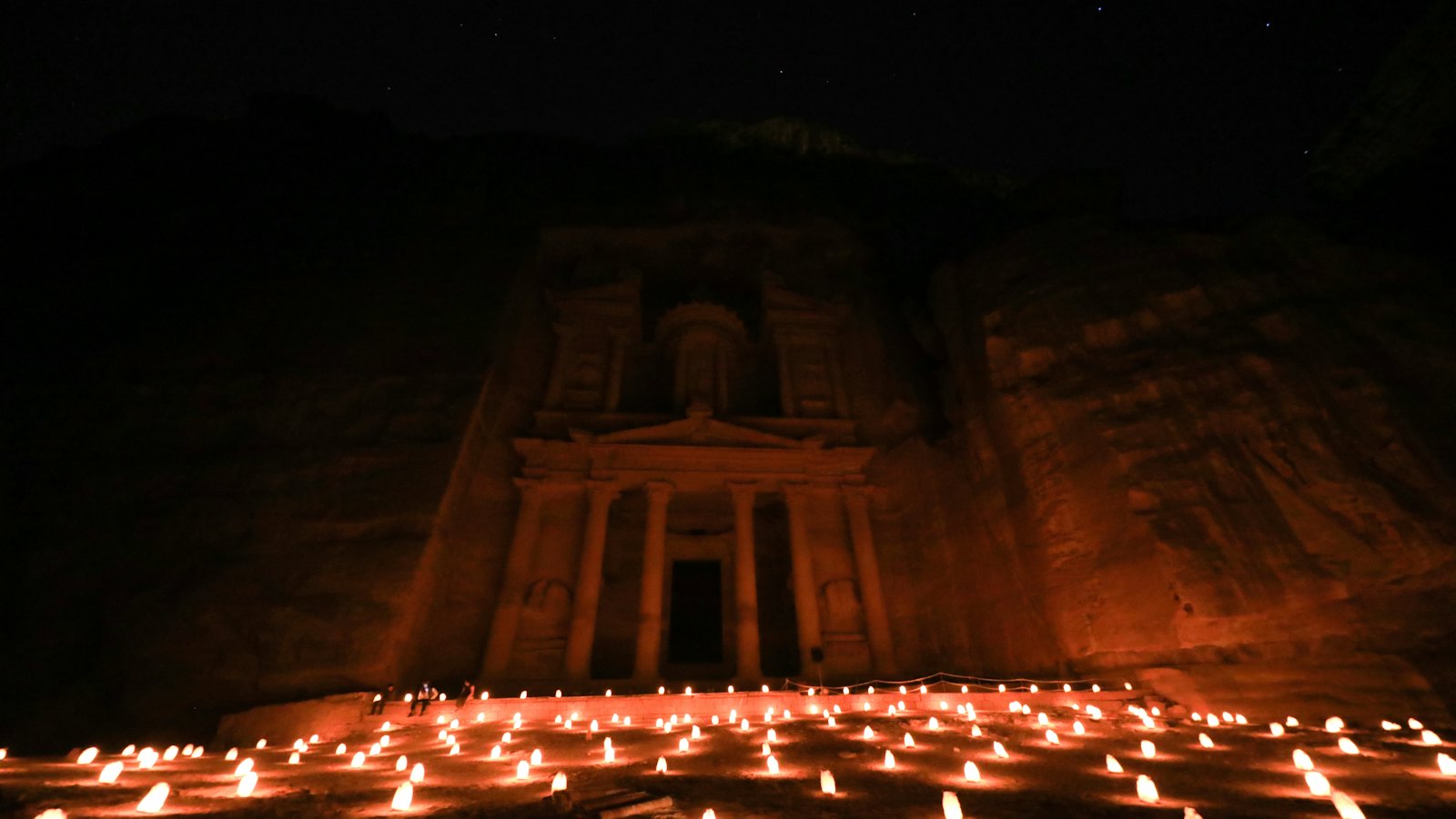
- Petra by Night: The candlelit programme operates on selected evenings and requires a separate ticket. Confirm locally because schedules can change.
- Little Petra: Siq al-Barid is a smaller Nabataean site a short drive away and works well on an arrival afternoon.
What to eat in Wadi Musa
Jordanian meals are generous, herb-fragrant and easy to share. Wadi Musa has visitor-oriented restaurants near Petra as well as simpler grills, bakeries and sweet shops farther uphill. Menus close to the entrance usually cost more, so walk or take a short taxi into town for better value.
Try mansaf, Jordan's signature dish of rice and lamb served with a tangy jameed yoghurt sauce. Maqluba layers rice with meat and vegetables before the pot is turned upside down for serving. Musakhan combines sumac-seasoned chicken, onions and flatbread, while zarb is meat and vegetables cooked slowly in an underground oven. For a quick meal, order shawarma, falafel, hummus, mutabbal or grilled chicken with Arabic bread and pickles.
Breakfast commonly includes eggs, labneh, olives, tomatoes, foul medames and warm bread. Finish with knafeh, baklava or dates, accompanied by sweet mint tea or cardamom coffee. A basic local meal may cost JOD 3 to JOD 7 (RM 17 to RM 40), while a fuller restaurant dinner is roughly JOD 8 to JOD 15 (RM 46 to RM 86). Ask whether service is included before adding a tip.
Halal food and prayer spaces
Petra and Wadi Musa are very Muslim-friendly, and halal food is the norm rather than a special category. Local meat dishes are generally suitable for Muslim travellers, though Malaysians who require formal certification should ask the restaurant directly because displayed certification is less common than at home. Alcohol is available at some tourist hotels and restaurants, so confirm if this matters to you.
Small mosques are found throughout Wadi Musa, and staff at your accommodation can direct you to the nearest one. Petra itself is a vast archaeological area rather than a modern complex with prayer rooms at every stop. Plan prayers around the visitor centre, nearby facilities or a clean, discreet place during a long trail, and carry a compact prayer mat and qibla app. Water and toilets are available at several points, but facilities become more limited on higher routes.
Queen Alia International Airport provides prayer facilities, making it sensible to pray before the three-hour transfer. For food checks, Google Maps and Muslim travel apps can help, but local confirmation is more reliable than an old listing. During Ramadan, some daytime restaurants reduce hours while visitor-facing outlets may continue operating.
Getting around Petra and Wadi Musa
Walking is the main way to explore Petra. Walking from the visitor entrance to the Treasury takes a while, and continuing to the Monastery creates a demanding full day with many steps. There is no urban transit card or internal train system.
Taxis handle most local journeys in Wadi Musa. Grab does not operate in Jordan, and app-based ride availability can be limited around Petra, so ask your accommodation to arrange a car or negotiate with an official local driver. A short town journey is commonly around JOD 2 to JOD 5 (RM 12 to RM 29), while trips to Little Petra cost more. Confirm whether the quoted price is one way or includes waiting and return travel.
Animals and electric vehicles may be offered on parts of the archaeological route. Availability, access and permitted operating areas can change. Settle the total price before accepting any ride, including whether a tip is expected, and use only authorised services. Travellers concerned about animal welfare may prefer walking or available electric transport.
A rental car is useful between Jordanian destinations but not inside Petra. Parking is available around the visitor area, while central Wadi Musa's steep roads and limited spaces can be awkward. Scheduled coaches are practical for Amman and Aqaba, but book early when possible and verify the departure point.
A practical four-day itinerary
- Day 1: Arrive at Queen Alia Airport and transfer to Wadi Musa. If timing and energy allow, visit Little Petra before sunset, then have an early dinner and prepare water, snacks and walking gear for the next morning.
- Day 2: Enter Petra early, walk through the Siq to the Treasury, then continue past the Street of Facades, theatre, Royal Tombs and Colonnaded Street. Climb to the Monastery only if your fitness and daylight allow. Return slowly rather than squeezing every trail into one exhausting day.
- Day 3: Re-enter Petra for the High Place of Sacrifice or another trail missed on day two. Spend the afternoon resting in Wadi Musa. If Petra by Night is operating and the timing suits you, buy the separate ticket locally.
- Day 4: Depart for Amman, the Dead Sea, Wadi Rum or Aqaba. Build extra time into any same-day connection with an international flight because the road journey is long and delays happen.
Two full Petra days suit most visitors. A strong walker can see the headline monuments in one long day, but the second day makes the entrance fee, journey from Malaysia and steep terrain feel more worthwhile.
Money, SIMs and practical advice
Jordan uses the Jordanian dinar (JOD). For quick planning, JOD 1 is about RM 5.75, but check the current rate before departure. The dinar is strong, so small-looking prices can become substantial in ringgit.
Cards work at many hotels, established restaurants and the Petra Visitor Centre, but keep cash for taxis, snacks, tips and smaller shops. DuitNow QR is not used. ATMs are available at the airport and in Wadi Musa; decline dynamic currency conversion if a machine offers to charge you directly in ringgit.
Local SIM counters operate at Queen Alia Airport, while eSIMs are convenient if your phone supports them. Coverage around Wadi Musa is generally useful, but signals can weaken on remote trails. Jordan uses Type C, F and G sockets, so Malaysians should pack a universal adaptor. The supply is 230V.
Tipping around 5 to 10 percent is appreciated when service is not included. Carry sun protection, layers and more water than expected. Temperatures shift sharply between sunny afternoons and desert nights. Petra is generally manageable for independent travellers, but politely refuse persistent offers, confirm every taxi or animal-ride price in advance, and do not follow unofficial guides onto isolated routes. Travel insurance should cover hiking, medical care and disrupted connections.
Before you go
- Best time to go
- March to May and September to November offer Petra's most comfortable walking weather. Spring brings mild days and occasional rain, while autumn is usually dry and less punishing than midsummer. June to August can be intensely hot on exposed trails, so enter early and avoid strenuous climbs around midday. December to February brings cold nights, short daylight hours and occasional rain or even snow, which can disrupt access. Prices and visitor numbers often rise around Easter, year-end holidays and Jordan's milder spring weeks. Malaysian school holidays can also make connecting flights more expensive. For a balance of weather and cost, consider late October or early November, then pack layers for the evening.
- Visa for Malaysians
- Malaysian passport holders need a Jordanian visa. As of September 2026, they can obtain it on arrival at Queen Alia Airport or as an e-Visa for stays of up to 90 days. The standard single-entry fee is JOD 40 (about RM 230), with no prior approval required. A Jordan Pass bought before arrival waives this fee when you stay at least two whole nights; leaving sooner means paying the fee on departure. Register with the Residence and Borders Department or a police station by day 14 if staying longer than 14 days, or risk a JOD 200 fine. Your passport should remain valid for at least six months. Visas are not issued on arrival at King Hussein Bridge, and Malaysian Emergency Certificates are not accepted. Confirm the latest requirements on the Jordan Ministry of Interior and Jordan Pass official sites before you fly.
- Honest budget guide
- Allow RM 280 to RM 550 per person per day in Petra, excluding international flights and the Jordan Pass or admission ticket. At the time of writing, one-way KL to Amman fares start at RM 1,017, while the median found is RM 1,540. Budget accommodation commonly costs RM 120 to RM 220 a room nightly, and comfortable mid-range rooms cost about RM 250 to RM 450. Set aside RM 70 to RM 150 per person daily for food and RM 20 to RM 60 for local taxis, more if using private transfers. A four-day Petra trip commonly totals around RM 3,200 to RM 5,800 per person including return flights, shared rooms, admission and ground transfers. Solo private transfers raise the total considerably. These figures are indicative and vary with season, booking time and exchange rates.
Frequently asked questions
Do Malaysians need a visa for Petra and Jordan?
Yes. As of September 2026, Malaysians can obtain a visa on arrival at Queen Alia Airport or apply for an e-Visa, with stays of up to 90 days. The standard single-entry fee is JOD 40. A Jordan Pass can waive it if purchased before arrival and you stay at least two whole nights. Confirm current rules with Jordan's Ministry of Interior before flying.
Is there a direct flight from Kuala Lumpur to Petra?
No. Petra has no airport, and there is no direct KLIA to Amman service as of September 2026. Fly to Queen Alia International Airport with at least one stop, then travel about three hours by road to Wadi Musa. At the time of writing, one-way fares found start at RM 1,017 via Abu Dhabi.
How many days are enough for Petra?
Allow two full days inside Petra, plus arrival and departure time. One day covers the Siq, Treasury and several central monuments, but reaching the Monastery or taking a high trail makes it extremely tiring. A second day lets you explore at a steadier pace. Four days overall works well when travelling from Amman.
Is Petra Muslim-friendly for Malaysian travellers?
Yes. Jordan is Muslim-majority, halal meat is widely available and mosques are easy to find in Wadi Musa. Formal halal logos are less commonly displayed than in Malaysia, so ask directly if certification matters. Petra's trails have limited prayer facilities, making a compact prayer mat and qibla app useful.
What is the best month to visit Petra?
April, May, October and early November usually provide comfortable conditions for long walks. Spring can bring rain, while autumn is generally drier. Summer afternoons are very hot and winter nights can be close to freezing. Late October is a particularly useful compromise between daylight, manageable temperatures and seasonal demand.
How much money should I budget for four days in Petra?
Budget roughly RM 3,200 to RM 5,800 per person, including return flights from Kuala Lumpur, shared accommodation, food, Petra admission or a Jordan Pass and ground transport. Private transfers, single rooms and peak dates raise the figure. Carry some Jordanian dinars for taxis, tips and small purchases even if your hotel accepts cards.
Does Grab work in Petra?
No, Grab does not operate in Jordan. Wadi Musa is served mainly by local taxis arranged directly or through accommodation. Agree on the full fare before leaving and clarify whether it includes waiting or a return journey. Walking covers central Petra itself, although the distances and elevation changes are substantial.
Can I visit Petra with children or older parents?
Yes, but plan around the terrain. The route through the Siq to the Treasury is lengthy but relatively gradual; areas beyond it involve rough ground, heat and many steps. The Monastery climb is particularly strenuous. Stay near the entrance, begin early, schedule rests and ask about authorised electric transport if mobility is limited.
Jom pergi
Ready to go Petra? Compare available flights and hotels for your dates. Check baggage, cancellation terms and the final total on the booking provider before paying.






