




On this page13 sections
- Overview
- Getting there from KL: non-stop flights and terminals
- Baiyun Airport to the city
- Where to stay in Guangzhou
- Things to do in Guangzhou
- What to eat in Guangzhou
- Halal food and prayer spaces
- Getting around Guangzhou
- Sample itinerary: 4 days in Guangzhou
- Money, SIM and practical tips
- Canton Fair, wholesale buying and rail side trips
- Before you go
- FAQ
Guangzhou is the capital of Guangdong and the home of Cantonese cooking, so many Malaysian Chinese families will find the language, the roast meats and the morning tea habit strangely familiar. It is also one of the oldest Muslim footholds in China, with a mosque whose minaret has watched over the old city for centuries. Malaysians can now visit visa-free for up to 30 days, and non-stop flights take a little over four hours with no time difference. Here is what KLIA flyers need: flights and terminals, halal food and mosques, getting around without Grab, payment apps that work, and costs in ringgit.
Getting there from KL: non-stop flights and terminals
At the time of writing, six airlines fly non-stop between KLIA and Guangzhou Baiyun:
- Malaysia Airlines: from KLIA Terminal 1.
- China Southern Airlines: from KLIA Terminal 1, with Guangzhou as its home base.
- Batik Air Malaysia: from KLIA Terminal 1.
- AirAsia: normally from KLIA Terminal 2.
- Spring Airlines: a Chinese low-cost carrier, listed by airport guides at KLIA Terminal 2.
- 9 Air: a smaller budget airline based in Guangzhou.
Frequencies change with the season, so check which days your airline flies. The flight takes a little over four hours, and Guangzhou shares Malaysia's clock.
Amaboxly's KL fare scan (updated 14 September 2026) priced the cheapest one-way seat at about RM 361, a non-stop Spring Airlines fare. The middle of the range sat near RM 482 and the dearest fares near RM 617, while the cheapest one-stop routing, via Singapore, was about RM 449. Prices move daily.
At the Guangzhou end, Baiyun's Terminal 1 closed for renovation on 7 May 2026. Lists dated August 2026 put China Southern at Terminal 2 and AirAsia, Batik Air and Spring Airlines at the new Terminal 3. Malaysia Airlines was not listed, so confirm the terminal on your e-ticket.
Baiyun Airport to the city
Baiyun International Airport (CAN) is about 28 km north of the centre, and only Terminal 2 currently has a working metro station. Prices are indicative (about CNY 1.65 to RM 1).
- Metro Line 3 (Terminal 2): Airport North station sits under the terminal. Trains run via Guangzhou East Railway Station to Tiyu Xilu in Tianhe in roughly 30 to 45 minutes, and the distance-based fare works out at about CNY 7 to CNY 8 (under RM 5). Service runs from about 6:00 to about 23:15. Airport South station (Terminal 1) is shut during the rebuild.
- From Terminal 3: take the free 24-hour inter-terminal shuttle bus to Terminal 2 (every 10 to 30 minutes) or the intercity train, then Line 3. Intercity trains from Baiyun Airport East station also serve Huadu and Panyu.
- Airport express buses: lines run to hubs such as Guangzhou Railway Station, Haizhu Square and Tianhe. Before Terminal 3 opened, fares were around CNY 20 (about RM 12) for a 50 to 60 minute ride, but routes and stops have shifted since, so ask at the bus desk.
- Taxi: older estimates put the fare at roughly CNY 100 to CNY 150 (RM 60 to RM 90) to Guangzhou Railway Station, Guangzhou East or Canton Tower, taking an hour or more. At Terminal 3 the official rank is at Gate 72, and ride-hailing pick-ups are in car park P12.
Where to stay in Guangzhou
Most visitors stay along the north bank of the Pearl River, where Metro Lines 1, 3 and 5 tie the districts together.
- Tianhe and Zhujiang New Town: the modern centre of towers and malls, facing Canton Tower across the river. Line 3 runs straight to the airport, so it suits first-timers, shoppers and business travellers.
- Yuexiu: the historic core around Beijing Road, Yuexiu Park and the Sun Yat-sen Memorial Hall. Three mosques are here and the Middle Eastern and Uyghur eateries of Xiaobei are close by, which makes it the best base for Muslim travellers.
- Liwan: the old Xiguan quarter of Shangxiajiu, the Chen Clan Ancestral Hall and leafy Shamian Island. Pick it for heritage lanes and traditional teahouses; Shamian is quiet at night.
- Haizhu and Pazhou: south of the river near Canton Tower and the Canton Fair complex. Handy for the fair, but rates climb sharply in fair weeks.
Things to do in Guangzhou
Expect ancient temples, colonial streets and a glassy skyline, nearly all near a metro station.
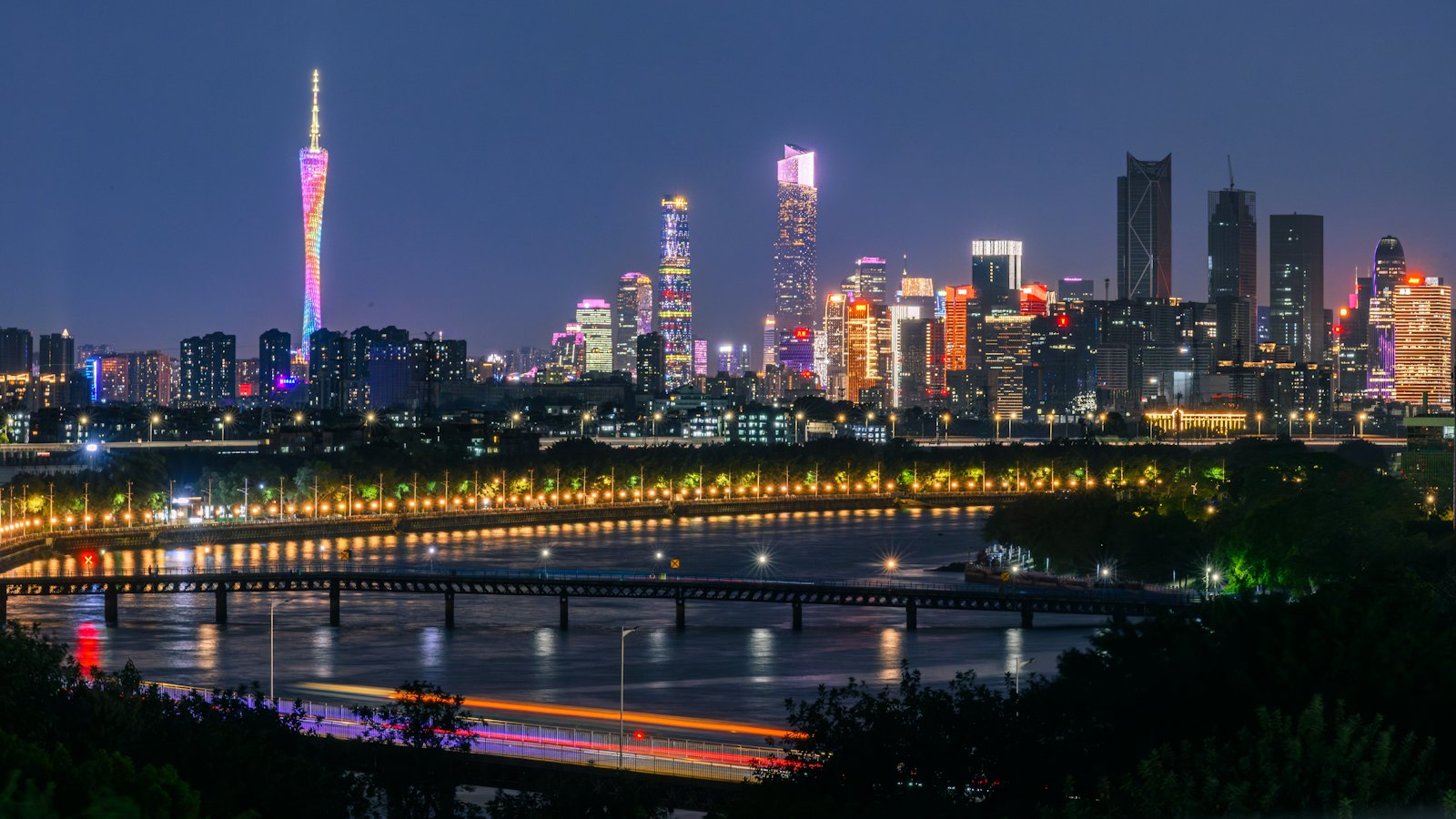
- Canton Tower: indoor and open-air observation decks more than 400 m up, plus the rooftop Bubble Tram. Tickets are sold as packages, from roughly CNY 150 (about RM 90) up to several hundred yuan.
- Pearl River night cruise: one to two hours past the lit-up towers from Tianzi, Dashatou or Xidi piers.
- Chen Clan Ancestral Hall: a 19th-century clan academy with astonishing roof carvings, now a folk art museum, on Metro Lines 1 and 8.
- Shamian Island: the former British and French concession, with restored colonial buildings and quiet lanes where traffic is restricted.
- Shangxiajiu and Beijing Road: arcaded qilou shophouses that recall old Ipoh or George Town, plus glass panels on Beijing Road over old road surfaces from earlier dynasties.
- Yuexiu Park: the Five Rams statue, symbol of the city, and the Ming-era Zhenhai Tower, home of the Guangzhou Museum.
- Huaisheng Mosque: one of China's oldest mosques, with a plain 36 m minaret that once guided ships. Non-Muslims can see the grounds but not the prayer hall.
- Guangdong Museum: the city's biggest museum, in Zhujiang New Town. Entry has long been free with ID, daily numbers are limited and it closes on Mondays.
- Chimelong and Baiyun Mountain: Panyu's theme parks, including a big safari park, or forest trails and a cable car just north of the centre.
What to eat in Guangzhou
Much of what Malaysians call Cantonese food began here, and locals are proud of the saying "eat in Guangzhou". Many classics use pork, lard or pork stock, so Muslim readers should skip to the halal section.
- Yum cha: morning tea with dim sum, summed up as "one pot, two pieces". Old teahouses in Liwan and around Shangxiajiu fill early, so arrive before the breakfast rush.
- Siu mei: roast goose, char siu and crackling pork. Roast goose is a local favourite.
- White cut chicken: poached chicken with a ginger and spring onion dip, familiar to anyone raised on chicken rice.
- Congee and wonton noodles: the everyday breakfast and supper.
- Desserts: double-skin milk, ginger milk curd and sweet soups such as red bean, black sesame and sago.
- Seafood: pick live fish or prawns straight from the tank.
Tianhe's malls and the streets around Beijing Road and Shangxiajiu are lined with eateries, and picture menus plus a translation app will get you through. Cantonese cooking is mild, so pack chilli sauce if you need heat.
Halal food and prayer spaces
Guangzhou has a long Muslim history and today hosts Hui Muslims plus Arab and African traders, so halal food is not hard to find. The catch is certification: the word qingzhen (清真) on a shopfront marks Muslim-run food that is halal by local standards, but it is not the same as JAKIM-recognised certification.
- Qingzhen noodle shops: Hui-run beef noodle and hand-pulled noodle shops are common across the city, the daily staple for many Muslim visitors.
- Xiaobei (Metro Line 5): long the most international halal area, known for Middle Eastern and Uyghur restaurants along Baohan Zhijie. Places open and close, so check recent reviews on your map app.
- Around Huaisheng Mosque: the stretch of Guangta Road by the mosque has traditionally had a few halal eateries and shops.
Ordinary Cantonese restaurants are not a safe fallback: pork-free menus are rare and lard is common.
For prayer, Yuexiu has several active mosques. Huaisheng Mosque (56 Guangta Road, near Ximenkou station) is the oldest. Xianxian Mosque on Jiefang North Road, near Guangzhou Railway Station, is the largest, with a prayer hall for 1,000 worshippers and an old Muslim cemetery that tradition links to the Companion Sa'd ibn Abi Waqqas. Xiaodongying Mosque, built in 1468, is near Gongyuanqian station. Malls generally have no prayer rooms, and we found no published prayer room details for Baiyun's terminals, so pray at KLIA before boarding if you can. Load Muslim Pro or a qibla app at home, since Google Play does not work in China.
Getting around Guangzhou
The metro reaches almost every sight, with bilingual signs and English announcements. Expect bag checks at entrances and packed Line 3 trains at rush hour.
- Fares: CNY 2 for a couple of stops up to about CNY 20 for the longest trips, so most rides cost RM 1.20 to RM 5.
- Paying: since 12 October 2025 every line accepts tap-in with contactless Visa or Mastercard cards issued outside mainland China, Malaysian cards included, though at older stations not every gate takes them. Alipay and WeChat have metro QR codes, and the Yang Cheng Tong (Lingnan Pass) card also covers buses and ferries.
- Day passes: CNY 20 for 24 hours or CNY 50 for 72 hours.
- Ride-hailing: Grab has no service in China, so the city runs on DiDi. Its app comes in English and it also runs inside Alipay and WeChat, where rides are charged to the card you linked there.
- Taxis: metered, from CNY 12 for the first 3 km, then CNY 2.60 per km, with surcharges on longer trips. Show your destination in Chinese characters.
- Maps: Google Maps is unreliable in China. Install Amap (Gaode), which has an English mode; Apple Maps uses its data.
Sample itinerary: 4 days in Guangzhou
Four days covers the old town, the new skyline and one bigger outing. Shuffle the days around the weather and Friday prayers.
- Day 1: Check in, then head to Zhujiang New Town for the riverside and the Guangdong Museum (not on a Monday). Go up Canton Tower at sunset and end with a Pearl River night cruise.
- Day 2: Old Guangzhou. Dim sum or a halal noodle breakfast, then the Chen Clan Ancestral Hall, the qilou arcades of Shangxiajiu and a slow afternoon on Shamian Island. Beijing Road in the evening.
- Day 3: Yuexiu. Huaisheng Mosque (on a Friday, time it for the midday prayer), Yuexiu Park and the Five Rams, then the Sun Yat-sen Memorial Hall. Dinner in Xiaobei.
- Day 4: Chimelong's safari park with the kids, the Baiyun Mountain cable car, or Foshan's old temples on the Guangfo metro. Allow at least three hours to reach the airport, since traffic and terminal transfers can be slow.
A fifth day fits Shenzhen or Hong Kong by high-speed train (see the last section).
Money, SIM and practical tips
- Currency: Chinese yuan (CNY, or renminbi). In late September 2026 one ringgit bought about CNY 1.65, which makes a CNY 100 note worth around RM 61.
- Mobile payments: Alipay and WeChat Pay both let visitors link a Malaysian Visa or Mastercard, so set one up before you fly.
- E-wallets: Touch 'n Go eWallet pays at merchants accepting Alipay+. DuitNow cross-border QR does not cover China; at the time of writing PayNet lists only Singapore, Indonesia, Thailand and Cambodia.
- Cash and cards: keep some yuan for stalls and taxis. Airport ATMs take foreign cards and big hotels usually accept them, but many shops take only Alipay, WeChat Pay or cash.
- SIM and eSIM: on local SIMs and hotel Wi-Fi you cannot reach Google, WhatsApp, Instagram or Facebook. A roaming eSIM from a non-mainland provider sends data abroad, so your usual apps keep working.
- Plugs: 220V, with two-pin and Australian-style angled three-pin sockets, so pack a travel adapter for your UK-style plugs.
- Tipping: not part of local custom.
- Safety: generally safe, but pickpockets work shopping streets and stations. Use official taxis, ignore touts and check your change for fake notes.
- Emergencies: 110 for police, 119 for fire and 120 for an ambulance.
Canton Fair, wholesale buying and rail side trips
The visa exemption covers business visits, though actual work needs a proper visa, so carry your invitation letter, return ticket and hotel booking.
The Canton Fair, China's largest trade fair, fills the Pazhou complex in Haizhu twice a year, usually from mid-April to early May and mid-October to early November, so confirm the exact dates on the official fair site. Hotel rates climb sharply in fair weeks, so book early or stay further out along the metro.
Outside fair season, wholesale malls such as Onelink Plaza by Haizhu Square (gifts, toys, jewellery) and the trading streets of Xiaobei draw small traders from around the world. The best prices go to bulk buyers, usually 20 pieces or more, and many sellers only bargain on bulk orders. Get a quote from a freight forwarder before you buy big.
For a side trip, the fastest high-speed trains from Guangzhou South reach Hong Kong West Kowloon, via Shenzhen, in under an hour. Hong Kong lets Malaysians stay 90 days without a visa. Coming back to the mainland starts a new 30-day stay, but the 90-day cap per 180 days still counts.
Before you go
- Best time to go
- October to early December is the most comfortable time for Guangzhou, with warm, drier days after the summer rains. October highs average about 29°C and November about 25°C. April and May are pleasant but turning wet, and May and June are the rainiest months. Summer is hot and sticky, with record highs near 39°C, with typhoons possible from June to September. December to February is cool, with January nights near 10°C, so bring a light jacket. The Canton Fair and China's National Day holiday in early October push up prices and crowds, and Chinese New Year brings flower fairs while some districts empty out. For Malaysian families, the 2026 year-end school break starts on 4 or 5 December depending on your state and ends on 31 December, so book those seats early.
- Visa for Malaysians
- Guangzhou is visa-free for Malaysians as of September 2026: an ordinary Malaysian passport lets you stay up to 30 days each time you enter mainland China. It rests on a reciprocal visa waiver that took effect on 17 July 2025. Your time in China may not total more than 90 days within any 180-day window, and you need six months or more left on the passport. The exemption covers tourism, family visits, business, exchanges and medical treatment, but not work, study or journalism. Carry your return ticket and hotel booking. There is no visa fee, but you must complete an arrival card: since 20 November 2025 you can submit it in advance on the National Immigration Administration (NIA) website, the NIA 12367 app or mini programs in WeChat and Alipay, or fill it in at the airport. Before booking, double-check the current position with the Chinese Embassy in Malaysia at my.china-embassy.gov.cn.
- Honest budget guide
- Expect a daily spend of about RM 180 to RM 450 for each traveller in Guangzhou, not counting flights, depending mostly on your hotel. Flights: at the time of writing, Amaboxly's scan of KL departures puts the cheapest one-way ticket at around RM 361 (Spring Airlines, non-stop) and a typical fare near RM 480, so a return often works out at roughly RM 750 to RM 1,000. A budget room is under about CNY 200 (RM 120) a night and a comfortable mid-range room CNY 200 to CNY 500 (RM 120 to RM 300), far more during the Canton Fair. Allow RM 50 to RM 120 a day for food and RM 15 to RM 30 for transport. A mid-range five-day, four-night trip for two people splitting a room works out at around RM 2,000 to RM 3,000 each, flights included. Treat every figure here as indicative.
Frequently asked questions
Do Malaysians need a visa for Guangzhou?
No. As of September 2026, an ordinary Malaysian passport gives you up to 30 days per visit to mainland China without a visa, capped at 90 days in any 180-day period. Keep at least six months on your passport and complete the arrival card online before you fly or on arrival.
Is there a direct flight from KL to Guangzhou?
Yes, several. Malaysia Airlines, China Southern and Batik Air fly non-stop from KLIA Terminal 1 and AirAsia normally from Terminal 2, while Spring Airlines and 9 Air also serve the route. The flight takes a little over four hours. At the time of writing the cheapest one-way fare in Amaboxly's scan is about RM 361, on Spring Airlines.
Is Guangzhou Muslim-friendly?
Reasonably so, for a Chinese city. Yuexiu has several historic mosques, including Huaisheng and the larger Xianxian Mosque, and halal food is easy to find at Hui-run qingzhen noodle shops and in Xiaobei. Qingzhen signs are not the same as JAKIM-recognised certification, and ordinary Cantonese kitchens use pork and lard.
Can I use Grab in Guangzhou?
No, Grab does not operate in China. Use DiDi, which has an English app and also runs inside Alipay and WeChat, so rides are charged to the card you linked there. Metered taxis start at CNY 12, and the metro takes contactless Visa and Mastercard.
How many days in Guangzhou is enough?
Three to four days covers Canton Tower and a river cruise, the Chen Clan Ancestral Hall and Shamian Island, Yuexiu Park and the old mosques, plus Chimelong or Baiyun Mountain. Add a day or two for Foshan, Shenzhen or Hong Kong by train.
What is the best month to visit Guangzhou?
October and November are the most comfortable, warm and fairly dry. Avoid Canton Fair weeks for cheaper hotels and early October if you dislike crowds. December is cooler but pleasant, while May to September is hot, wet and sometimes hit by typhoons.
What does a 5-day Guangzhou trip cost from Malaysia?
Budget roughly RM 2,000 to RM 3,000 per person for a mid-range five-day trip, covering return flights, a shared hotel room, meals, metro rides and a few attractions. Backpackers spend less, and Canton Fair weeks cost much more.
Can I use Touch 'n Go eWallet or DuitNow QR in Guangzhou?
Touch 'n Go eWallet works at merchants accepting Alipay+, though not everywhere. DuitNow cross-border QR does not work in China. The most reliable choice is Alipay or WeChat Pay linked to your Malaysian Visa or Mastercard, with a little cash as backup.
Jom pergi
Ready to go Guangzhou? Compare available flights and hotels for your dates. Check baggage, cancellation terms and the final total on the booking provider before paying.






