




On this page13 sections
- Overview
- Getting there from KL: direct flights and KLIA terminals
- Jiangbei Airport to the city
- Where to stay in Chongqing
- Things to do in Chongqing
- What to eat in Chongqing
- Halal food and prayer spaces
- Getting around Chongqing
- Sample itinerary: 4 days in Chongqing
- Money, SIM and practical tips
- Adding Chengdu or a Yangtze cruise
- Before you go
- FAQ
Chongqing is the mountain city on the Yangtze, where a monorail runs through an apartment block, roads and walkways stack up the hillsides on several levels, and dinner arrives in a bubbling pot of chilli oil. It became a favourite of travel videos in the 2020s, and Malaysians have followed, helped by visa-free entry and non-stop flights from KLIA. This guide covers the direct flights (including one route ending in October 2026), the 30-day visa-free rule, the ride in from Jiangbei Airport, halal food and the city mosque, paying without much cash, and what the trip costs in ringgit.
Getting there from KL: direct flights and KLIA terminals
At the time of writing, three airlines fly non-stop between KLIA and Chongqing Jiangbei International Airport, with the fastest flights taking about 4.5 hours. Clocks read the same in both cities (UTC+8).
- Sichuan Airlines: opened the route in December 2025 with three flights a week and was listed as flying daily when we checked, from KLIA Terminal 1.
- Hainan Airlines: about four flights a week (recently Monday to Thursday), also from Terminal 1.
- AirAsia X: about four flights a week from KLIA Terminal 2, recently on Tuesdays, Thursdays, Saturdays and Sundays. AirAsia's own travel notice lists Kuala Lumpur to Chongqing as suspended from 24 October 2026, so only book it if you fly home before then.
Schedules change each season, so check the airline's website before you apply for leave, and confirm the terminal on your e-ticket. In Chongqing, international flights use Terminal 3A.
Our KL fare scan (last refreshed 21 September 2026) shows one-way fares from about RM 550 (Shandong Airlines, one stop via Jinan), and the median across the dates we sampled was about RM 775 one-way. Other one-stop options ran via Shenzhen, Guangzhou, Haikou and Bangkok, and the scan also picked up non-stop fares. A connection can add many hours, so weigh the saving against a long layover.
Jiangbei Airport to the city
Jiangbei Airport (CKG) lies roughly 20 km north of the centre, and international flights arrive at Terminal 3A, which has its own metro station. Prices are indicative, at roughly 1.65 yuan to RM 1.
- Metro Line 10: ride south from the Terminal 3 station and change at Qixinggang to Line 1 for Jiaochangkou or Xiaoshizi, both beside Jiefangbei. Allow roughly an hour; on the official distance-based fare table the trip works out at about 7 yuan (around RM 4).
- Metro Line 3: this monorail starts at Terminal 2, about 15 minutes away on the free shuttle bus (or one stop on Line 10), and runs through Guanyinqiao to Lianglukou in about 50 minutes.
- Airport buses: K-numbered express routes have linked the airport with Jiefangbei, Chongqing North railway station and Shapingba. They are cheap, but routes change and signage is mostly Chinese, so ask at the ground transport centre.
- Taxi: use the official rank and ignore touts in the arrivals hall. Expect around 80 yuan (about RM 50) to Jiefangbei, a little more after midnight when night rates apply, and roughly half an hour in light traffic, longer at rush hour.
- DiDi: book in the English app or its Alipay mini program, and meet the driver at the pick-up point the app shows.
Landing near midnight? The metro may have stopped, so plan on a taxi or DiDi.
Where to stay in Chongqing
Chongqing spreads over steep hills and two river banks, so choose a base on a metro line near the sights you care about. Places a few hundred metres apart on a map can be separated by long flights of stairs.
- Jiefangbei and Jiaochangkou: the core of the Yuzhong peninsula, walking distance from Hongyadong, Shibati and Chaotianmen, with Lines 1, 2 and 6 close by. Best for first-timers, and the nearest area to Chongqing Mosque.
- Guanyinqiao: a big shopping district north of the Jialing River on Line 3, which runs direct to Chongqing North railway station and airport Terminal 2. Good for families who want malls and newer hotels.
- Nan'an riverside (Nanbin Road): across the Yangtze, facing the famous lit-up skyline. Suits couples and photographers, though you will rely on the metro, taxis or the cableway to cross.
- Shapingba and Ciqikou: the western side, with a local shopping hub at Shapingba and the old porcelain port of Ciqikou, but a longer ride to Jiefangbei.
Before booking, check how far the hotel is from the nearest metro exit, in distance and in height, since two dots close on a map may be split by a river or a cliff.
Things to do in Chongqing
Most of these cost little, and several look best after dark.
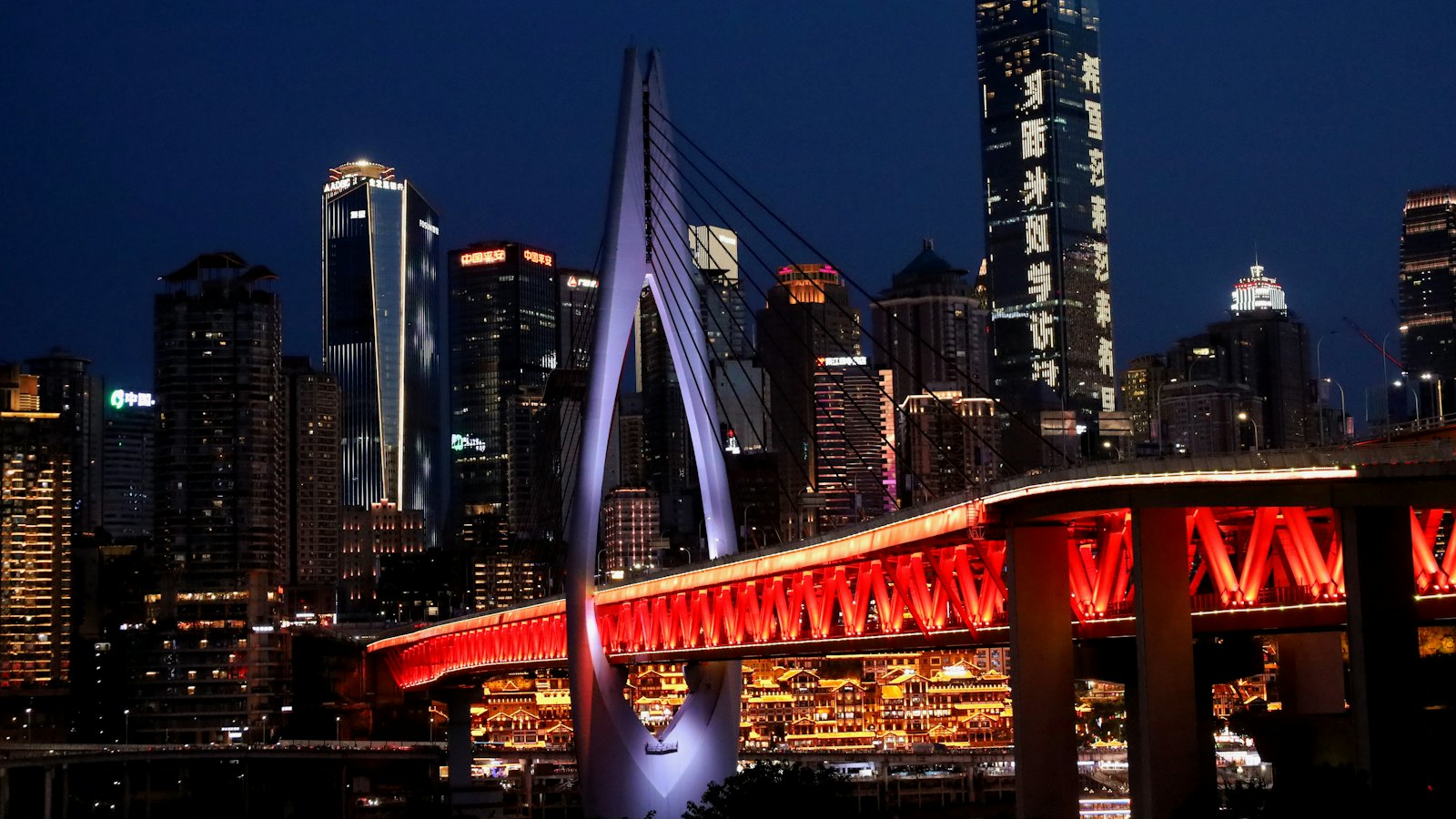
- Hongyadong: a stilted, cliff-hugging stack of shops that glows gold at night. View it first from the Qiansimen Bridge.
- Liziba station: the Line 2 monorail glides through a 19-storey residential block. Watch from Liziba Park below, then ride through it yourself.
- Yangtze River Cableway: a five-minute, 1,166 m ride over the river, about 20 yuan one-way or 30 yuan return (RM 12 to RM 18).
- WFC skydeck: the observation deck of the 339 m Chongqing World Financial Centre above Jiefangbei, listed at about 118 yuan (roughly RM 71).
- Chaotianmen and Raffles City: where the Jialing joins the Yangtze, under the Crystal skybridge. At the time of writing, a free drone show lights up the confluence on Saturday nights.
- Two Rivers night cruise: an hour past the lit skyline, roughly 95 to 118 yuan (RM 58 to RM 72).
- Ciqikou Ancient Town: old riverside lanes and snack stalls on Metro Line 1.
- Eling Park and TestBed 2: a hilltop park and an old banknote factory turned cafe hub, near Liziba.
- Three Gorges Museum: free entry, covering the ancient Ba people and wartime Chongqing, facing People's Square. Closed on Mondays.
- Wulong Karst: giant natural stone bridges and sinkholes. High-speed trains from Chongqing East station reach Wulong South in 40 to 50 minutes; local buses and shuttles cover the rest.
What to eat in Chongqing
Chongqing cooking is fiery and numbing, built on dried chillies and Sichuan peppercorns. Ask for "wei la" (mild) unless your tolerance is truly local-level. Almost everything below contains pork or non-halal meat, or is cooked in beef tallow, so Muslim readers should see the halal section.
- Chongqing hotpot: the red broth is traditionally cooked with beef tallow, chillies and bean paste, and locals dip beef tripe, duck intestine and greens. A split "yuanyang" pot gives you a clear broth on one side.
- Xiaomian: small bowls of noodles in chilli oil, a cheap breakfast at no-frills shops. Wan za mian adds soft peas and a minced meat sauce.
- Suan la fen: hot and sour sweet potato noodles from street stalls.
- Suancaiyu: fish simmered in a sour broth of pickled mustard greens.
- Laziji: bite-sized fried chicken hidden in a mountain of dried chillies.
- Mahua: crunchy twisted fried dough from Ciqikou, easy to pack as a gift.
Graze around Jiefangbei, Hongyadong, Ciqikou and the Guanyinqiao malls, and pick a hotpot place full of locals over one with touts outside.
Halal food and prayer spaces
Be realistic: Chongqing is one of the harder Chinese cities for halal food. Pork is everywhere, standard hotpot broth is built on beef tallow, and you should not expect JAKIM-recognised certificates on menus. What you can find is Muslim-run food.
- Qingzhen restaurants: the characters 清真, often on a green sign with Arabic script, mark Muslim-run places, usually owned by Hui or Uyghur families. They serve no pork, but they are not JAKIM certified and standards vary, so look around before you sit down.
- Lanzhou beef noodles: hand-pulled noodle shops, typically run by Hui Muslims, are common in Chinese cities and are usually the easiest fallback.
- Halal hotpot: search 清真火锅 in Dianping, Meituan or Amap for Muslim-run hotpot, and read recent reviews before you go.
- Chongqing Mosque (重庆清真寺): on Zhongxing Road in Yuzhong district, under a kilometre south-west of Jiefangbei. Ask there about nearby halal eateries and check prayer times locally.
- Prayer spaces: do not count on prayer rooms in malls or attractions, and we could not confirm one at Jiangbei Airport. Pray at a KLIA surau before boarding, then in your hotel, using a qibla and prayer-times app such as Muslim Pro that you set up before you fly.
- Self-catering: convenience stores sell fruit and bread, and many Malaysians pack instant noodles or sambal.
Getting around Chongqing
The metro is the easiest way to beat the hills. The network is extensive and includes two monorail lines, Lines 2 and 3.
- Fares: charged by distance, from 2 yuan for a short hop; most trips a visitor makes cost 2 to 9 yuan (about RM 1.20 to RM 5.50). Day passes have sold for around 18 yuan (one day) and 45 yuan (three days).
- Paying: buy single tickets at station machines, which accept WeChat Pay and Alipay, or scan a ride QR code in Alipay or WeChat if your account supports it. The local Changtong card also covers buses and the cableway.
- Ride-hailing: Grab has no service in mainland China. DiDi fills that gap, with an English-language app and mini programs inside Alipay and WeChat.
- Taxis: yellow cabs are plentiful and cheap, but few drivers speak English, so show your destination in Chinese characters.
- Walking: expect stairs, lifts and footbridges between levels. The Huangguan Escalator near Lianglukou costs 2 yuan and saves a punishing climb.
- Maps: Google Maps does not work properly in China. Amap (Gaode) has an English mode, and Apple Maps, which runs on Amap data, works well on iPhone.
Sample itinerary: 4 days in Chongqing
Four days covers the icons plus one day out of town. If you land on a Saturday, keep that evening free for the drone show.
- Day 1: Ride Line 10 into the city and check in near Jiefangbei. After dark, see Hongyadong from the Qiansimen Bridge, then walk on to Chaotianmen where the two rivers meet.
- Day 2: Morning at Liziba station, then up to Eling Park and the cafes of TestBed 2. Afternoon at the Three Gorges Museum (closed Mondays), and a Two Rivers night cruise from the Chaotianmen piers to finish.
- Day 3: Day trip to Wulong Karst by high-speed train from Chongqing East to Wulong South. Wear proper shoes, as the natural bridges loop involves many steps. Late supper around Jiefangbei.
- Day 4: Ride the Yangtze River Cableway early to beat the queues, stroll Nanbin Road on the Nan'an side, then snack your way through Ciqikou before taking Line 10 back to Terminal 3.
With a fifth day, add the UNESCO-listed Dazu Rock Carvings west of the city, or catch sunset from the WFC skydeck.
Money, SIM and practical tips
- Currency: renminbi (yuan, CNY). In late September 2026, RM 1 bought about 1.65 yuan, which makes 100 yuan about RM 61.
- Mobile payment first: most shops, stalls and taxis expect Alipay or WeChat Pay. Both let you link a Malaysian Visa or Mastercard, so set them up and test a small payment before you fly. China's central bank also lists Touch 'n Go eWallet among the foreign e-wallets some merchants accept directly.
- DuitNow QR: not usable in China at the time of writing; PayNet's cross-border QR list covers only Singapore, Indonesia, Thailand and Cambodia.
- Cash and cards: carry a few hundred yuan for emergencies. ATMs at the airport accept international cards, and places showing the Visa or Mastercard logo take those cards.
- Internet: Google, WhatsApp, Instagram and Facebook are blocked on Chinese networks. A roaming eSIM from a non-Chinese provider usually routes data abroad, so your usual apps keep working.
- Power: 220 V. Sockets take two-pin plugs or the angled Chinese three-pin plug, and a Malaysian plug usually will not fit, so bring a universal adapter.
- Tipping: not expected.
- Safety: use the official taxi rank rather than touts, mind your phone and wallet in the Hongyadong crowds, and watch for slippery steps after rain.
- Documents: carry your passport. Hotels register it with the police at check-in, and you need it for train tickets and some attractions.
Adding Chengdu or a Yangtze cruise
Plenty of Malaysians pair Chongqing with Chengdu, capital of neighbouring Sichuan. High-speed trains link the two in about an hour and a half, and tickets are issued in your passport name, online or at the station. Chengdu adds the giant panda base and teahouses. KLIA also has non-stop flights to Chengdu Tianfu, so an open-jaw ticket (into one city, out of the other) saves backtracking, and your 30-day visa-free stay covers both.
Chongqing is also the traditional starting point for multi-night Yangtze River cruises through the Three Gorges towards Yichang. Prices vary widely by ship and cabin. Meals on board are generally not halal, so Muslim travellers should ask the operator about food in writing before paying, or settle for the one-hour Two Rivers night cruise in the city.
Before you go
- Best time to go
- Chongqing is at its most pleasant in spring (March to May) and autumn (late September to November), when days are mild, though fog is common. Summer is tough: long counted among China's three furnace cities, Chongqing averages highs of about 34 degrees in July and August, and rain peaks in June. Winter (December to February) is cool, damp and often grey, with average lows of 6 to 8 degrees and highs of 10 to 14, but it is prime hotpot season and calmer. Avoid National Day Golden Week (1 to 7 October) and Chinese New Year (6 February 2027), when domestic crowds pack Hongyadong; February is usually the priciest month to fly. Malaysian school holidays, such as the year-end break from 5 to 31 December 2026 in most states, also push up KL fares.
- Visa for Malaysians
- Malaysians need no visa for China as of September 2026: an ordinary Malaysian passport gets up to 30 days per trip, thanks to the bilateral visa-waiver agreement that took effect on 17 July 2025. Holidays, seeing relatives, business meetings, exchanges, medical care and transit all qualify; paid work, studying and journalism do not. Across any rolling 180 days, visa-free time in China is capped at 90 days, with no cap on how often you enter. Check that your passport has six months or more to run. Malaysians must also complete an arrival card, online before the flight (NIA website, NIA 12367 app, or the WeChat or Alipay mini program) or at the airport. Recheck the current rules on the Chinese Embassy in Malaysia website before you fly.
- Honest budget guide
- Expect to spend about RM 150 to RM 400 a day each in Chongqing, not counting flights, depending mostly on your hotel. At the time of writing, the cheapest one-way fare in Amaboxly's KL fare scan was about RM 550 (Shandong Airlines, one stop), and the median was about RM 775, so a return built from two one-ways lands at about RM 1,100 to RM 1,600. Budget hotels cost about 150 to 250 yuan (RM 90 to RM 150) a night and mid-range rooms 300 to 600 yuan (RM 180 to RM 360). Food runs RM 50 to RM 120 a day, the metro under RM 15, and paid sights RM 50 to RM 150 in total. All in, a 5D4N trip with flights and a shared mid-range room lands at about RM 2,000 to RM 3,200 per head. Treat all figures as indicative.
Frequently asked questions
Do Malaysians need a visa to visit Chongqing?
No visa is required. Since 17 July 2025 a reciprocal waiver lets Malaysians with an ordinary passport spend up to 30 days per trip anywhere in mainland China, Chongqing included, with visa-free days capped at 90 in each rolling 180. Bring a passport with six months' validity, fill in the arrival card online or on landing, and recheck the Chinese Embassy in Malaysia website before departure.
Is there a direct flight from KL to Chongqing?
Yes. At the time of writing Sichuan Airlines (listed as daily) and Hainan Airlines (about four a week) fly non-stop from KLIA Terminal 1, and AirAsia X flies from Terminal 2 until 24 October 2026, the date AirAsia lists for suspending the route. Expect roughly 4.5 hours in the air and no time difference. One-stop routings via Jinan or Shenzhen are often cheaper.
Is Chongqing Muslim-friendly?
Partly. Chongqing's signature dishes, hotpot included, are not halal, and JAKIM-recognised restaurants are hard to find. Muslim-run qingzhen noodle shops, especially Lanzhou beef noodle outlets, are the usual fallback, and Chongqing Mosque on Zhongxing Road is within walking distance of Jiefangbei. Do not count on prayer rooms in malls or attractions, so plan to pray at your hotel.
How many days in Chongqing is enough?
Most first-timers find three or four days about right. Two days covers Hongyadong, Liziba station, the cableway and a night cruise; a third adds Ciqikou and the museums; a fourth allows a trip to Wulong Karst. Adding Chengdu or a Yangtze cruise stretches the trip to a week or more.
What is the best month to visit Chongqing?
April, May, October and November are usually the most comfortable, with mild temperatures and less rain than summer. Dodge the first week of October if you can, since China's National Day holiday brings huge domestic crowds. July and August are very hot, while winter is cool and misty but ideal for hotpot.
How much money should I bring for 5 days in Chongqing?
Allow roughly RM 2,000 to RM 3,200 each for 5D4N, covering flights at current fare levels and a shared mid-range hotel. Once there, RM 150 to RM 400 a day pays for your room share, meals, the metro and a few paid sights, mostly through Alipay or WeChat Pay. These numbers are indicative.
Can I use Grab in Chongqing?
No. Grab is not available in mainland China, so install DiDi before you go; it has an English version and also works as a mini program inside Alipay and WeChat. Yellow taxis are everywhere and inexpensive, though drivers rarely speak English, so keep a screenshot of your hotel name in Chinese characters.
Can I use Touch 'n Go or my Malaysian bank card in Chongqing?
Mostly through Alipay or WeChat Pay. Link your Malaysian Visa or Mastercard to either app before you travel and you can pay almost anywhere by QR code. Touch 'n Go eWallet is on China's list of foreign e-wallets that some merchants accept directly. DuitNow QR does not work in China at the time of writing, so carry some yuan as a backup.
Jom pergi
Ready to go Chongqing? Compare available flights and hotels for your dates. Check baggage, cancellation terms and the final total on the booking provider before paying.






