




On this page13 sections
- Overview
- Getting there from KL: non-stop flights from KLIA
- Kunming Changshui Airport to the city
- Where to stay in Kunming
- Things to do in Kunming
- What to eat in Kunming
- Halal food, mosques and prayer spaces
- Getting around Kunming
- Sample itinerary: 4 days in Kunming
- Money, SIM and practical tips
- Onward by train: Dali, Lijiang and Xishuangbanna
- Before you go
- FAQ
Kunming, the capital of Yunnan, sits almost 1,900 metres up on a plateau, and its nickname, the City of Eternal Spring, is fair: summers rarely feel hot and winters are dry and bright. For Malaysians it is among the simplest parts of China to reach, with non-stop flights from both KLIA terminals, no visa for short stays and a Hui Muslim community whose noodle shops and mosques sit in the old centre. It is also the rail gateway to Dali and Lijiang. Below: flights with our own fare data, the visa-free rule, the trip in from Changshui Airport, halal food, costs in ringgit and a four-day plan.
Getting there from KL: non-stop flights from KLIA
Three airlines fly non-stop between Kuala Lumpur and Kunming as of late September 2026, according to published schedules. AirAsia uses KLIA Terminal 2, with a daily early-afternoon departure and, on some days, a late-evening one. Batik Air Malaysia leaves Terminal 1 in the late evening several days a week, and China Eastern also uses Terminal 1, with a daily mid-afternoon flight plus some small-hours departures. Flying time is about 3 hours 45 minutes to 4 hours, and Kunming keeps Malaysian time. The late-evening flights land after 1am, once the airport metro has closed.
Our scan of KL departures, dated 21 September 2026, turned up AirAsia non-stop seats from about RM 385 one-way (for an April 2027 date), a middle price near RM 470 and the dearest results around RM 1,230. One-stop routings cost more: via Singapore from about RM 530, via Jinan or Haikou from roughly RM 550 to RM 620, via Guangzhou or Shenzhen around RM 630 to RM 670, and via Bangkok from about RM 810. With direct fares this cheap, connecting rarely pays off. Treat these as a snapshot at the time of writing.
Kunming Changshui Airport to the city
Changshui International Airport (KMG) sits about 25 km northeast of central Kunming, roughly 30 to 50 minutes from the old centre by road. Prices are indicative, at about 1.65 yuan to RM 1.
- Metro Line 6: the station is under the terminal. Trains run from about 06:20 to about 23:00 and reach Tangzixiang, the downtown terminus, in roughly half an hour for 5 to 6 yuan (under RM 4). Change at East Coach Station for Line 3 to Dongfeng Square and the old centre, or at Tangzixiang for Line 2, whose trains run through onto Line 1 for Kunming Railway Station.
- Airport shuttle bus: at the time of writing, Line 2 goes to Kunming Railway Station for about 25 yuan (around RM 15) in roughly 35 to 50 minutes, with departures until about 2am, the cheap fix for the late AirAsia and Batik Air arrivals. Confirm the last bus at the counter.
- Taxi: use the official rank. Expect roughly 60 to 100 yuan (RM 36 to RM 60) including the expressway toll, taking 30 to 50 minutes.
- DiDi: book in the app and follow its pick-up directions; fares are close to taxi prices.
Where to stay in Kunming
The city is spread out, so choose a base around what you plan to do.
- Old centre (Wuhua District, near Nanping Pedestrian Street, Zhengyi Road and Jinma Biji Square): the most practical first-timer base, on Metro Line 3 and a short walk from Shuncheng Street and the Nancheng Mosque. Ideal for Muslim travellers who want halal meals on the doorstep.
- Green Lake (Cuihu): leafy streets, cafes and the park where the winter gulls gather. Calmer, liked by couples and older travellers, and still near the old centre.
- Around Kunming Railway Station: on Metro Line 1 (Line 2 trains run through to it) and the airport bus route, with many budget and mid-range rooms. Handy for late arrivals.
- Dianchi lakeside (near Haigeng): lake views, fresh air and the Yunnan Ethnic Village nearby. Suits families on a slow trip, though reaching the old town means taxis or DiDi.
Many fast trains leave from Kunming South Railway Station in Chenggong, about 20 km south of the centre on Metro Lines 1 and 4, so check which station your ticket names and leave generous time to get there.
Things to do in Kunming
- Stone Forest (Shilin): a UNESCO-listed maze of grey limestone pillars. Ride the high-speed train from Kunming South to Shilin West (about 20 to 30 minutes on the fastest trains), then Bus 99 to the gate (40 to 60 minutes, about 10 yuan). Entry is around 130 yuan (RM 80), plus an optional 25 yuan battery car; allow three to four hours.
- Western Hills and Dragon Gate: temples and a path cut into the cliff far above Dianchi Lake, about 15 km west of the centre.
- Green Lake Park: from about November to March, black-headed gulls fly in from Siberia and locals feed them by the water.
- Haigeng Dam: a Dianchi lakeside promenade where winter gulls also gather, lovely at sunset.
- Dounan Flower Market: in Chenggong, often described as Asia's biggest flower market, with its own stop (Dounan) on Metro Line 1.
- Zheng He Park, Jinning: the Ming admiral Malaysians know as Laksamana Cheng Ho was born into a Hui Muslim family in Kunyang, now Jinning District. The park, more than 30 km south of the centre, has a memorial hall and the tomb stele of his father, Ma Haji.
- Yunnan Ethnic Village: a lakeside park beside Dianchi showcasing the homes, customs and dances of 26 of Yunnan's ethnic groups.
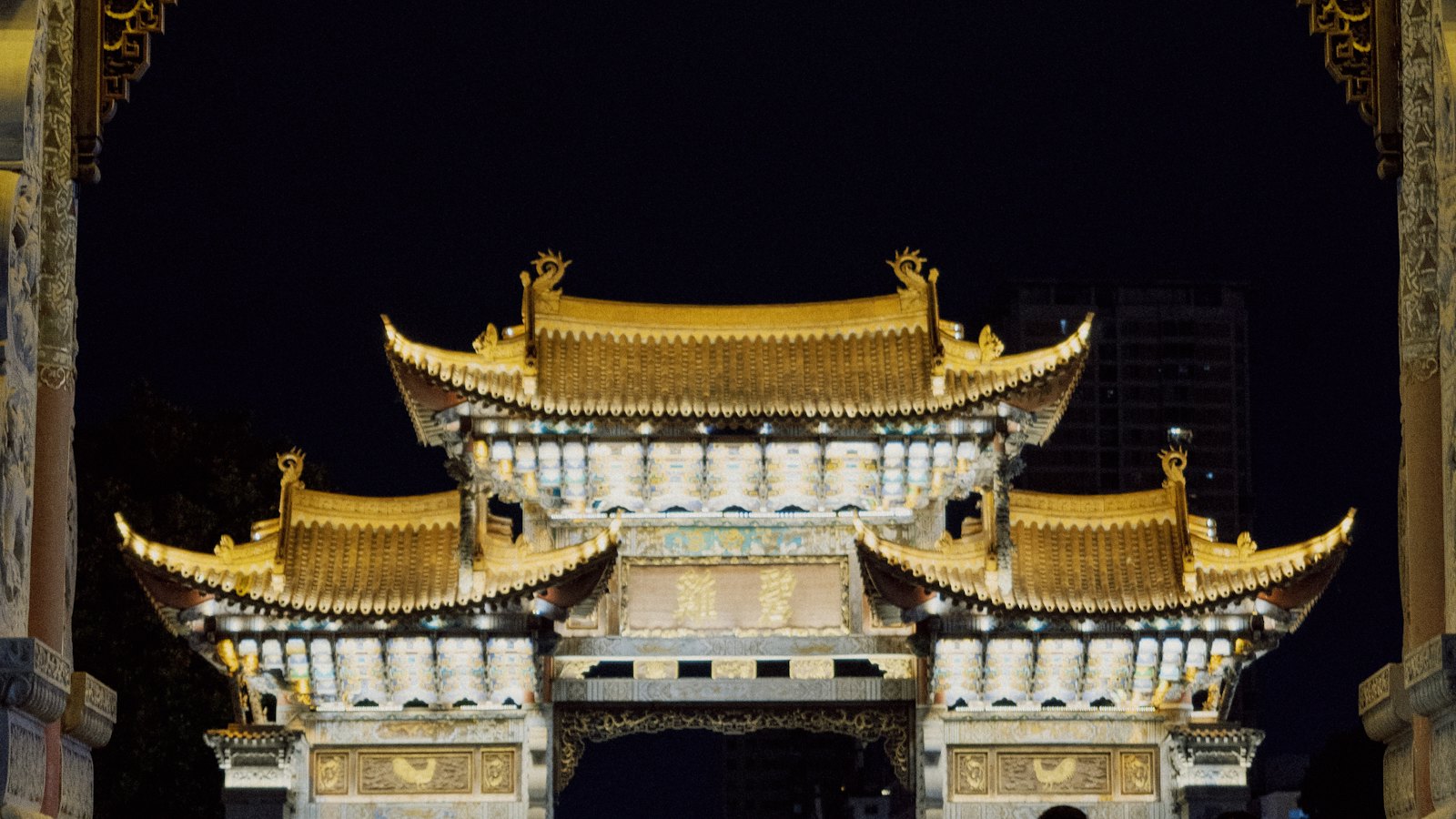
- Old centre after dark: the Jinma Biji arches and Nanping Pedestrian Street.
What to eat in Kunming
Yunnan cooking leans sour and spicy, built on rice noodles, wild herbs, edible flowers and mushrooms. Some classics use pork or lard, so check the halal section below.
- Crossing-the-bridge rice noodles (guoqiao mixian): scalding broth arrives with little plates of raw slices, greens and noodles that you tip in to cook at the table. The stock is usually chicken and often pork bones, so Muslims should order it at qingzhen shops.
- Beef rice noodles and Hui beef dishes: the everyday halal staple around Shuncheng Street, with pickles and chilli.
- Steam pot chicken (qiguo ji): chicken steamed slowly in a clay pot with a central funnel, giving a clear, herbal broth.
- Wild mushrooms: in the rainy months, roughly June to September, restaurants serve many foraged varieties, often as hotpot. Some are toxic if undercooked, so eat them only at established restaurants.
- Flower cakes (xianhua bing): flaky rose-petal pastries, the classic souvenir. Traditional dough contains lard, so Muslims should buy from qingzhen bakeries only.
- Erkuai and rushan: pressed rice cakes, and Bai-style cow's milk cheese, often grilled. Erkuai is commonly stir-fried with pork, so ask.
Everyday noodle shops are inexpensive, and usually far cheaper than the elaborate crossing-the-bridge sets at well-known restaurants.
Halal food, mosques and prayer spaces
Kunming is one of the easier Chinese cities for halal eating, thanks to its long-rooted Hui Muslim community.
- The sign: 清真 (qingzhen) on a shopfront marks a Muslim-run restaurant serving halal food. It is a declaration by the Muslim owners, not a JAKIM certificate, so judge by the owners and whether alcohol is sold. A no-pork sign is not the same thing.
- Shuncheng Street: the lanes beside the Shuncheng Street Mosque in Wuhua District hold the city's densest cluster of halal food, from beef noodles and lamb skewers to Hui pastries. The mosque dates from 1425 and houses the Kunming Islamic College.
- Nancheng Mosque: on Zhengyi Road, with separate prayer halls for men and women, wudu areas and a canteen serving beef noodle soup. It is a short walk from Wuyi Road Metro Station and handy for Friday prayers.
- Airport: reports of a dedicated prayer room at Changshui are inconsistent and halal food there is not well documented, so eat and pray in town before heading out, or carry a travel mat.
Muslim Pro or HalalTrip give prayer times and qibla. Google Maps is patchy in China, so save the mosques in Amap (Gaode) or Apple Maps beforehand.
Getting around Kunming
- Metro: six lines with distance-based fares of about 2 to 10 yuan (roughly RM 1.20 to RM 6). Buy single tickets at bilingual machines or scan an Alipay or WeChat transit code at the gate. Line 6 serves the airport, Line 3 crosses the old centre, and Lines 1 and 4 reach Kunming South Railway Station.
- Ride-hailing: Grab does not operate in China; its service covers eight Southeast Asian countries. Use DiDi, which has an English interface, signs you up with a Malaysian phone number and takes Visa or Mastercard, or open it as a mini program inside Alipay. It translates your destination for the driver.
- Taxis: metered, with a daytime flag fall of around 8 yuan and a slightly higher night rate. Show your destination in Chinese characters, as few drivers speak English.
- High-speed trains: fast trains to Shilin, Dali, Lijiang and Xishuangbanna leave from Kunming South or the central Kunming Railway Station, depending on the train, so check the station on your booking. Book on the official 12306 app or Trip.com with your passport details, and bring the passport to pass the gates.
Install DiDi, Alipay and a map app before leaving Malaysia.
Sample itinerary: 4 days in Kunming
Four days covers the city and the Stone Forest without rushing, which helps at about 1,900 metres, where some visitors feel breathless at first.
- Day 1: Take the early-afternoon AirAsia flight, which lands around 5pm, and ride Line 6 into town. Wander Nanping Pedestrian Street and the Jinma Biji arches, then eat dinner in the Shuncheng Street lanes.
- Day 2: Stone Forest. An early train from Kunming South to Shilin West and Bus 99 to the gate, the pillars until mid-afternoon, then back for a quiet night.
- Day 3: Western Hills and Dragon Gate in the morning, the Yunnan Ethnic Village across the water after lunch, and from November to March, gulls at Haigeng Dam as the sun sets.
- Day 4: Green Lake Park early, Friday prayers or a visit to the Nancheng Mosque, qingzhen flower cakes for the family, and the airport by metro or taxi.
A fifth day fits Zheng He Park in Jinning plus a stop at Dounan Flower Market, both in the south.
Money, SIM and practical tips
- Currency: the Chinese yuan (renminbi). RM 1 bought about 1.65 yuan in late September 2026, so 100 yuan is roughly RM 60.
- Paying: China runs on QR payments. Link a Visa or Mastercard to Alipay, and ideally WeChat Pay, before you fly. Touch 'n Go eWallet also pays Alipay merchants through Alipay+, drawing on your ringgit balance with a margin of roughly 1% built into the rate. DuitNow cross-border QR does not cover China. Carry some cash as a fallback.
- Data: many Western apps, including Google and WhatsApp, are blocked on mainland networks. A roaming eSIM set up before departure usually routes data outside the mainland, so those apps keep working, while a local SIM does not.
- Power: 220V. Sockets take flat two-pin (Type A) and angled three-pin (Type I) plugs, so pack an adapter for your Malaysian chargers.
- Tips: not customary.
- Altitude: the sun is strong at 1,900 metres even on cool days; wear sunscreen and drink water.
- Safety: generally safe. Mind pickpockets in crowds and refuse strangers who try to steer you into shops.
- Emergencies: 110 for police, 120 for ambulance.
Onward by train: Dali, Lijiang and Xishuangbanna
Many Malaysians turn Kunming into the first stop of a Yunnan loop, and the 30-day visa-free stay leaves room for it. Fast trains leave from Kunming South or the central Kunming Railway Station, depending on the service:
- Dali: roughly 2 hours on the faster trains, for Erhai Lake, the old town and Bai culture.
- Lijiang: roughly 3 to 4 hours direct, for the old town and Jade Dragon Snow Mountain.
- Xishuangbanna: about 3 hours south on the fastest China-Laos Railway trains, a warm, tropical contrast with Dai culture.
Tickets are released only a short time before travel and vanish around Chinese holidays, so book on 12306 or Trip.com once your dates are fixed. A well-paced week is two nights each in Kunming, Dali and Lijiang, returning to Kunming for the flight home. Every ticket is issued in a named passenger's identity, so keep your passport on you.
Before you go
- Best time to go
- The best months for Kunming are March and April and late October to November, when days are mostly dry, sunny and mild. The wet season lasts roughly May to October, bringing afternoon showers, green hills and wild mushrooms, but seldom real heat. Winter is dry and sunny, with January averaging around 9°C and chilly nights, so pack a warm jacket; it is also when the Siberian gulls crowd Green Lake. Skip the first week of October, when China celebrates National Day, and the Chinese New Year rush in early February 2027, when domestic tourists fill hotels and trains. Malaysia's year-end school break (4 December for Kedah, Kelantan and Terengganu, 5 December elsewhere, until 31 December 2026) lifts fares, so book cheap AirAsia seats early.
- Visa for Malaysians
- Malaysian ordinary passports get visa-free entry to China for up to 30 days each trip as of September 2026, under the bilateral waiver that took effect on 17 July 2025. Visa-free days must total no more than 90 in any 180-day period, and the waiver covers tourism, family visits, business and similar short trips, not work or study. Your passport needs six months' validity; carry a return ticket and hotel booking. Complete the arrival card online before departure on the National Immigration Administration site (s.nia.gov.cn) or NIA 12367 app, or at the airport. Hotels report foreign guests to the police for you, but if you stay with friends or in a rented flat, you or your host must register with the local police within 24 hours. Check my.china-embassy.gov.cn for the latest rules before flying.
- Honest budget guide
- Day-to-day costs in Kunming run about RM 180 to RM 450 per person, excluding flights, depending mainly on your hotel. Flights: at the time of writing, our scan of KL fares listed AirAsia non-stop seats from about RM 385 one-way and typical prices near RM 470, so two one-way tickets at those prices come to roughly RM 770 to RM 950. Simple hotels often cost roughly 150 to 250 yuan a night (about RM 90 to RM 150), and comfortable mid-range ones 250 to 500 yuan (RM 150 to RM 300). Allow RM 60 to RM 150 a day for food, RM 15 to RM 30 for local transport and about RM 120 to RM 160 for the Stone Forest trip. Five days and four nights, mid-range with a shared room, totals roughly RM 1,800 to RM 2,600 each including flights. All figures are indicative.
Frequently asked questions
Do Malaysians need a visa to visit Kunming?
No visa is needed for short trips. Under the waiver in force since 17 July 2025, and still valid in September 2026, Malaysians with six months left on an ordinary passport can stay up to 30 days per visit, capped at 90 days in any 180. Fill in the arrival card online or at the airport, and check the Chinese Embassy in Malaysia website for changes.
Is there a direct flight from KL to Kunming?
Yes. Published September 2026 schedules show AirAsia non-stop from KLIA Terminal 2, plus Batik Air Malaysia and China Eastern from KLIA Terminal 1. Expect about 3 hours 45 minutes in the air on the same clock as KL. Our fare scan priced AirAsia one-way tickets from about RM 385 at the time of writing.
Is Kunming Muslim-friendly?
More than most Chinese cities. Kunming's Hui Muslim community runs a dense cluster of qingzhen (halal) eateries around Shuncheng Street, and the old centre has several historic mosques, including Nancheng and Shuncheng Street. Most places are Muslim-run rather than formally certified, so look for the qingzhen sign, avoid pastries made with lard, and pray in town, as an airport prayer room is not reliably documented.
How many days in Kunming is enough?
Three or four days covers the old centre, Green Lake, the Western Hills and a Stone Forest day trip. A fifth day adds Zheng He Park and Dounan Flower Market. On a week-long holiday, keep two or three nights for Kunming and ride the fast train to Dali and Lijiang for the rest.
What is the best month to visit Kunming?
March, April, late October and November are the safest bets for mild, mostly dry days, and late October also misses the Golden Week crowds of early October. December to February is sunny but cold at night and is gull season on Green Lake. June to September is wetter and brings the wild mushroom season.
How much money for 5 days in Kunming?
Around RM 1,800 to RM 2,600 per person covers a mid-range trip with return flights, a shared hotel room, meals, the metro and a Stone Forest outing. Backpackers can spend less, while taxis everywhere and upscale hotels raise the total. Set up Alipay or Touch 'n Go eWallet and keep a little yuan in cash.
Can I use Grab in Kunming?
No. Grab runs only in eight Southeast Asian countries, and China is not among them. Download DiDi instead: it works in English, accepts a Malaysian phone number and takes Visa or Mastercard, or use its mini program inside Alipay. Metered taxis are plentiful and the metro is cheap.
How do I get from Kunming airport to the city late at night?
Metro Line 6 stops around 11pm, so flights landing after 1am need another option. At the time of writing, airport shuttle bus Line 2 runs to Kunming Railway Station until about 2am for around 25 yuan (RM 15). A taxi from the official rank or a DiDi costs roughly 60 to 100 yuan (RM 36 to RM 60) and takes 30 to 50 minutes.
Jom pergi
Ready to go Kunming? Compare available flights and hotels for your dates. Check baggage, cancellation terms and the final total on the booking provider before paying.






