




On this page13 sections
- Overview
- Flights from KL to Harbin
- Taiping Airport to the city
- Where to stay in Harbin
- Things to do in Harbin
- What to eat in Harbin
- Halal food and prayer spaces
- Getting around Harbin
- Sample itinerary: 4 days in winter Harbin
- Money, SIM and practical tips
- Dressing for minus 20°C: winter kit for Malaysians
- Before you go
- FAQ
Harbin, capital of China's northernmost province, began as a Russian railway town on the Songhua River. Now its winter nights sink below minus 20°C and whole palaces are carved from river ice. For Malaysians who have only seen snow in photos, it is the classic first-winter trip, timed around the Ice and Snow World that opens each December. Summer works too, with July averaging about 24°C. Below: flights, visa-free entry, halal meals, the old Daowai Mosque and costs in ringgit.
Flights from KL to Harbin
No airline links Kuala Lumpur and Harbin non-stop all year. Last winter Batik Air Malaysia added a seasonal once-a-week Airbus A330 from KLIA Terminal 1, from 22 December 2025 to 26 January 2026, leaving KL at 5.50pm and landing around 1am after a little over seven hours. A repeat for winter 2026/27 was unconfirmed at the time of writing, so check Batik Air's site before planning around it.
Until then, the practical way in is one change at a mainland Chinese hub. At the time of writing, the cheapest one-way seat in Amaboxly's KL fare scan was about RM 600 (Shandong Airlines via Jinan, departing 10 November), with Shenzhen Airlines via Shenzhen close behind at about RM 630. China Southern via Guangzhou and Hainan Airlines via Haikou sat near the median of the 17 fares, around RM 1,260 to RM 1,300, and none was non-stop.
- Terminal: Batik Air, China Southern and Shenzhen Airlines use KLIA Terminal 1, and Terminal 2 is mainly AirAsia, so expect Terminal 1 for Shandong and Hainan too. Check your booking.
- Time: layovers range from a short change to most of a day, so compare durations as well as prices.
- Entry point: you clear Chinese immigration at your first Chinese airport, then fly on domestically.
Taiping Airport to the city
Taiping International Airport (HRB) is roughly 35 km from the centre, with no metro link at the time of writing. Ringgit figures use about RM 0.61 per yuan and are indicative.
- Airport bus: four numbered lines run into town for about 20 yuan (around RM 12), taking 45 minutes to an hour. Buy tickets at the counter inside the terminal. Line 1 suits most visitors, stopping at Harbin Railway Station in Nangang and ending at the Civil Aviation building on Zhongshan Road. It is listed as meeting flights, while other lines stop by early evening, so confirm times at the counter.
- Taxi: about 100 to 130 yuan (RM 60 to RM 80) plus a toll of around 20 yuan, taking 45 minutes to an hour. Use the official rank, agree on the meter or an all-in price first, and ignore touts in the terminal.
- DiDi: available in Harbin, with an English interface and in-app message translation for telling the driver where you are.
- Hotel pickup: worth it for a post-midnight January landing.
Snow can slow the airport expressway, so leave a generous buffer on departure day.
Where to stay in Harbin
Most visitors stay south of the Songhua River, where the old town, stations and metro lines meet. January rates are far higher than summer ones, so book festival dates early.
- Daoli (Central Street): the easy first-timer base, within walking distance of St Sophia Cathedral, the riverbank and the Flood Control Monument, with cafes to duck into when your fingers go numb.
- Nangang: the commercial and university district around Harbin Railway Station, where airport bus Line 1 stops. Good for train day trips, with plenty of business hotels and malls.
- Daowai and Laodaowai: the older Chinese quarter east of Central Street. Muslim travellers who want to be near the Daowai Mosque and halal restaurants should look here first, though hotel choice is thinner.
- Songbei (north bank): near Ice and Snow World, Sun Island and the tiger park. Newer hotels, handy for late festival nights but quiet after dark.
Things to do in Harbin
Winter is the main draw, but the Russian-era streets work all year.
- Harbin Ice and Snow World: full-size castles cut from Songhua River ice and lit at night. Last season it opened on 17 December 2025, with adult tickets at 328 yuan (about RM 200); children under 1.2 m and over-65s entered free. Arrive around 3pm for daylight and night lights. It has its own Line 2 metro station.
- Sun Island: a snow sculpture expo in winter, green riverside parkland in summer, with a cable car across the river.
- Central Street: a 1.45 km cobbled pedestrian street, paved in 1925, lined with Baroque and Renaissance facades.
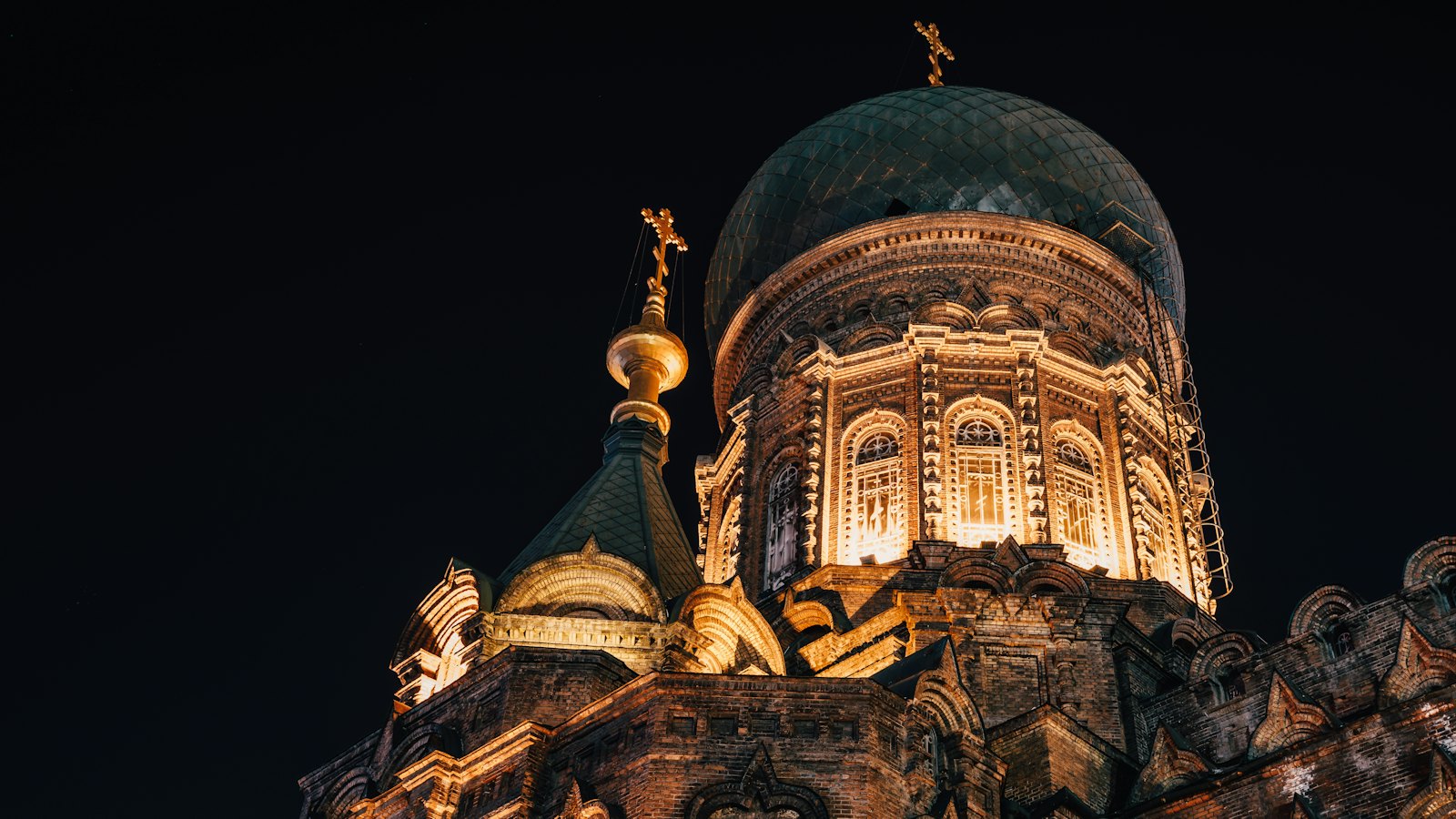
- St Sophia Cathedral: a former Orthodox church completed in 1932, now an architecture museum with an entry fee of around 15 to 20 yuan.
- The frozen Songhua: walk out onto the ice or take a horse or dog sledge ride in deep winter; ferries cross in summer.
- Zhaolin Park: ice lanterns in a tradition dating to 1963, calmer than Ice and Snow World.
- Siberian Tiger Park: next to Sun Island, with a caged bus ride past hundreds of tigers.
- Yabuli: China's largest ski resort and a 2025 Asian Winter Games venue, about 2.5 hours away by train, with skiing from November to March.
What to eat in Harbin
Harbin food is hearty northeastern cooking with a Russian streak. Many classics use pork, so Muslim readers should read the halal section first.
- Guobaorou: crisp battered slices in a sweet and sour glaze, often credited to Harbin. The standard version is pork.
- Dumplings: pork with cabbage or celery are common fillings; halal kitchens use beef or lamb.
- Red sausage (hongchang): Harbin's famous smoked sausage, usually pork and not halal.
- Dalieba: a huge round loaf introduced by Russian railway-era bakers, handy for the train.
- Stews: potato, cabbage, glass noodles and meat, often served in a big iron pot to share.
- Frozen pears and tanghulu: pears frozen black then thawed, and candied hawthorn skewers.
- Ice lollies: the century-old Modern (Madieer) shop on Central Street sells them all year, and eating one outdoors in January is a local ritual.
Central Street is easiest for Russian-style cafes and bakeries, while Laodaowai is packed with small snack bars. A snack-bar meal can cost under 30 yuan (about RM 18), and a sit-down meal roughly 30 to 100 yuan (RM 18 to RM 60) a person.
Halal food and prayer spaces
Harbin's Muslim community is small, so halal food exists but needs more planning than in Xi'an or Beijing.
- Qingzhen signs: places marked 清真 (qingzhen, often on a green sign) are pork-free Chinese Muslim kitchens, usually Hui-run. It is a local label, not a JAKIM certificate, and alcohol rules vary.
- Lao Ren Yi: an old, popular halal restaurant with several branches, listed among the Laodaowai eateries. Order the steamed dumplings.
- Noodle shops: Lanzhou-style beef noodle shops, normally Hui-run and marked qingzhen, are the most dependable quick meal.
- Attractions: do not assume stalls at the ice parks or on Central Street are halal; pack snacks.
The Daowai Mosque at 270 Shisidao Street is the largest in Heilongjiang, first built in 1897 and extended in 2003, with a prayer hall for about 600 people and timber halls mixing Islamic, Russian and Chinese styles. It is an active mosque; ask there about Friday prayer times and dress modestly.
We could not confirm a prayer room at Taiping Airport, so pray at your hotel or at the KLIA surau before leaving. Muslim Pro gives prayer times and qibla offline, and searching 清真 in Amap or Dianping lists nearby halal restaurants.
Getting around Harbin
Harbin is spread out, and winter kills any wish for long walks. Figures are indicative.
- Metro: three lines at the time of writing. Line 2 is the visitor line, crossing the river via Harbin Railway Station, Central Street, Sun Island and Ice and Snow World; Line 1 runs east to west and Line 3 is a loop. Most trips cost 2 to 6 yuan (about RM 1.20 to RM 3.70), and ticket machines work in English. Last trains can leave around 9pm, so check before a late night out.
- Taxis: about 8 yuan for the first 3 km, then around 1.9 yuan per km by day and 2.5 yuan at night, plus a 1 yuan fuel surcharge. Show your destination in Chinese, and expect few free cabs at rush hour or when the ice parks close.
- Ride-hailing: Grab does not operate in mainland China. DiDi does, with an English interface and in-app translation; set it up before you fly.
- Trains: Harbin West handles most high-speed services, while Harbin Railway Station is in the centre.
On foot, icy pavements are the real hazard, so wear boots with proper grip.
Sample itinerary: 4 days in winter Harbin
This plan assumes January, a hotel in Daoli or Nangang and a morning arrival.
- Day 1: Rest, then stroll Central Street in the afternoon, try an ice lolly and reach the Flood Control Monument and frozen river by dusk. End at St Sophia Cathedral once the square is lit.
- Day 2: Morning at the Siberian Tiger Park or the Sun Island snow sculptures. From about 3pm, Ice and Snow World until the lights peak, then Metro Line 2 back before the taxi scramble (check the last train time first).
- Day 3: A long day trip by train to Yabuli for skiing or a beginner lesson. Not keen on snow sports? Stay in town for sledging on the Songhua and the Zhaolin Park ice lanterns after dark.
- Day 4: Laodaowai's Chinese Baroque lanes, the Daowai Mosque and a halal lunch nearby, then the airport with a winter buffer.
Coming in July or August? Swap the ice sites for Sun Island parkland, river ferries and long evenings on Central Street.
Money, SIM and practical tips
- Currency: Chinese yuan (CNY). In late September 2026 one yuan was about RM 0.61, so 100 yuan is around RM 61.
- Paying: Harbin runs largely on QR codes, so set up Alipay or WeChat Pay with your Visa or Mastercard before leaving. Hotels and big stores take cards; carry some cash too.
- Touch 'n Go eWallet: pays at Alipay+ merchants on the mainland, but keep a backup. DuitNow QR does not cover China.
- Internet: Google services, WhatsApp and Instagram are blocked on Chinese networks. A roaming plan or travel eSIM bought before you fly generally gets round this but can fail, so save offline maps and bookings first.
- Power: 220V, mostly Type A and Type I sockets, so Malaysian three-pin plugs need an adapter.
- Tipping: not expected.
- Batteries: cold drains phones fast. Keep yours inside your jacket and carry a power bank.
- Scams: Harbin is generally safe. Watch for unlicensed drivers at the airport and stations quoting flat fares, and agree prices for photo props or rentals near the ice parks first.
Dressing for minus 20°C: winter kit for Malaysians
Harbin's cold is beyond anything most Malaysians have felt: January averages around minus 17°C and nights can drop past minus 30°C. Good layers matter more than one expensive coat.
- Base: thermal tops and long johns, two sets so one can dry overnight.
- Middle: fleece or wool, plus warm trousers over the thermals.
- Outer: a long, hooded, windproof down jacket. Wind off the river bites harder than the number suggests.
- Feet: insulated, waterproof snow boots with grippy soles and thick wool socks.
- Hands and head: touchscreen liner gloves under mittens, a beanie over the ears (it sits fine over a hijab) and a scarf you can pull over your nose.
- Skin: lip balm and heavy moisturiser for the very dry air.
Indoor heating is strong, so wear layers you can peel off in malls and on the metro. Take warm-up breaks and watch children for pale, numb cheeks or fingers, an early sign of frostbite. Buy and test boots and gloves in KL before flying.
Before you go
- Best time to go
- Go between late December and mid-February for ice sculptures and snow, or from July to September for mild, green weather. January averages about minus 17°C and cold snaps dip below minus 30°C. Ice and Snow World usually opens in mid to late December (17 December last season) and runs until the thaw, often into late February or March. Crowds peak over New Year's Day and around Chinese New Year on 6 February 2027, when domestic tourists fill hotels. The Malaysian school break at year end (5 to 31 December 2026 for most states) also lifts KL fares, so mid-January weekdays are the sweet spot. Summer averages about 24°C in July, but July and August bring more than half of the year's rain.
- Visa for Malaysians
- As of September 2026, Malaysians with an ordinary passport can enter China, Harbin included, for up to 30 days per visit with no visa. This comes from the China-Malaysia mutual visa exemption agreement in force since 17 July 2025, covering tourism, family visits, business, exchanges and medical treatment. The 30 days start from the day after arrival, and visa-free time cannot exceed 90 days in any 180. Anyone coming to work, study or report, or staying beyond 30 days, must get a visa first. China's embassy asks for at least six months of passport validity. Entry costs nothing, though visitors must complete an arrival card; from 20 November 2025 it can be done online through the National Immigration Administration website, its NIA 12367 app or an Alipay or WeChat mini program, or on paper at the airport. Confirm the latest rules on my.china-embassy.gov.cn before travelling.
- Honest budget guide
- Allow roughly RM 300 to RM 600 per person per day in winter, excluding flights, and somewhat less in summer. Flights: at the time of writing, one-way seats in our fare scan start at about RM 600 with one stop, with a median near RM 1,260. Hotels: budget rooms run roughly 150 to 300 yuan (RM 90 to RM 180) a night and mid-range about 350 to 700 yuan (RM 210 to RM 430), climbing sharply in January. Eating out costs around 100 to 200 yuan daily (RM 60 to RM 120), and metro rides plus the odd taxi add RM 15 to RM 50. Ice and Snow World alone was 328 yuan (about RM 200) last season. A five-day winter trip for one typically totals RM 3,000 to RM 5,500 with flights, before winter clothing. All figures are indicative.
Frequently asked questions
Do Malaysians need a visa for Harbin?
No. As of September 2026, Malaysian ordinary passport holders can stay in mainland China, Harbin included, for up to 30 days per entry without a visa, with no more than 90 days in any 180. You still need a free arrival card, filed online or on paper at the airport, and six months of passport validity. Check my.china-embassy.gov.cn before travelling.
Is there a direct flight from KL to Harbin?
Not year-round. Batik Air Malaysia ran a weekly seasonal non-stop from KLIA Terminal 1 between 22 December 2025 and 26 January 2026, just over seven hours each way, but a repeat for winter 2026/27 was unconfirmed at the time of writing. Otherwise connect via Jinan, Shenzhen, Guangzhou or Haikou, from about RM 600 one-way in our scan.
When is the Harbin Ice Festival?
The main ice sites open from mid to late December and stay open while the cold holds, usually through February and sometimes into March. Last season Ice and Snow World opened on 17 December 2025. January gives the most reliable ice and the full programme, but it is also the coldest month and Chinese New Year week is very crowded.
Is Harbin Muslim-friendly?
Manageable with planning. Halal choices are fewer than in Beijing or Xi'an, but qingzhen (Chinese Muslim) restaurants, Lanzhou-style beef noodle shops and the long-running Lao Ren Yi cover daily meals. The Daowai Mosque, first built in 1897, is Heilongjiang's largest and an active place of worship. Pack snacks for the ice parks.
How cold is Harbin in winter?
Very. January averages about minus 17°C and nights can fall below minus 30°C, with sharp wind along the river. You need thermal layers, a windproof down jacket, insulated snow boots with grip, thick gloves and a hat covering your ears. Indoor heating is strong, so wear layers you can take off.
How many days in Harbin is enough?
Three to four days suit most winter trips: one for Central Street, St Sophia and the river, one for Sun Island and Ice and Snow World, and one for Yabuli skiing or Laodaowai and Zhaolin Park. Add a day for a longer ski trip. In summer, two or three days in the city is plenty.
How much should I budget for 5 days in Harbin?
For one person in winter, budget roughly RM 3,000 to RM 5,500 in total, covering one-stop return flights, four nights in a budget or mid-range hotel, food, local transport and the main ice sites. January hotel rates and holiday fares push you towards the top of that range, and warm clothing is extra. Figures are indicative.
Can I use Grab in Harbin?
No, Grab does not operate in mainland China. Use DiDi, which has an English interface and in-app message translation; set it up before you fly. Taxis are scarce at rush hour and when the ice parks close, so the metro, at 2 to 6 yuan, is the easier way to Ice and Snow World.
Jom pergi
Ready to go Harbin? Compare available flights and hotels for your dates. Check baggage, cancellation terms and the final total on the booking provider before paying.






