




On this page13 sections
- Overview
- Getting there from KL: flights via the Gulf
- Václav Havel Airport to the city
- Where to stay in Prague
- Things to do in Prague
- What to eat: Czech classics and where to try them
- Halal food and prayer spaces in Prague
- Getting around Prague: tickets, trams and apps
- A 4-day Prague itinerary
- Money, SIM and practical tips
- Day trips: Kutná Hora, Český Krumlov and Karlovy Vary
- Before you go
- FAQ
Prague, the capital of Czechia, is a compact old city of spires, cobbled lanes and river views that you can cover on foot and by tram. Many Malaysians fall for it in December, when Christmas markets glow as school holidays start, though spring and early autumn are calmer. This guide gives KLIA travellers the essentials: one-stop routes and our fare scan, visa-free Schengen entry with the new biometric checks, the airport transfer, where Muslim travellers can eat and pray, and the cost in ringgit.
Getting there from KL: flights via the Gulf
Prague has no non-stop link with Kuala Lumpur right now (September 2026), so expect one connection. The simplest routings go through the Gulf, and every carrier below uses KLIA Terminal 1; AirAsia's Terminal 2 plays no part:
- Etihad via Abu Dhabi
- Air Arabia via Sharjah
- Qatar Airways via Doha, also sold on Malaysia Airlines partner fares
- Emirates via Dubai, or Turkish Airlines via Istanbul
Allow roughly 13 to 14 hours in the air plus the layover. Amaboxly's own KL scan (21 September 2026) put Etihad through Abu Dhabi cheapest at about RM 1,220 one-way, Air Arabia through Sharjah near RM 1,300, Doha routings from around RM 1,780 and Dubai or Istanbul from around RM 1,880. The median was about RM 1,320, and the cheapest date landed in late October. Fares shift daily.
Immigration happens at your first Schengen airport, which is Prague itself on Gulf routings. Prague runs six hours behind Malaysia until 25 October 2026 and seven hours behind after the clocks go back.
Václav Havel Airport to the city
Václav Havel Airport Prague (PRG) lies about 12 km west of the centre, and Gulf flights use Terminal 1. Prices are indicative, at roughly CZK 100 to RM 19.
- Trolleybus 59 plus metro: trolleybuses run every few minutes to Nádraží Veleslavín (about 15 minutes), where metro line A continues to Malostranská, Staroměstská and Můstek. A 90-minute ticket covers it all: CZK 46 in the PID Lítačka app or CZK 50 on paper (about RM 9). A big suitcase needs its own luggage ticket on single fares (CZK 23 in the app, CZK 25 on paper), while a 24-hour pass (CZK 140 in the app, about RM 27) includes one large bag.
- Bus 100: about 18 minutes to Zličín on metro line B.
- Airport Express (AE): a direct bus from Terminal 1 to Praha hlavní nádraží, the main station, in about 40 minutes, running 5.30am to 10pm every 20 to 30 minutes. Adults pay CZK 200 (about RM 38), children 6 to 15 pay CZK 100 and luggage is free. Regular transit tickets are not valid on it.
- Uber: the official airport taxi, booked in the app, at self-service kiosks or at staffed counters, with pick-up points in front of both arrival halls. Bolt and Liftago also work in Prague. Street taxi meters are capped at CZK 60 plus CZK 36 per km, which puts the Old Town at very roughly CZK 600 to CZK 800 (RM 115 to RM 150) depending on traffic; app prices vary with demand but show before you book.
- Night buses 907 and 910: about 45 minutes to the centre.
Where to stay in Prague
The historic core is compact and trams reach nearly everything, so pick an area for its feel.
- Old Town (Staré Město) and Josefov: minutes from Old Town Square and Charles Bridge. Best for a short first visit and families who want to walk everywhere, though rooms cost more and evenings are noisy.
- Lesser Town (Malá Strana): baroque lanes below the castle on the west bank. Quieter at night and romantic for couples, but cobbles and slopes are tough with big luggage.
- New Town around Wenceslas Square: the most practical base for Muslim travellers, with several halal-listed Turkish, Lebanese and Middle Eastern eateries on and around the square. Metro lines A, B and C all stop nearby (Můstek and Muzeum), and the Airport Express stop at the main station is a short walk away.
- Vinohrady and Žižkov (Praha 2 and 3): leafy residential streets, cafés, a big Christmas market on Náměstí Míru and better value. Good for longer stays, with the old town a short metro or tram ride away.
Things to do in Prague
The big sights are close together, and early mornings beat the tour groups.
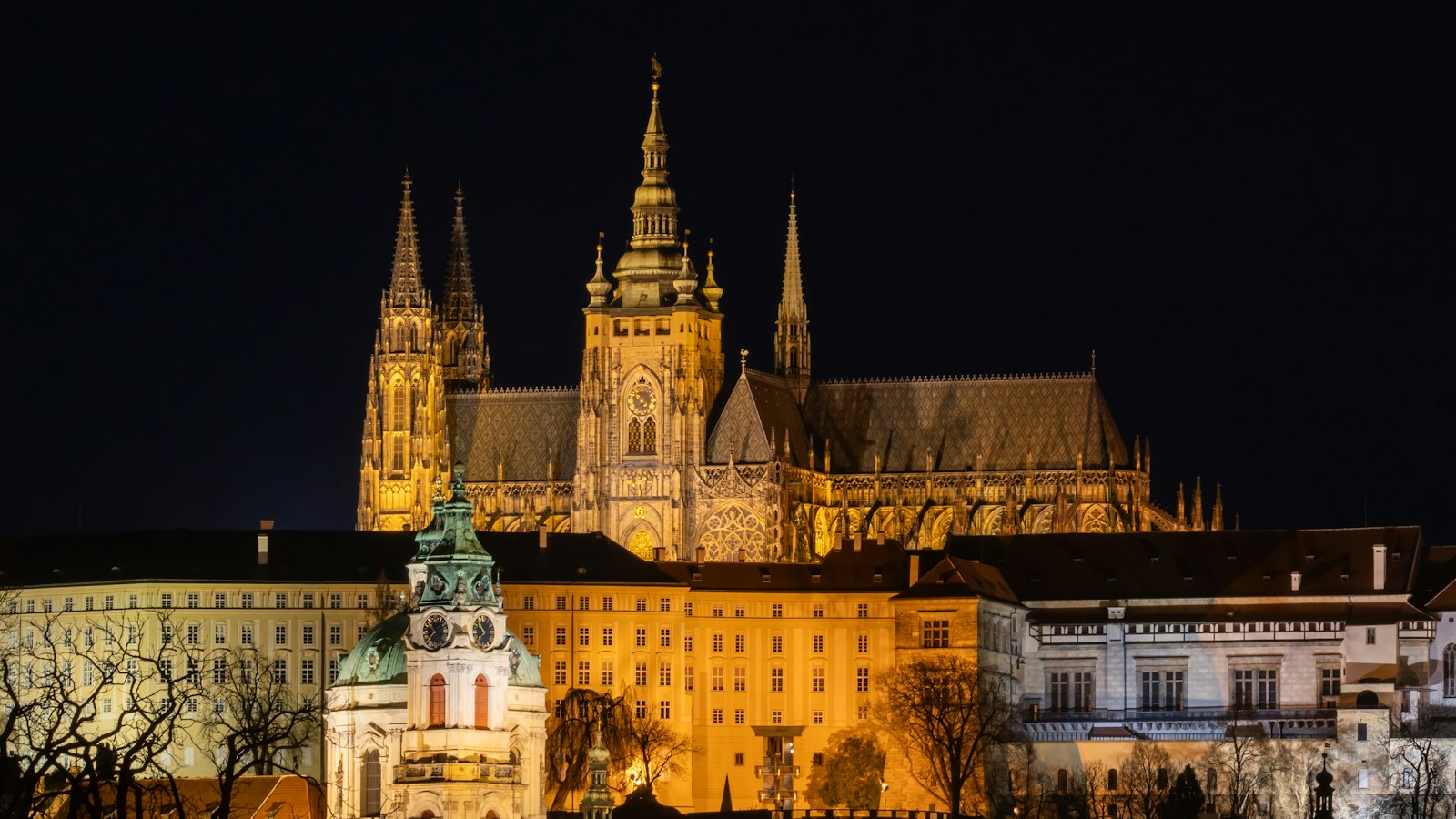
- Prague Castle: the world's largest castle complex and still the president's seat. Courtyards open 6am to 10pm; the CZK 450 basic ticket (about RM 86) covers St Vitus Cathedral, the Old Royal Palace, St George's Basilica and Golden Lane, valid for two days.
- Charles Bridge: go at sunrise to see the statues, including the bronze St John of Nepomuk, without the crush.
- Old Town Square: the Astronomical Clock's apostles parade hourly from 8am to 11pm, and the Old Town Hall tower has a lift to the top.
- Petřín Hill: the funicular reopened on 22 September 2026 with new cars after two years of repairs. 24- and 72-hour passes cover it (otherwise CZK 100 one way), and a lookout tower and mirror maze wait at the top.
- Vyšehrad: a clifftop fortress with free grounds, river views and casemates guarding original Charles Bridge statues.
- Josefov: the Jewish Quarter, home to one of Europe's best-preserved Jewish cemeteries.
- Náplavka Farmers' Market: over 90 riverside stalls, Saturdays 8am to 2pm.
- Christmas markets: Wenceslas Square runs 28 November 2026 to 6 January 2027, alongside Old Town Square and Náměstí Míru.
- Signal Festival: light art projected onto buildings, 15 to 18 October 2026.
What to eat: Czech classics and where to try them
Czech food is built for cold weather: meat, gravy and sliced bread dumplings called knedlíky.
- Svíčková na smetaně: marinated beef in a creamy vegetable sauce with dumplings, cranberries and whipped cream.
- Guláš: a thick stew of beef, pork or game with onions and paprika, eaten with dumplings or bread.
- Vepřo knedlo zelo: roast pork, dumplings and sauerkraut, the national plate.
- Smažený sýr: breaded fried cheese with potatoes and tartar sauce, the meat-free pub staple.
- Bramboráky: crisp potato pancakes with marjoram and garlic.
- Kulajda: a South Bohemian cream soup of mushrooms, potatoes, dill and egg.
- Koláče: yeast pastries topped with fruit, poppy seed or sweet cottage cheese.
- Trdelník: the rolled spit cake sold all over the old town. It is really a Slovak and Moravian treat that spread through Prague's tourist streets only this century.
Old-style pubs serve the classics at lunch and bakeries do breakfast. Manifesto Market Anděl in Praha 5 gathers 14 kitchens under one roof, open daily 11am to 10pm and fully cashless. Christmas market stalls lean heavily on ham, sausages and mulled wine, so read the halal notes below before ordering.
Halal food and prayer spaces in Prague
Only a small Muslim community lives in Czechia, and halal-certified restaurants are scarce, so expect Muslim-owned kitchens whose owners say the meat is halal rather than JAKIM-style certificates. Zabihah's Prague listings are led by Turkish kebab and grill houses, followed by Middle Eastern, Indian, Lebanese and Pakistani places, many of them in Praha 1 (Old Town and New Town) with more in Praha 2 and 3. Some may also serve alcohol, so ask.
Czech restaurants are harder: pork is the default, beef will not be halal-slaughtered, and soups or sauces may hide bacon, lard or wine. Fish, vegetarian dishes and fried cheese are safer picks.
- Prague Mosque: in the Černý Most district (Praha 14), the area served by the eastern end of metro line B. Completed in 1999, it also hosts the head office of the Czech Muslim communities. Confirm the address and Friday prayer times before going.
- Central prayer room: the Islamic Foundation in Prague has run a prayer room with a cultural centre in the city centre since 2003. Check its current address and hours locally before relying on it for Zuhur and Asr.
- Airport: quiet rooms with chairs, open 24 hours, airside in Terminal 1 near the Runway Restaurant and in Terminal 2 on the third floor of Pier D (stairs between gates D4 and D5). No mats or ablution areas are listed, so carry a travel mat.
Zabihah helps with food; Muslim Pro handles prayer times and qibla. December sunsets come around 4pm, squeezing Zuhur, Asr and Maghrib together, while in June Isyak is very late.
Getting around Prague: tickets, trams and apps
Metro, trams, buses and ferries share one time-based PID ticket; the Petřín funicular is included only on 24- and 72-hour passes. Current 2026 fares:
- 30 minutes: CZK 36 in the app, CZK 39 paper (about RM 7)
- 90 minutes: CZK 46 app, CZK 50 paper (about RM 9)
- 24 hours: CZK 140 app, CZK 150 paper (RM 27 to RM 29)
- 72 hours: CZK 340 app, CZK 350 paper (about RM 65)
There are no gates, only spot checks. Stamp a paper ticket once when you first board or enter the metro, or it is invalid. App tickets become valid a minute after you activate them, tickets from on-board touchscreen terminals are valid from purchase, and touchscreen machines take contactless cards. Children under 15 and seniors over 65 ride free with a passport as proof of age, and those aged 60 to 65 pay half.
The metro has three lines (A, B and C), with trams filling the gaps and climbing to the castle. The Prague Visitor Pass (48, 72 or 120 hours) bundles unlimited transit, including the airport run, with free or discounted entry to more than 70 attractions and experiences.
Grab is not available in Czechia. Uber, Bolt and Liftago are, and app bookings show the price before you confirm, which avoids meter arguments. Meters are capped at CZK 60 to start, CZK 36 per km and CZK 7 per waiting minute.
A 4-day Prague itinerary
A first-timer plan with one day out of town; shuffle it to catch the Saturday market.
- Day 1: Trolleybus 59 and metro A into town, then Old Town Square for the clock on the hour. Walk Josefov, cross Charles Bridge at dusk and eat near Wenceslas Square.
- Day 2: Charles Bridge at sunrise, up through Malá Strana to Prague Castle for St Vitus and Golden Lane. In the afternoon, take the new Petřín funicular to the lookout tower for sunset.
- Day 3: Train to Kutná Hora for the Sedlec Ossuary and St Barbara's Church, back by evening. On a Saturday, fit in Náplavka market first.
- Day 4: Morning on the Vyšehrad ramparts, a riverside walk past the Dancing House, lunch at Manifesto Market Anděl or a Praha 1 kebab house, then the airport. Leave spare time, because the EU border system also registers your exit.
With five or six days, add Český Krumlov or Karlovy Vary and a slow afternoon in Vinohrady.
Money, SIM and practical tips
- Currency: Czechia is in the EU but pays in koruna (CZK), not euro. RM 1 buys roughly CZK 5.25 as of late September 2026, so CZK 100 is about RM 19.
- Paying: cards work almost everywhere and some food halls take no cash, but keep a few coins for small stalls. When a terminal or cash machine asks which currency to bill, pick koruna, not ringgit.
- Exchange offices: licensed ones cannot charge commission except on coins and cheques, and you may cancel an exchange within three hours for sums up to the equivalent of EUR 1,000. Keep the receipt and never deal with street changers, who fall outside these rules.
- Data: a Europe-wide eSIM set up before departure is simplest and still works if you add Vienna or Budapest.
- Plugs: Czech sockets are types C and E (230 V); Malaysian type G plugs will not fit without an adapter.
- Tipping: locals usually round the bill up by a few koruna, and around 10 percent is normal for good service in tourist restaurants. It is not usually added to the bill.
- Local rules: public drinking is banned in the centre, quiet hours begin at 10pm, and street-sold tours are illegal, so book licensed guides.
- Safety: generally safe, but pickpockets target crowds at the clock, the bridge and Christmas markets. Emergency number: 112.
Day trips: Kutná Hora, Český Krumlov and Karlovy Vary
Three UNESCO-listed towns make easy escapes.
- Kutná Hora: about 52 km east, roughly an hour by train from the main station, with departures about hourly. A former silver-mining and minting town, famous for the Sedlec Ossuary, a chapel decorated with human bones that draws over 200,000 visitors a year, and the Gothic Church of St Barbara.
- Český Krumlov: 134 km south, around three hours by coach. A castle and a Gothic, Renaissance and Baroque old town wrapped in a bend of the Vltava, the postcard view many travellers picture when they think of Czechia. An overnight stay beats the tour-bus crowds.
- Karlovy Vary: 106 km west, roughly two hours by coach. A grand spa town, part of the Great Spa Towns of Europe listing, known for its colonnades and mineral springs, 16 of them meant for drinking, which visitors sample as they stroll.
Before you go
- Best time to go
- May, June and September are the most comfortable months for Prague, with daytime highs of roughly 20°C to 24°C and long light evenings. July and August are warmest (highs around 26°C) and busiest, and early summer brings the most rain. December is the Malaysian favourite: Christmas markets open in late November, and school's out in Malaysia from 5 December 2026 until the 31st (Kedah, Kelantan and Terengganu break on the 4th). Expect highs near 5°C, occasional snow and the year's highest room rates, so book early. January is cold but usually among the cheapest months, and Signal Festival lights the streets from 15 to 18 October 2026.
- Visa for Malaysians
- Malaysians need no visa for Czechia as of September 2026: you may stay 90 days per 180-day window, and that allowance is shared by every Schengen country. Your passport must remain valid for three months beyond your departure from Schengen and have been issued within the previous 10 years. There is no fee, e-visa or arrival card. The EU's Entry/Exit System (EES), fully live since 10 April 2026, has replaced passport stamps: expect to give fingerprints and a face photo the first time you arrive, and budget time for the queue. ETIAS, the planned EUR 20 online authorisation, is not running yet, and the EU says it will announce the start date several months ahead. Carry your return ticket, bookings and proof of funds, and buy travel insurance. Check the Czech Embassy Kuala Lumpur pages on mzv.gov.cz for the latest before flying.
- Honest budget guide
- Day-to-day spending in Prague runs about RM 300 to RM 650 a head, assuming a shared room and leaving out airfare. Flights: Etihad through Abu Dhabi tops our fare scan at about RM 1,220 one-way at the time of writing, with most options near RM 1,300, so budgeting the same again for the way home gives roughly RM 2,450 to RM 2,700 in airfare. Rooms: booking-site averages are around USD 108 (RM 440) for a 3-star and USD 153 (RM 625) for a 4-star, with hostels and simple guesthouses cheaper; December is dearest. Food: RM 100 to RM 200 a day; a casual meal is about CZK 250 (RM 48). Transport: CZK 340 (RM 65) for a 72-hour pass. Five days and four nights at mid-range comfort, room shared, lands around RM 4,300 to RM 5,800 each, airfare included. Treat all of these numbers as indicative.
Frequently asked questions
Do Malaysians need a visa for Prague?
No. As of September 2026 Malaysians enter Czechia visa-free for up to 90 days within any 180, counted across Schengen. Bring a passport valid three months past departure and issued within the last 10 years. Fingerprints and a photo are taken under the EU Entry/Exit System, and ETIAS is not yet required.
Is there a direct flight from KL to Prague?
No, not at the time of writing. Connect once through the Gulf from KLIA Terminal 1 with Etihad, Air Arabia, Qatar Airways or Emirates, or via Istanbul on Turkish Airlines. Etihad's one-way fare of about RM 1,220 was the lowest in our scan.
Is Prague Muslim-friendly?
Reasonably, with some planning. Certified halal restaurants are rare, but you will find a fair number of halal-listed Turkish, Middle Eastern and South Asian eateries in Praha 1 to 3. There is a mosque at Černý Most, an Islamic Foundation prayer room in the centre and quiet rooms at the airport. Czech menus are pork-heavy, so ask.
How many days in Prague is enough?
Three full days cover the castle, Charles Bridge, the Old Town, Josefov and Petřín at an easy pace. Four days adds Kutná Hora, and five or six leave time for Český Krumlov or Karlovy Vary, or a hop to Vienna or Budapest.
What is the best month to visit Prague?
May, June and September bring mild days of about 20°C to 24°C. December wins for Christmas markets and matches Malaysian school holidays, but it is cold and the priciest month for rooms. January is usually among the cheapest months if you can handle near-freezing weather.
What does a 5-day Prague trip cost?
Budget about RM 4,300 to RM 5,800 each for a mid-range stay of five days and four nights in a shared room. That includes airfare of roughly RM 2,450 to RM 2,700 for two one-way tickets (our scan's outbound fare, doubled), plus RM 300 to RM 650 a day in the city. Indicative only.
Can I use Grab in Prague?
No, Grab does not run in Czechia. Uber, Bolt and Liftago do, and Uber is the official airport taxi. Apps show the fare before you confirm. For most sightseeing, a 24- or 72-hour transit pass is cheaper than any car.
Do I need euros in Prague?
No. Czechia uses the koruna (CZK), about CZK 5.25 to RM 1 at the time of writing. Cards are accepted almost everywhere, so carry only a little cash, change it at licensed offices and keep the receipt.
Jom pergi
Ready to go Prague? Compare available flights and hotels for your dates. Check baggage, cancellation terms and the final total on the booking provider before paying.






