




On this page12 sections
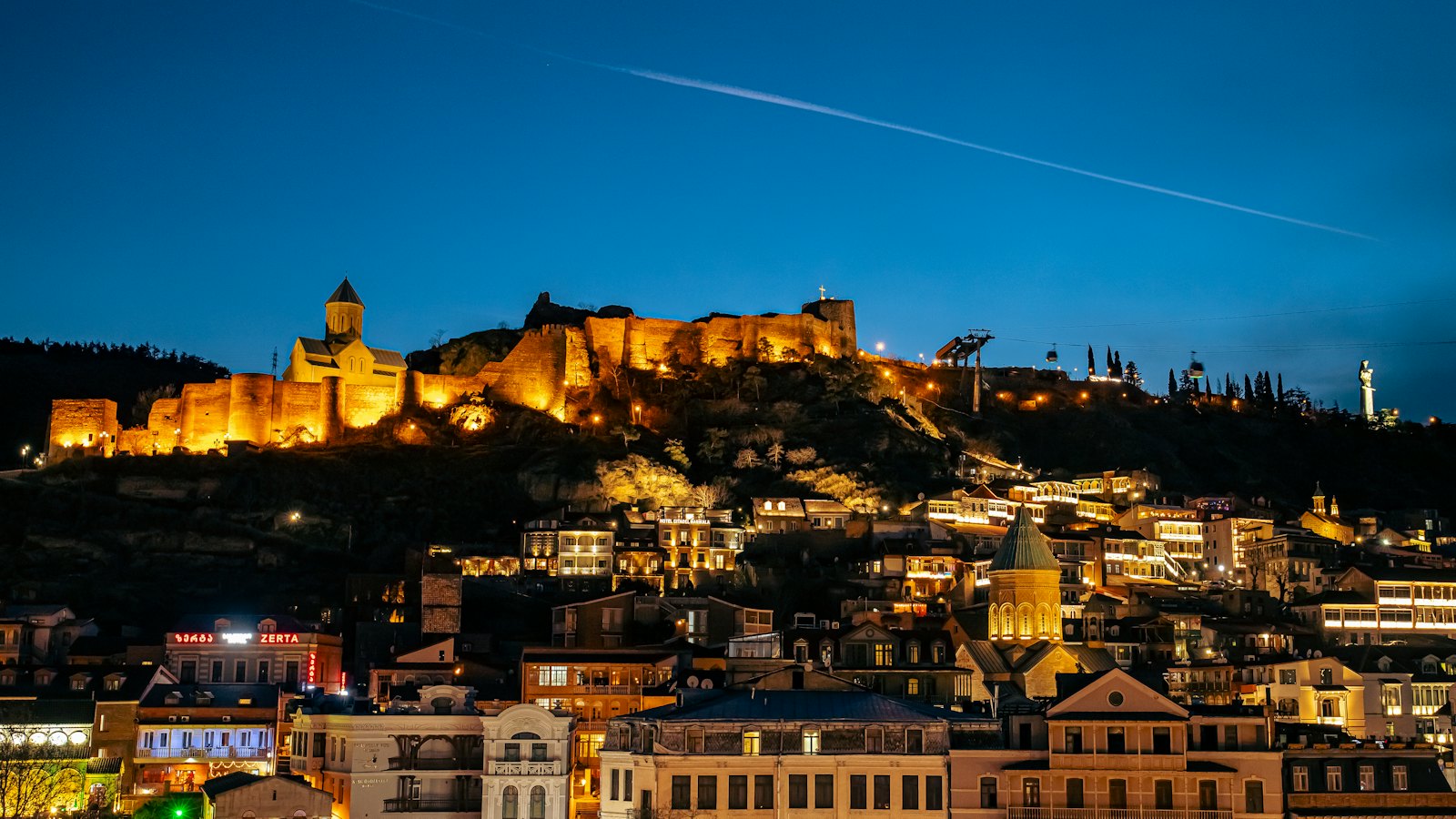
Tbilisi suits travellers who like discovering a city on foot. Along the Mtkvari River, its sloping old quarter brings together carved balconies, churches, sulphur baths and intimate wine cellars. Malaysians will find visa-free entry, four distinct seasons and generally good value compared with many European destinations, although finding halal meals takes preparation. This guide covers flights from KLIA, airport transfers, neighbourhoods, Muslim-friendly dining and a three-day route through the city. It also explains everyday details such as metro payments, Bolt prices, Georgian currency, winter conditions and the power adaptor required.
Getting there from Kuala Lumpur
No nonstop service between Kuala Lumpur International Airport and Tbilisi appears in schedules checked in September 2026. Travellers must change aircraft at least once, with Sharjah, Doha, Dubai, Istanbul and Abu Dhabi among the usual transit points. Air Arabia routes passengers through Sharjah, while journeys involving Emirates and flydubai commonly connect in Dubai. Faster combinations take about 11 to 16 hours from departure to arrival. Less convenient connections may increase the full journey to more than 20 hours.
A fare check completed by Amaboxly on 21 September 2026 found a lowest one-way price of RM 1,356 for an Air Arabia departure on 24 November 2026, including a change in Sharjah. Across the results examined, the median one-way price was RM 1,372. Sample alternatives started near RM 1,602 through Doha, RM 1,877 through Dubai and RM 1,908 through Istanbul. Those amounts are dated examples rather than guaranteed offers. Compare the total travel duration, luggage entitlement and conditions for missed connections before purchasing.
Confirm which KLIA terminal your booking departs from when you reserve, since budget and full-service carriers do not always use the same terminal, and terminal arrangements can change, particularly when separate carriers operate different legs. Check the terminal again on departure day. Reaching KLIA at least three hours before the scheduled flight provides a sensible margin.
From Tbilisi Airport to central districts
Tbilisi International Airport lies approximately 17 km southeast of the central area. A car normally needs 25 to 40 minutes when roads are clear, although weekday traffic can extend the trip. For simple budgeting, 1 Georgian lari, shown as GEL, is roughly RM 1.50 to RM 1.60. The actual conversion rate will fluctuate.
- Municipal bus: This is normally the least expensive useful option. It travels towards central Tbilisi and serves stops with access to the metro. Budget about 1 GEL to 2 GEL, or RM 1.50 to RM 3, and allow approximately 45 to 60 minutes. Confirm the route number and service hours after landing.
- Airport train: Trains cover the route in roughly 40 minutes and tickets usually cost only a few lari. Departures are infrequent, so rely on the train only when its timetable matches your arrival.
- Ride-hailing: Bolt is widely available. Trips to central neighbourhoods generally fall between 25 GEL and 45 GEL, about RM 39 to RM 70, subject to traffic and demand. Follow the application's directions to the designated meeting point.
- Official taxi: Vehicles wait outside arrivals. Establish the metered or quoted charge before departure because unsolicited drivers may demand much more. An indicative central fare is 40 GEL to 70 GEL, around RM 62 to RM 109.
Choosing where to stay
Tbilisi's slopes make the precise location of a hotel more important than its straight-line distance from an attraction. Two addresses that look close together may be separated by steep alleys, stairways or an awkward river crossing.
- Old Tbilisi and Abanotubani: Choose this area for historic balconies, the bath district, Narikala scenery and evening walks beside the river. The busiest lanes may be noisy, costly and difficult with heavy bags.
- Liberty Square and Rustaveli: This central corridor provides metro stations, museums, shopping and a straightforward walk into the old quarter. It works well for visitors who prioritise convenient connections.
- Marjanishvili: This relatively level and lively district often delivers better accommodation value. It is also useful for families and Muslim visitors because Turkish, Middle Eastern and Central Asian restaurants are easier to find nearby.
- Vera: Stay here for cafes and a more residential atmosphere within reach of Rustaveli. Review the property's exact position because several streets have demanding climbs.
Guesthouse rooms often start at RM 80 to RM 150, while comfortable mid-range accommodation typically costs RM 180 to RM 350. Before booking, read recent comments about heating, street noise, lifts and stair access, especially for winter travel or large suitcases.
Essential sights and experiences
Most central highlights can be covered across two active days, but an additional day creates room for museums, bathing and unhurried meals.
- Explore Old Tbilisi: Wander through irregular lanes, internal courtyards, churches and rows of restored timber balconies on both banks of the river.
- See Abanotubani: The brick domes identify natural sulphur baths associated with the story of Tbilisi's foundation. Visitors wanting privacy should reserve an individual room.
- Climb to Narikala Fortress: The hillside reveals wide views of the river, tiled roofs and newer districts. Rain can make the rough paths slippery.
- Visit the Mother of Georgia: This elevated statue symbolises both welcome and defence in Georgian culture.
- Cross the Bridge of Peace: The contemporary footbridge connects the historic quarter to Rike Park and becomes particularly striking when illuminated.
- Enter the Georgian National Museum: Its exhibits introduce Georgia's archaeology, art and turbulent twentieth-century experience.
- Follow Rustaveli Avenue: Important theatres, museums, shops and cafes occupy the city's principal boulevard.
- Browse Dry Bridge market: Vendors sell paintings, domestic objects, souvenirs and Soviet-period pieces. Ask about export rules before buying anything that may qualify as an antique.
- Ascend Mtatsminda: The hill offers cooler air in summer and another expansive perspective over Tbilisi.
- See the Chronicle of Georgia: These monumental columns stand above Tbilisi Reservoir and are most conveniently reached by taxi or Bolt.
What to eat in Tbilisi
Georgian meals are filling, rich in bread and well suited to sharing. Meat appears frequently, but it cannot be regarded as halal unless the establishment clearly confirms its source and preparation.
Khachapuri is cheese-filled bread made in several regional forms. The Adjarian style resembles a boat and is finished with butter and egg, while flatter varieties are simple to divide among a group. Khinkali are pleated dumplings containing broth, traditionally with meat, though restaurants may offer mushroom, cheese or potato fillings. Lobio combines seasoned beans and is often accompanied by mchadi corn bread. Badrijani nigvzit consists of aubergine with walnut paste, and pkhali describes colourful vegetable and walnut spreads. For something sweet, try churchkhela, a chewy market snack made from concentrated grape juice and nuts.
Restaurants in the historic centre make traditional food convenient, although menus aimed at tourists may charge more. Bakeries and informal places beyond Liberty Square, including those around Marjanishvili, frequently offer stronger value. When choosing baked goods, ask whether they contain pork, lard, meat broth or alcohol. Vegetarian choices reduce some concerns, but preparation on shared grills or surfaces is still possible. Residents commonly drink the tap water, while inexpensive bottled water is readily available for sensitive stomachs.
Halal dining and places to pray
Muslim visitors can travel comfortably in Tbilisi with some advance checking. Formal halal certification remains uneven, and Georgian meat must not be treated as permissible without confirmation. Turkish, Azerbaijani, Iranian and Middle Eastern restaurants provide the most likely options. Several operate near Marjanishvili, with others located around the old quarter and bath district. Ask whether every meat item is halal, whether sauces include alcohol and whether pork shares the same grill. A no-pork notice alone does not establish halal preparation.
Tbilisi Central Mosque, also known as the Jumah Mosque, is near Abanotubani and is the principal Muslim place of worship in the city. Its position allows prayer to fit naturally into a day exploring Old Tbilisi. Purpose-built prayer rooms are uncommon in Georgian shopping centres. Carrying a small prayer mat is therefore useful, while Muslim Pro or HalalTrip can assist with prayer times and qibla direction. Check recent business information before travelling across town because restaurants may close or change owners.
After arriving at the airport, ask its information counter whether a quiet room or prayer space is currently available and where it is located. Travellers landing late may also want to bring packaged food from Malaysia, subject to Georgian customs restrictions.
Moving around the city
For longer journeys through central Tbilisi, the metro is usually faster than road transport. Buses connect neighbourhoods that the rail network does not reach. Public transport is inexpensive, with a ride or integrated travel period commonly priced near 1 GEL, about RM 1.50 to RM 1.60. Payment arrangements sometimes change, but local transport cards and contactless bank cards are widely accepted. Read the information beside the validator and keep using the same payment method when a transfer benefit applies.
The two metro lines include useful stations at Liberty Square, Rustaveli, Marjanishvili and Station Square. Visitors generally find the signs and announcements understandable, although some entrances have limited lift access. Buses extend coverage effectively, but congestion can make arrival times unreliable.
Grab is unavailable in Tbilisi. Bolt provides the closest familiar alternative for Malaysian travellers and is particularly helpful after dark, on steep streets or when visiting places beyond the metro. A short central journey often costs 6 GEL to 15 GEL, approximately RM 9 to RM 23. Rain and busy periods may produce higher prices. With a street taxi, request use of the meter or settle the charge before entering.
Walking reveals much of the city's character, but old pavements are uneven and drivers can be assertive at crossings. Shoes with reliable grip are advisable around Narikala and the hillier lanes.
Three days in Tbilisi
- Day 1: Start from Liberty Square and continue on foot into Old Tbilisi. Explore the streets near Sioni Cathedral, cross the Bridge of Peace and pass through Rike Park. Proceed to Abanotubani, identify Tbilisi Central Mosque and finish at Narikala Fortress or the Mother of Georgia. An evening reservation for a private sulphur bath offers a restful conclusion.
- Day 2: Visit the Georgian National Museum in the morning, then follow Rustaveli Avenue towards Vera for lunch. Return through the central neighbourhoods without rushing and browse the Dry Bridge market later in the afternoon. Remain near the river as the lights appear, but avoid buying large or old objects until their export status is clear.
- Day 3: Take Bolt to the Chronicle of Georgia while daylight is good. Return to Marjanishvili for lunch and explore its surrounding streets. During the afternoon, ride the funicular towards Mtatsminda for elevated city views. Keep dinner flexible for Turkish halal cooking, Georgian vegetable plates or final souvenir shopping.
With a fourth day, consider an organised visit to Mtskheta, Georgia's former capital of major historic importance. A longer mountain excursion is another possibility, although the choice should depend on the forecast and current road conditions.
Money, connectivity and practical advice
The national currency is the Georgian lari, abbreviated GEL. Using 1 GEL as roughly RM 1.50 to RM 1.60 is adequate for advance estimates, but consult a current rate before exchanging or withdrawing cash. Central supermarkets, hotels and restaurants generally take cards. Notes and coins remain helpful at markets, small bakeries and stops outside the city. Prefer ATMs operated by recognised banks, reject unnecessary dynamic currency conversion and carry some smaller denominations. DuitNow QR is not routinely accepted in Georgia.
Prepaid local SIM cards can be purchased in Tbilisi and may also be offered at the airport. Activating an eSIM before departure makes it possible to request Bolt immediately after landing. Travellers needing substantial data may find a Georgian package better value. Save offline maps and download a Georgian language pack before the flight.
Electricity is supplied at 220V through European Type C and Type F sockets, meaning Malaysian plugs require an adaptor. Tipping is flexible rather than compulsory. If a bill does not include service, rounding up or adding about 5 to 10 percent is appreciated for attentive table service.
Normal precautions are sufficient in the central sightseeing districts. Be alert to exaggerated taxi prices, weak exchange rates at unofficial counters and pickpocketing in crowded spaces. Never assume traffic will yield at every pedestrian crossing. During winter, frozen surfaces on steep roads often present a greater practical concern than crime.
Before you go
- Best time to go
- Late spring and early autumn offer the most comfortable conditions. May, June, September and early October combine pleasant walking temperatures with crowds that are usually manageable. Spring turns the surrounding hills greener but can bring showers. Early autumn is commonly mild and carries the atmosphere of the broader food and grape harvest season. July and August may feel hot in central streets, even when evenings become cooler. Winter brings low temperatures, occasional snow and ice on sloping roads, though rooms can cost less outside festive dates. Malaysian school breaks may increase airfare prices, especially in late May, June and December, regardless of local visitor levels. September is particularly attractive, but central accommodation should be secured early for event weekends.
- Visa for Malaysians
- Malaysian tourists qualify for visa-free entry to Georgia. As of September 2026, Malaysian passport holders can stay in Georgia for up to one year without a visa. This visa-free entry does not require an e-visa, payment or online arrival form. Georgia's e-visa portal is for nationalities that need a visa in advance, so Malaysians do not need to use it. Bring a passport valid for the journey, evidence of accommodation, onward or return travel and proof of adequate funds in case an immigration officer asks.
- Honest budget guide
- A comfortable, value-conscious daily allowance is RM 180 to RM 350 per person, excluding international airfare. A basic room often costs RM 80 to RM 150 nightly, while a mid-range property is usually RM 180 to RM 350. Set aside approximately RM 60 to RM 120 each day for meals and RM 15 to RM 45 for buses, metro travel and occasional Bolt rides. Amaboxly's 21 September 2026 search recorded one-way Kuala Lumpur fares from RM 1,356 with Air Arabia through Sharjah and a median of RM 1,372. For five days, one person sharing accommodation can estimate RM 3,100 to RM 5,000, including return flights, food, local travel and modest attractions. Season, luggage, hotel standard, activities and currency movements will affect the final amount.
Frequently asked questions
Do Malaysians need a visa for Georgia?
Malaysian passport holders visiting for tourism do not need a Georgian visa. As of September 2026, they can stay for up to one year without a visa, with no e-visa or online arrival form required. Bring a valid passport and supporting travel documents such as accommodation and onward travel proof when you fly.
Is there a direct flight from Kuala Lumpur to Tbilisi?
No nonstop KLIA to Tbilisi flight was shown in schedules checked in September 2026. Available trips require a connection, often in Sharjah, Doha, Dubai, Istanbul or Abu Dhabi. Amaboxly found a one-way Air Arabia option from RM 1,356 through Sharjah. Review connection duration, terminal details and through-checked baggage before buying.
Is Tbilisi Muslim-friendly?
The city has a central mosque and restaurants serving Turkish, Azerbaijani, Iranian and Middle Eastern cuisine, particularly near Marjanishvili and Old Tbilisi. Halal certification is inconsistent, however, so confirm the meat source, sauces and grill arrangements. Seafood and meat-free Georgian dishes provide useful alternatives when a restaurant cannot answer clearly.
How many days are enough for Tbilisi?
Three complete days allow time for the old quarter, Abanotubani, Narikala, Rustaveli Avenue, the national museum and several elevated viewpoints. Use a fourth day for Mtskheta, markets or a more relaxed sulphur bath visit. Five days gives enough flexibility to include a longer countryside or mountain outing without compressing the city programme.
What is the best month to visit Tbilisi?
May, June, September and the beginning of October generally suit Malaysian visitors best. Temperatures are easier for extended walks, while nights are cool without severe winter weather. September also coincides with seasonal produce and the wider grape harvest period. Bring rain protection and a light outer layer because conditions may shift during the day.
How much money do I need for five days in Tbilisi?
Plan on approximately RM 3,100 to RM 5,000 per person when return flights from Kuala Lumpur, shared lodging, meals, urban transport and modest admission costs are included. Without airfare, a reasonable daily range is RM 180 to RM 350. Private guides, premium bath rooms, nightlife and excursions into the mountains will raise the total.
Can I use Grab in Tbilisi?
Grab does not provide service in Tbilisi. Use Bolt for airport transfers, late trips, hillside routes and destinations beyond convenient public transport. Central rides are often 6 GEL to 15 GEL, while an airport journey usually falls near 25 GEL to 45 GEL. Traffic, rainfall and demand can change the price displayed.
Is Tbilisi expensive for Malaysians?
Costs are generally moderate for Malaysian visitors, particularly when they choose guesthouses, public transport, neighbourhood bakeries and casual restaurants. Flights and accommodation usually consume the largest share of the budget. Tourist-centre dining, private sulphur baths and organised mountain tours are pricier, but historic streets, neighbourhood walks and many viewpoints can be experienced without an admission charge.
Jom pergi
Ready to go Tbilisi? Compare available flights and hotels for your dates. Check baggage, cancellation terms and the final total on the booking provider before paying.






