




On this page13 sections
- Overview
- Getting there from KL: who flies to Chennai
- Chennai Airport to the city: metro, train or cab
- Where to stay in Chennai
- Things to do in Chennai
- What to eat in Chennai
- Halal food and prayer spaces in Chennai
- Getting around Chennai
- Sample itinerary: 4 days in Chennai
- Money, SIM and practical tips
- Silk, gold and day trips beyond Chennai
- Before you go
- FAQ
Many Malaysian Indian families trace their roots to Tamil Nadu, and for them Chennai, the old Madras and the state capital, can feel oddly familiar. Tamil shop signs, banana leaf meals and flaky parotta all echo home, while the temple towers, a 17th-century East India Company fort and the sheer volume of traffic say otherwise. What follows is aimed at KLIA flyers: the free 30-day e-visa, the non-stop flights, the metro from the airport, halal biryani and Friday prayers, the months that dodge the monsoon floods, and what it all costs in ringgit.
Getting there from KL: who flies to Chennai
Kuala Lumpur and Chennai are linked by three non-stop airlines at the time of writing (September 2026). The flight west takes roughly four hours, and Chennai runs two and a half hours behind Malaysian time.
- AirAsia: boards at KLIA Terminal 2, and its non-stop fares turned up most often in our scan.
- Malaysia Airlines: full service from Terminal 1. Check whether your fare type includes checked bags.
- IndiGo: India's biggest airline, a low-cost carrier that departs from KLIA Terminal 1, not Terminal 2.
Our fare scan: Amaboxly's own scan of KL departures turned up one-way tickets starting near RM 446 at the time of writing (Scoot, one stop in Singapore), with non-stop AirAsia and IndiGo seats from about RM 456. Most one-way prices we tracked sat between roughly RM 450 and RM 650, clustering near RM 550. One-stop routings via Bengaluru, Colombo or Bangkok cost more.
Every international flight at Chennai uses Terminal 2. Budget airlines charge for checked bags, so prebook extra kilos if you plan to shop.
Chennai Airport to the city: metro, train or cab
Chennai International Airport (MAA) lies on GST Road in the southwest, roughly 16 to 21 km from central areas. Rupee figures below are indicative, converted at ₹23.5 per ringgit.
- Metro (Blue Line): the Airport station sits beside the terminal complex, with airport shuttles covering the gap, and trains run through Guindy, Saidapet, Teynampet and Thousand Lights to Chennai Central. Fares on the network run from ₹10 to ₹50, so even the longest ride is around RM 2, and Central is 30 to 40 minutes away. Trains run from about 5am to 11pm. Change at Alandur for the Green Line.
- Suburban train: Tirusulam station is across GST Road from the airport, reached by an underpass, with trains towards Egmore and Chennai Beach. Tickets cost a few rupees, but rush-hour carriages are packed.
- Uber and Ola: book in the app and meet at the pickup point it shows. Uber's route data puts the average ride into the city at about ₹573 (roughly RM 24) and around 40 minutes, more with traffic or surge pricing.
- Prepaid taxi: counters in arrivals sell fixed fares, from roughly ₹550 (about RM 23) to the centre depending on distance and car.
With big suitcases, take a cab. Travelling light, the metro is cool, quick and almost free.
Where to stay in Chennai
Chennai sprawls and its roads clog easily, so stay near a metro line or your main sights.
- Egmore: central, with a railway terminus, a Green Line stop, the Government Museum and plenty of budget and mid-range hotels. A sensible first-timer choice.
- T. Nagar: the shopping district of Ranganathan Street, Usman Road and Pondy Bazaar. Ideal for families buying sarees, gold and festival clothes, though loud and congested, and the nearest metro stations are a short auto ride away.
- Anna Salai and Nungambakkam: the Mount Road corridor, with the Blue Line beneath it, larger hotels, malls, and the Thousand Lights and Mount Road mosques. Suits couples and business travellers wanting mid-range comfort.
- Triplicane: one of the city's oldest quarters, a few streets back from Marina Beach around the Wallajah Big Mosque, with simple lodges (locally called mansions) and cheap eateries. Practical for Muslim travellers on a budget.
Resort hotels also line the East Coast Road towards Mahabalipuram, relaxing but an hour or more from the centre in traffic.
Things to do in Chennai
Go early, before the midday heat.
- Marina Beach: the long city beach south of Fort St George, liveliest at sunset with snack carts and families. Swimming is prohibited because of the dangerous undercurrent.
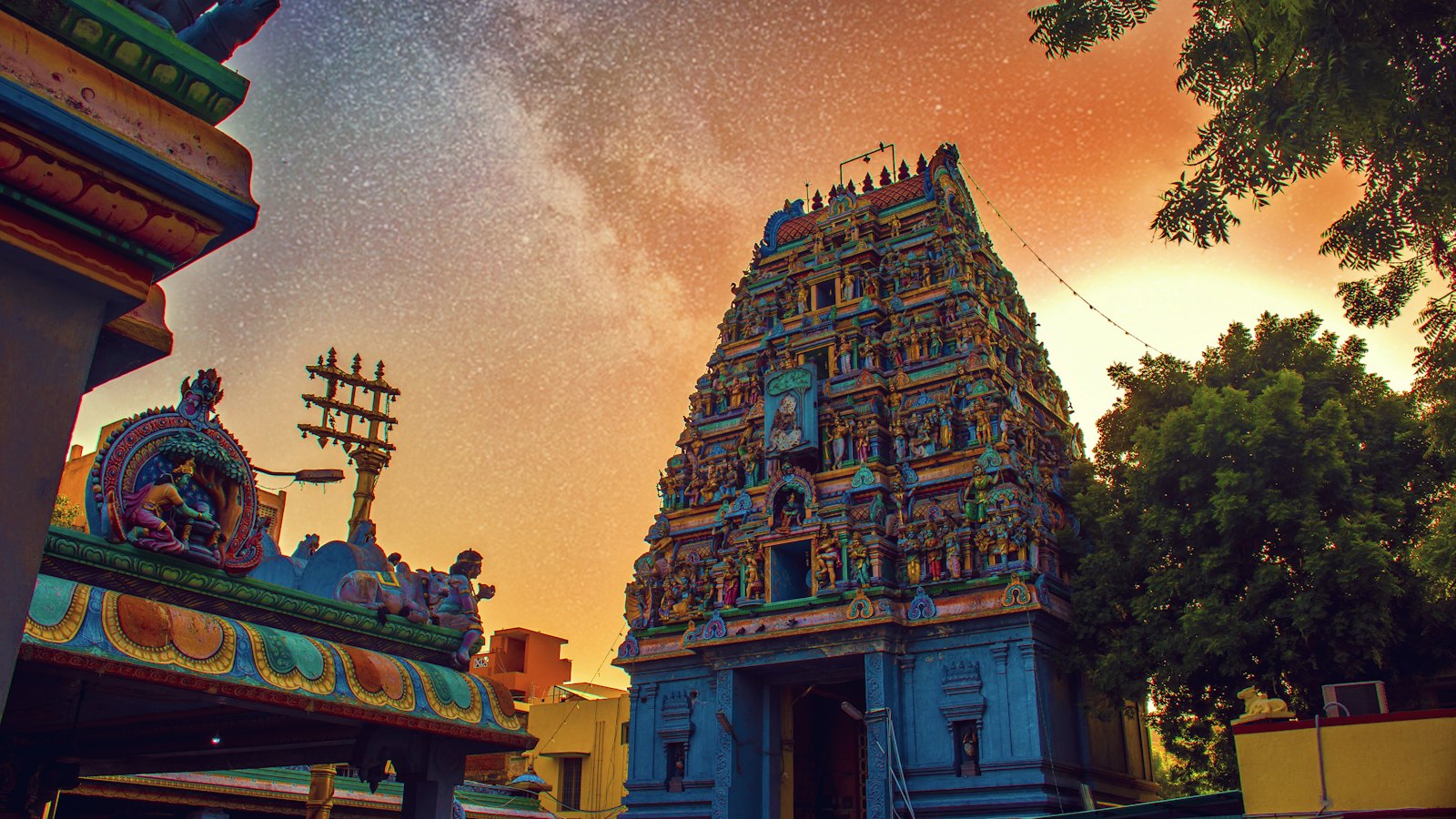
- Kapaleeshwarar Temple, Mylapore: a Shiva temple with a towering painted gopuram. Remove your shoes and cover shoulders and knees.
- San Thome Basilica: a white church in Mylapore, said to stand over the tomb of St Thomas the Apostle.
- Fort St George: built from 1640, the first English fortress in India, now home to the state legislature and a museum of the Raj era.
- Government Museum, Egmore: the second-oldest museum in India, best known for its South Indian bronzes.
- Wallajah Big Mosque, Triplicane: a granite mosque completed in 1795 by the family of the Nawab of Arcot, and the largest in the city.
- Elliot's Beach, Besant Nagar: a calmer strip of sand backed by cafes.
- DakshinaChitra: a heritage museum about 25 km south with traditional houses from across South India.
- Music Season: from about mid-November into January, halls across the city stage Carnatic concerts.
- Tamil cinema: see a new Tamil release in a Chennai cinema, where the opening-day crowd is half the show.
What to eat in Chennai
Chennai's food will feel like the original version of much that Malaysians eat at mamak stalls and banana leaf restaurants. Many restaurants here call themselves hotels, so the sign may only mean lunch.
- Tiffin: idli, dosa, vada and ven pongal with sambar and coconut chutney, for breakfast and again in the evening.
- Meals: the lunchtime spread of rice, sambar, rasam, vegetables, curd and pickle on a banana leaf or steel plate, with refills. Close to banana leaf rice at home, but usually vegetarian.
- Filter kaapi: strong coffee with frothy milk, poured between a steel tumbler and a small bowl to cool it.
- Biryani and paya: Chennai puts its own twist on Mughlai cooking, and Muslim-run biryani shops are the place to try biryani and paya, a spiced trotter broth.
- Chicken 65: the spicy fried chicken now found across India is credited to Chennai's Buhari Hotel.
- Chettinad cooking: fiery, spice-heavy meat dishes, best known for Chettinad pepper chicken.
- Kothu parotta: shredded parotta stir-fried on a griddle with egg, meat and gravy.
- Atho: Burmese-style noodle salad sold by street hawkers around Burma Bazaar in George Town, near Parry's Corner. Muslim readers should ask about the meat first.
Eat street food hot off the griddle and drink bottled water.
Halal food and prayer spaces in Chennai
Halal food is not hard to find in Chennai, but it works differently from Malaysia. India has no JAKIM-style government body; halal certification is mostly issued by non-governmental groups such as the Jamiat Ulama-i-Hind Halal Trust and Halal India, so do not expect certificates on restaurant walls the way you do at home. In practice you rely on Muslim-owned restaurants and biryani shops, where the meat is halal on the owner's word.
Roughly one in ten Chennai residents is Muslim (2011 census):
- Triplicane: the historic Muslim quarter around the Wallajah Big Mosque on Triplicane High Road, with biryani shops and tea stalls nearby.
- Anna Salai: the main road through Thousand Lights, home to the Mount Road Mosque and the Thousand Lights Mosque (1810). The latter is Shia, so Sunni visitors may prefer the Wallajah mosque or a neighbourhood masjid for Jumaat.
- Vegetarian restaurants: pure veg places serve no meat, fish or eggs. They are usually not halal-certified, but many Malaysian Muslims treat them as a dependable fallback.
We could not confirm a dedicated prayer room at Chennai airport from official sources, so ask an information desk or staff after security, and consider praying before you leave for the airport. HalalTrip and Zabihah list Muslim-friendly restaurants. When unsure, just ask if the meat is halal; the question is common here.
Getting around Chennai
Traffic is what you plan around: short hops can take 45 minutes at rush hour, so group sights by area and use rail where you can.
- Metro: the Blue Line runs from the airport up Anna Salai to Chennai Central and on to Wimco Nagar; the Green Line links Central, Egmore, Koyambedu and St Thomas Mount. Fares are ₹10 to ₹50 (about RM 0.40 to RM 2). The first stretch of the new Yellow Line, from Poonamallee to Vadapalani, is due around October 2026 after earlier delays, so check whether it is running.
- Metro tickets: buy tokens at station counters or machines, or QR tickets in the official Chennai Metro (CMRL) app. A tourist card gives unlimited metro rides for one day.
- Suburban trains and MRTS: very cheap, handy for Egmore, Mylapore and Velachery. Avoid peak hours.
- Ride-hailing: Grab does not operate in India. Uber and Ola run cars and autos here, as do Indian apps such as Rapido, and short app car rides often cost ₹150 to ₹400 (RM 6 to RM 17), indicative.
- Auto-rickshaws: street autos rarely use the meter for visitors. Agree the price first, or book one in an app.
- Buses: MTC buses are cheap but crowded, signed mostly in Tamil, a bonus for Tamil-reading Malaysians.
For Mahabalipuram or Kanchipuram, hire a car with driver for the day.
Sample itinerary: 4 days in Chennai
Four days covers the city plus one proper day trip. Keep afternoons light in the hot months.
- Day 1: Land at Terminal 2 and take the metro or an app car to your hotel. Late afternoon at Marina Beach, then biryani in Triplicane and Maghrib at the Wallajah Big Mosque.
- Day 2: Kapaleeshwarar Temple and the lanes around its tank in Mylapore, then San Thome Basilica. After lunch, the bronzes at the Government Museum in Egmore. Sunset and dinner at Elliot's Beach.
- Day 3: Drive down the East Coast Road. Stop at DakshinaChitra, then Mahabalipuram for the Shore Temple, the carved rathas and the giant rock relief. Kothu parotta back in the city.
- Day 4: Morning at Fort St George and a wander through Parry's Corner. Afternoon shopping in T. Nagar, then head for the airport with a wide margin for traffic.
With a fifth day, add Kanchipuram for silk and temples, or head south to Pondicherry for a night.
Money, SIM and practical tips
- Currency: Indian rupee (₹). Our late-September 2026 check put the ringgit at about ₹23.5, making a ₹500 note worth a little over RM 21.
- Cash and cards: Visa and Mastercard work in hotels, malls and chain restaurants. Keep cash for autos, small eateries, temples and markets; bank ATMs are easy to find.
- QR payments: Indian shops run on UPI QR codes, which are built for Indian bank accounts. DuitNow QR does not work in India yet: PayNet and NPCI International announced a partnership in February 2026 whose second phase should let Malaysians scan UPI codes with their own banking or e-wallet apps, but India is not on PayNet's cross-border list at the time of writing.
- SIM: a travel eSIM bought in KL is least hassle. Expect passport and visa paperwork for a local SIM.
- Plugs: Indian sockets are types C, D and M (230 V); a universal adapter handles our UK-style plugs.
- Tipping: optional. Round up for drivers; bills often include a service charge (marked 'S.C.'), and if not, a modest tip is customary.
- Safety: generally safe, with traffic the real hazard. Never swim at the Marina.
- Scams: autos quoting inflated fixed fares, station touts and look-alike e-visa websites.
- Help: Malaysia has a Consulate General in Chennai, useful for lost passports.
Silk, gold and day trips beyond Chennai
For many Malaysian families a Chennai trip doubles as a shopping trip, often timed before a wedding or Deepavali.
- T. Nagar: Ranganathan Street, Usman Road and Pondy Bazaar are lined with multi-storey saree, textile and jewellery stores. Go on a weekday morning and keep your bag in front of you in the crowds.
- Buying gold: ask for the hallmark on each piece and an itemised bill showing weight, purity, making charges and tax, and compare the day's rate between shops.
- Kanchipuram: about 72 km southwest, famous for handwoven silk sarees and temple towers. Established weavers' shops and cooperatives beat a driver's favourite store.
- Mahabalipuram: about 60 km south, where 7th and 8th century Pallava monuments form a UNESCO World Heritage Site: the Shore Temple, the five rathas and the Descent of the Ganges relief. Go early, before the sun gets fierce.
- Pondicherry: further down the East Coast Road past Mahabalipuram, a former French town with quiet streets and a seafront promenade, better as an overnight stay.
Check your baggage allowance before a big silk haul.
Before you go
- Best time to go
- January and February are the best months to visit Chennai, with highs around 29 to 31°C and very little rain, and December is a close second for the Music Season if you can live with showers. October and November bring the northeast monsoon, the city's real rainy season, with heavy downpours, street flooding and the occasional Bay of Bengal cyclone, and the wet spell often runs well into December. April to June is fiercely hot, often 35°C and above, while June to September is warm with only moderate rain here. Festivals to plan around include Deepavali (early November in 2026; the Malaysian holiday is 8 November) and Pongal, the Tamil harvest festival in mid-January. Malaysian school holidays cover most of December 2026 and push up fares, so book early or aim for late January and February.
- Visa for Malaysians
- Malaysian passport holders must have an Indian visa as of September 2026, and for tourism the easy route is the 30-day e-Tourist Visa, which India's official fee schedule prices at zero for Malaysians. Apply only at indianvisaonline.gov.in, four days or more before you arrive (up to 120 days ahead). The 30-day version allows multiple entries but cannot be extended. Longer e-Tourist Visas cost US$40 for one year or US$200 for five, plus a 3% bank charge, with at most 180 days in India per calendar year. Passports must be valid for six months from the application date, with two empty pages. Foreign visitors can also file the free e-Arrival Card online within 72 hours before landing, through the visa portal, boi.gov.in or the Indian Visa Su-Swagatam app. Recheck everything on indianvisaonline.gov.in shortly before departure.
- Honest budget guide
- A day in Chennai typically costs RM 110 to RM 330 per person once you land, excluding flights. Flights: the Amaboxly scan of KL fares found one-way tickets from about RM 446 with a stop in Singapore and non-stop seats from about RM 456 at the time of writing; a return therefore runs roughly RM 900 to RM 1,300. Budget rooms go for around ₹1,400 to ₹3,000 (RM 60 to RM 130) per night, while comfortable mid-range hotels ask ₹3,500 to ₹7,500 (RM 150 to RM 320). Meals cost about RM 25 to RM 65 daily and getting around RM 15 to RM 50. Two people sharing a mid-range room for four nights should each budget roughly RM 1,400 to RM 2,500 with flights. Shopping is extra, and every number here is indicative.
Frequently asked questions
Do Malaysians need a visa for Chennai?
Yes, India requires a visa, but the 30-day e-Tourist Visa carries a zero fee for Malaysian passports under the current schedule (September 2026). Submit it on indianvisaonline.gov.in four or more days before travel, with a passport valid for six months, and file the free e-Arrival Card online within 72 hours before you land. Ignore agent sites that add fees.
Is there a direct flight from KL to Chennai?
Yes, three carriers do. AirAsia runs its non-stop service from KLIA Terminal 2, while Malaysia Airlines and IndiGo use Terminal 1 (as of September 2026). Expect about four hours in the air. At the time of writing our fare scan shows non-stop one-way seats from about RM 456 and one-stop fares via Singapore from about RM 446.
Is Chennai Muslim-friendly?
Largely, yes. About one in ten residents is Muslim, so Muslim-owned restaurants and biryani shops are common, especially in Triplicane, the historic Muslim quarter. Do not expect JAKIM-style certificates, since halal certification in India is mostly handled by private bodies rather than the government. The Wallajah Big Mosque is the largest in the city, and vegetarian restaurants make a dependable fallback.
How do I get from Chennai Airport to the city?
The Blue Line metro reaches Chennai Central in about 30 to 40 minutes for no more than ₹50 (around RM 2). Uber and Ola pick up from the app zone, averaging about ₹573 (RM 24) into the city, and prepaid taxi booths in arrivals sell fixed fares. The suburban train from Tirusulam is cheapest but crowded.
How many days in Chennai is enough?
Three to four days covers Marina Beach, Mylapore, the Egmore museum, Fort St George and a day trip to Mahabalipuram. Add a day for serious shopping in T. Nagar or silk in Kanchipuram, and two more to continue to Pondicherry.
What is the best month to visit Chennai?
January and February are the most comfortable, with warm dry days and cooler evenings. December is lively thanks to the Music Season but still gets heavy showers, and it overlaps with Malaysian school holidays. Skip October and November for monsoon floods, and April to June unless you handle 35 to 40°C well.
What does a 5-day Chennai trip cost from KL?
Around RM 1,400 to RM 2,500 per person covers five days and four nights at mid-range level with a shared room, return flights from KL included. Simple hotels and tiffin meals bring that down a lot. Keep a separate budget for sarees or gold. These figures are indicative.
Can I use Grab in Chennai?
No. Grab has no service anywhere in India. In Chennai the apps to install are Uber, Ola and Rapido, which cover cars and auto-rickshaws, and booking an auto in an app saves haggling with street drivers. For the metro, buy tokens at stations or QR tickets in the official Chennai Metro app.
Jom pergi
Ready to go Chennai? Compare available flights and hotels for your dates. Check baggage, cancellation terms and the final total on the booking provider before paying.






