




On this page13 sections
Kochi, still Cochin in the airport's name, is Kerala's old port city and one of the easiest parts of India to reach from Malaysia. Three airlines fly there non-stop from KLIA in about four hours, and until 31 December 2026 Malaysians pay nothing for the 30-day e-Tourist Visa. It feels like several towns in one: colonial Fort Kochi, the spice warehouses and mosques of Mattancherry, and modern Ernakulam with its metro and malls. About 18 percent of city residents were Muslim at the 2011 census, so halal meals are easy to find. Below: flights and fares, the e-Visa, the airport ride, food, prayer spaces and costs in ringgit.
Flying from KL to Kochi
Three Malaysian airlines fly this route non-stop. At the time of writing AirAsia flies non-stop from KLIA Terminal 2, while Batik Air and Malaysia Airlines use Terminal 1, so check your booking before heading to the airport. Expect roughly four hours in the air. Kochi's clocks sit two and a half hours behind KL, which makes the outbound trip feel short.
When we last refreshed our Kuala Lumpur fare tracker on 21 September 2026, the cheapest non-stop seat was about RM 528 one-way on AirAsia, available on several dates between February and August 2027, and the middle of the price range sat near RM 693. Batik Air's best non-stop price was around RM 639 one-way for an October 2026 date, and SriLankan Airlines via Colombo started near RM 818 one-way for anyone happy to stop on the way. Malaysia Airlines did not show up among the cheapest fares, so check its own site. Prices shift daily, so read these as a snapshot.
Low-cost tickets rarely include checked luggage or a meal, so price those in when comparing airlines.
Cochin Airport to the city
Cochin International Airport is at Nedumbassery, about 25 km northeast of the city centre and around 40 km by road from Fort Kochi. Prices are indicative, at roughly ₹23.5 to RM 1.
- Prepaid taxi: pay a fixed fare at the arrivals counter. Budget very roughly ₹1,000 to ₹1,500 (RM 43 to RM 64) to Ernakulam or Fort Kochi. The drive takes 45 minutes on a clear road and 90 or more in traffic.
- Uber: offers COK airport pickups; fares move with demand, so compare the app quote with the prepaid counter.
- Feeder bus plus metro: Kochi Metro's air-conditioned electric feeder bus links the airport with Aluva metro station for ₹80 (about RM 3.40). On KMRL's latest timetable buses leave the airport every 20 to 40 minutes from about 6.45am to 11.15pm. The metro then costs ₹50 to MG Road or ₹60 to Vyttila. Allow roughly 90 minutes to central Ernakulam.
- KSRTC buses: state buses, some air-conditioned, stop on the city side of the international terminal and run via Aluva and Vyttila toward Fort Kochi. They cost a small fraction of a taxi fare but take close to two hours.
- Homestay pickup: many Fort Kochi hosts send a car; agree the price first.
For Fort Kochi on public transport, ride the metro into Ernakulam, take a short auto-rickshaw hop to the High Court jetty and finish on the Water Metro.
Where to stay in Kochi
Kochi spreads across a peninsula, islands and the mainland, and the harbour divides the old town from the modern city. Pick your base by how you want to spend your days.
- Fort Kochi: heritage homestays, small boutique hotels and cafes on quiet lanes, with the fishing nets and old churches a short walk away. Suits couples and first-timers, though the airport run is long.
- Mattancherry: beside Fort Kochi, around Jew Town and the old spice market, with the copper-roofed Chembitta Palli mosque a short walk away at Kochangadi. Rooms are fewer and plainer, but it suits Muslim travellers who want a mosque within walking distance.
- Ernakulam (MG Road and Marine Drive): the modern centre, with metro stations, mid-range hotels, shops and train links. Good for families and for day trips to Alappuzha or Munnar.
- Edappally and the airport side: Edappally has LuLu Mall and a metro station, handy for shopping-focused family trips, while Aluva and Nedumbassery suit late arrivals and dawn departures.
The backwaters bring mosquitoes, so look for rooms with screens or nets.
Things to do in Kochi
Most sights sit in flat, walkable Fort Kochi and Mattancherry; go early or late to dodge the heat.
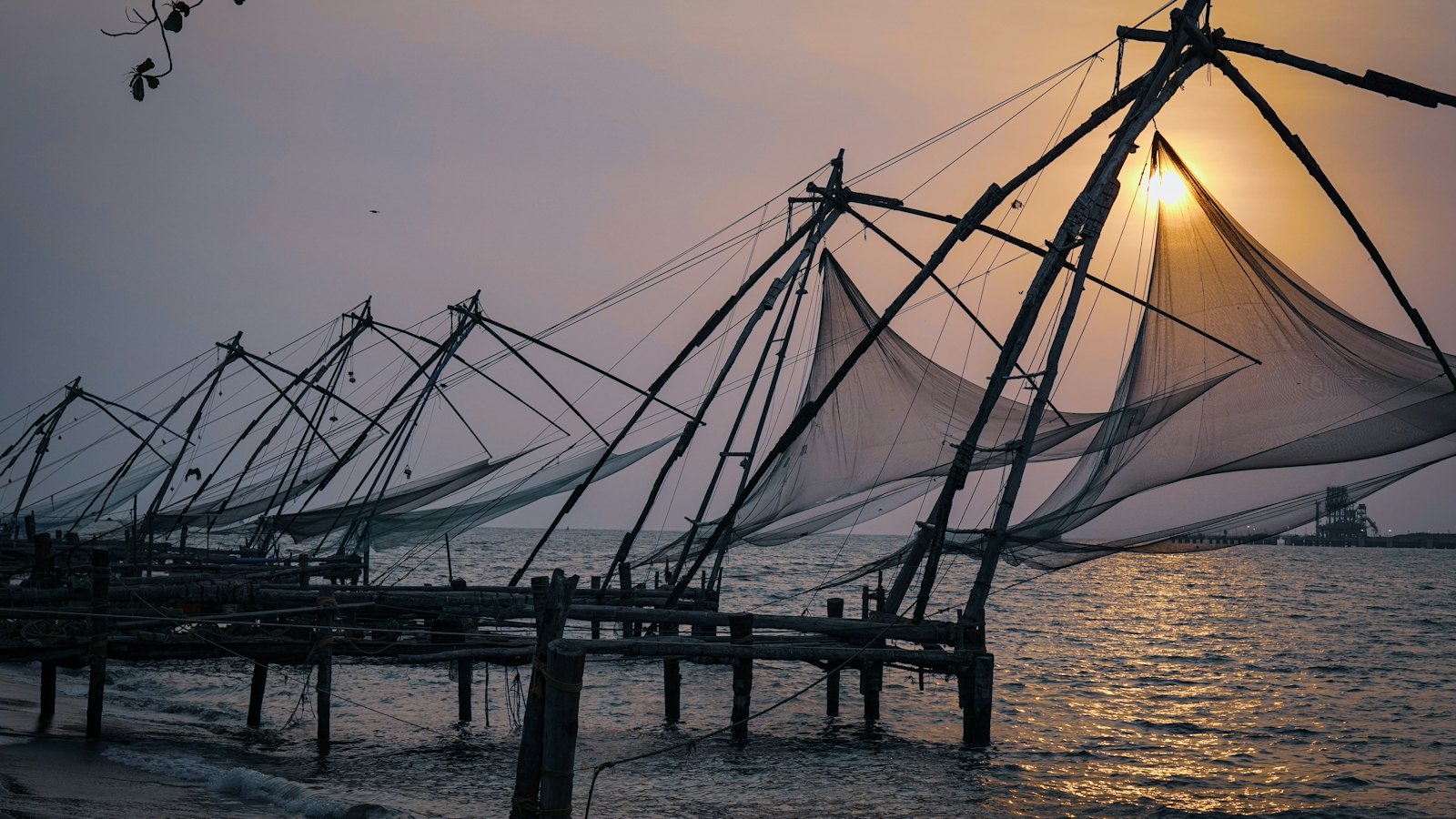
- Chinese fishing nets: the huge cantilevered nets along the Fort Kochi shore are the city's symbol. They look their best at sunset, and you can often watch the crews working them.
- St Francis Church: first built by the Portuguese in 1503, where Vasco da Gama was first buried before his remains went to Lisbon.
- Santa Cruz Basilica: nearby, the cathedral of the Latin Catholic Diocese of Cochin, with painted ceilings and murals inside.
- Mattancherry Palace (Dutch Palace): a 16th-century palace the Portuguese built for the Kochi royal family, known for its murals. Closed on Fridays.
- Jew Town and the Paradesi Synagogue: antique dealers and spice warehouses line the way to a synagogue founded in 1568. Visitors are not admitted on Saturdays or Friday afternoons.
- Kathakali: Kochi has more regular evening Kathakali theatres than anywhere else, so it is the easy place to see Kerala's costumed dance drama.
- Water Metro: the boat from High Court to Fort Kochi doubles as a cheap harbour cruise.
- Marine Drive: Ernakulam's waterfront promenade, at its best around sunset.
Cover shoulders and knees at churches, temples and the synagogue, and remove shoes when asked.
What to eat in Kochi
Kerala food leans on coconut, curry leaves, black pepper and seafood, and a lot of it will taste familiar. Flaky Kerala parotta, for one, is a close relative of roti canai.
- Appam with stew: lacy rice pancakes and a gentle coconut milk stew, the classic breakfast.
- Puttu and kadala curry: steamed rice flour cylinders with black chickpea curry.
- Karimeen pollichathu: pearl spot fish rubbed with spice paste and cooked in banana leaf, the dish most linked with the backwaters.
- Parotta and beef fry: a Kerala staple in Muslim and Christian eateries; chicken and mutton versions are everywhere for those who skip beef.
- Biryani: Malabar-style biryani is fragrant rather than fiery and made with small-grained kaima rice. Muslim-run eateries in Mattancherry are a good place to try it.
- Sadya: a vegetarian spread of rice and many small dishes on a banana leaf, served at Onam and at lunch in some restaurants. Banana leaf rice lovers will feel at home.
- Pazham pori and sulaimani: ripe banana fritters with spiced black tea for the afternoon break.
Small Kerala restaurants often call themselves "hotels", so a "Hotel" sign may mean food, no beds. Fort Kochi's cafes cost more than local places in Ernakulam and Mattancherry.
Halal food and prayer spaces
For Muslim visitors Kochi is among India's easier cities. About 18 percent of city residents were Muslim at the 2011 census, and Muslim-run restaurants are common. Halal labelling works differently from Malaysia, though.
- Certification: halal certification in India is voluntary and run by private bodies, with no JAKIM-style government agency, so many eateries simply have no certificate. Most Malaysians judge by ownership and ask staff.
- Muslim-owned places: the safest choice. Ask your host or driver, or search Google Maps. Many Muslim-owned businesses close for about three hours from noon on Fridays for Jumaat prayers, and shut on Hari Raya.
- Other kitchens: plenty of Christian-run and Hindu-run restaurants serve chicken and beef, but pork is on some menus (pork dishes are part of Kerala Christian cooking), and bars and toddy shops pour alcohol. Pork-free does not mean halal.
- Mosques: the copper-roofed Chembitta Palli stands at Kochangadi, between Fort Kochi and Mattancherry. The Cheraman Juma Masjid at Kodungallur, traditionally dated to AD 629 and often called India's first mosque, opens 5.30am to 6pm according to Kerala Tourism.
- Prayer rooms: Cochin airport's international terminal has prayer rooms, and LuLu Mall in Edappally has a ladies' room on the first floor and a men's room on the second.
- Apps: use Muslim Pro or your usual app for prayer times and qibla, and search Google Maps for "halal" to find meals nearby.
Getting around Kochi
Kochi mixes metro trains, boats, buses and auto-rickshaws. Mainland roads jam at rush hour, so plan three or four stops a day.
- Kochi Metro: one line of 25 stations from Aluva to Thrippunithura via Edappally, MG Road and Vyttila. Fares are ₹10 to ₹60 (under RM 3); the Kochi1 card suits longer stays.
- Water Metro: electric-hybrid boats link High Court with Fort Kochi, Vypin and Mattancherry, among other routes, for ₹20 to ₹40 (RM 1 to RM 2), running from morning into the early evening.
- Ferries: public ferries and a vehicle ferry also connect the islands with the mainland for less.
- Ride-hailing: Uber operates here with cars and bike taxis, and Ola and Rapido also work in Kochi. Grab has no service anywhere in India.
- Auto-rickshaws: plentiful and ideal for short Fort Kochi hops. Ask for the meter or agree a price first, and turn down suspiciously cheap rides that come with a shop stop.
- City buses: private and KSRTC buses are very cheap but packed at peak hours. Many destination boards carry English, and conductors usually help.
- Car with driver: the easiest way to reach Alappuzha, Munnar or Kodungallur; any hotel desk can book one for the day.
Sample itinerary: 4 days in Kochi
Four days lets you see the old town properly and still spend a day on the backwaters. Avoid putting Mattancherry on a Friday, when the palace is shut, or a Saturday, when the synagogue is closed to visitors.
- Day 1: Arrive, settle into Fort Kochi and rest. Late afternoon, walk past St Francis Church and Santa Cruz Basilica to the fishing nets for sunset, then eat seafood near the shore.
- Day 2: Mattancherry. See the palace murals, browse Jew Town's antique and spice shops, visit the Paradesi Synagogue, then have biryani for lunch and pray Zuhur at a nearby mosque. End with an evening Kathakali show.
- Day 3: Day trip to Alappuzha for a backwater cruise past canals and paddy fields, back in Kochi for dinner.
- Day 4: Water Metro to High Court, a walk along Marine Drive, then the metro to Edappally for LuLu Mall, spices, tea and banana chips before your flight.
With more time, spend a day north at the Cheraman Juma Masjid, or a night or two in the Munnar tea hills.
Money, SIM and practical tips
- Currency: Indian rupee. In late September 2026 RM 1 bought about ₹23.5, which makes ₹1,000 roughly RM 43.
- Cards and cash: Visa and Mastercard work at hotels, malls and bigger restaurants, while autos, small eateries and markets want cash. ATMs are easy to find; enable overseas withdrawals with your bank first.
- QR payments: shops everywhere display UPI codes, but India is not on PayNet's DuitNow cross-border QR list, so Malaysian banking apps cannot pay them. Rely on cash or card.
- SIM and eSIM: buy a travel eSIM before departure. Most Indian airports sell no tourist SIMs, and some phone shops refuse to sell SIMs to foreigners.
- Electricity: 230V through round-pin outlets of types C, D and M, so bring a universal adapter for your Malaysian chargers.
- Tips: not expected in most places. In smarter restaurants up to 10 percent is fine when no service charge is added.
- Safety: normal city care applies. Watch for inflated taxi quotes, drivers steering you to shops for commission, and "antiques" that are new, and book cruises through established operators.
- Health: drink bottled or filtered water and carry mosquito repellent.
Side trips: backwaters, Munnar and Kodungallur
Kochi is a handy base for Kerala's best-known sights.
- Alappuzha (Alleppey): about 60 km south, the centre of houseboat country. A day cruise covers canals, paddy fields and village life; an overnight boat includes meals cooked on board, so tell the operator early if you need halal meat or seafood only.
- Kumbalangi: an island village about 12 km from the centre, developed as a model tourism village, with Chinese fishing nets and mangrove-lined backwaters; a gentler option than a houseboat day.
- Munnar: tea estates across hills around 1,600 m above sea level, a cool escape from coastal humidity. It is about 130 km by winding road, so stay at least a night.
- Cheraman Juma Masjid, Kodungallur: north of Kochi, built in traditional Kerala style, with a museum on how Islam reached this coast.
Book a car and driver for these; buses are slow and connections awkward with luggage.
Before you go
- Best time to go
- December to February is the best time for Kochi, when rain is scarce after two monsoon seasons. The southwest monsoon drenches the city from June to September, and the lighter northeast monsoon brings more rain from October into early December; the wet months are green and quieter. March to May is hot and sticky. Onam, Kerala's harvest festival, lands in August or September with sadya feasts everywhere. December is the busiest month, with Christmas and the Cochin Carnival in Fort Kochi, which closes with a New Year's Day procession. Malaysian school holidays overlap: the 2026 year-end break starts on 4 December in Kedah, Kelantan and Terengganu and on 5 December elsewhere, so book early. The Kochi-Muziris Biennale art festival last ran from December 2025 to March 2026.
- Visa for Malaysians
- As of September 2026 Malaysians need a visa for India, but the 30-day e-Tourist Visa is free for Malaysian passport holders until 31 December 2026. The High Commission of India in Kuala Lumpur says the waiver covers only the 30-day e-Tourist Visa, so one-year and five-year versions still carry a fee. Apply at indianvisaonline.gov.in at least four days before arrival and no more than 120 days ahead; Cochin is a designated e-Visa entry airport. Your passport needs six months of validity on the day you apply plus two blank pages, and you should hold a return or onward ticket. The 30-day visa cannot be extended. Foreign visitors should also submit the online e-Arrival Card within 72 hours before landing, via the same site or the Indian Visa Su-Swagatam app. The government authorises no agent to charge fees for either. Confirm the rules on indianvisaonline.gov.in before flying.
- Honest budget guide
- Daily spending in Kochi runs about RM 160 to RM 380 per person, flights not included. Flights: our KL fare tracker showed non-stop AirAsia seats from about RM 528 one-way when we checked in September 2026; two one-way tickets at scan prices come to roughly RM 1,050 to RM 1,400. A homestay or basic guesthouse runs about ₹1,500 to ₹3,000 a night (RM 65 to RM 130), and a comfortable mid-range hotel ₹4,000 to ₹8,000 (RM 170 to RM 340). Local meals cost RM 40 to RM 90 a day, and autos, Uber and the metro add RM 15 to RM 50. A houseboat cruise is the main extra. For a five-day stay (four nights, twin-share, mid-range) expect around RM 2,100 to RM 2,900 each with flights. These numbers are indicative.
Frequently asked questions
Do Malaysians need a visa to visit Kochi?
Yes, but it is free for now. The 30-day e-Tourist Visa costs nothing for Malaysian passport holders until 31 December 2026. Apply at indianvisaonline.gov.in at least four days before arrival, then submit the online e-Arrival Card within 72 hours before landing. Longer e-Tourist Visas still carry a fee.
Is there a direct flight from KL to Kochi?
Yes, three airlines do. AirAsia departs KLIA Terminal 2, while Batik Air and Malaysia Airlines leave from Terminal 1, and the hop takes about four hours. In our September 2026 fare check the lowest non-stop price was about RM 528 one-way on AirAsia, with Batik Air from around RM 639.
Is Kochi Muslim-friendly?
Yes, more than most Indian cities. About 18 percent of city residents are Muslim, Muslim-run restaurants are easy to find, and the old quarter has historic mosques such as Chembitta Palli. Halal certification is voluntary in India and many eateries have none, so pick Muslim-owned places and ask. The airport and LuLu Mall have prayer rooms. Some Christian-run restaurants serve pork.
How many days in Kochi is enough?
Three or four days covers Fort Kochi, Mattancherry, Ernakulam and a backwater day at Alappuzha without rushing. Add a night or two in Munnar for the tea hills, or stretch to a week and loop through more of Kerala. Traffic makes it hard to fit many sights into one day.
What is the best month to visit Kochi?
December to February is the driest and most comfortable stretch. December is the busiest month because of Christmas, the Cochin Carnival and Malaysian school holidays. June to September is the main monsoon, wet but green and quieter, and March to May is hot. Our scan's lowest fare, about RM 528 one-way, appeared on dates from February to August 2027.
What does a 5-day Kochi trip cost from Malaysia?
Expect about RM 2,100 to RM 2,900 per head over five days, counting return airfare, four nights in a twin-share mid-range room, food, local transport and a backwater cruise. Homestay travellers who eat at local places spend less. The 30-day e-Visa is free for Malaysians until 31 December 2026. All figures are indicative.
Can I use Grab in Kochi?
No, Grab does not run in India. Uber works in Kochi, including airport pickups, with both cars and bike taxis, and Ola and Rapido operate too. Auto-rickshaws cover short trips, while the metro and Water Metro are cheap for longer ones. Download Uber and add a card before you leave Malaysia.
How do I get from Cochin airport to Fort Kochi?
The simplest options are a prepaid taxi from the arrivals hall or an Uber, very roughly ₹1,000 to ₹1,500 (RM 43 to RM 64) and 45 to 90 minutes depending on traffic. On a budget, take the ₹80 metro feeder bus to Aluva, the metro into Ernakulam, then the Water Metro from High Court to Fort Kochi.
Jom pergi
Ready to go Kochi? Compare available flights and hotels for your dates. Check baggage, cancellation terms and the final total on the booking provider before paying.






