




On this page13 sections
- Overview
- Getting there from KL: flights and routings
- Gimhae Airport to the city
- Where to stay in Busan
- Things to do in Busan
- What to eat in Busan
- Halal food and prayer spaces
- Getting around Busan
- Sample itinerary: 4 days in Busan
- Money, SIM and practical tips
- Adding Seoul, Gyeongju or cherry blossoms
- Before you go
- FAQ
Busan is Korea's second city and its biggest port, a place of steep hillside neighbourhoods, long sandy beaches and fish markets that open before sunrise. For Malaysians it is a relaxed counterpart to Seoul: milder winters, beach days in summer, seafood at every turn and plenty of free sights. Below is what KLIA flyers need to know: the current flight picture (nothing non-stop is running right now, though two airlines have announced returns), the K-ETA to sort out before boarding, the ride in from Gimhae Airport, halal food and prayer spaces, and what the trip costs in ringgit.
Getting there from KL: flights and routings
No airline flies non-stop between Kuala Lumpur and Busan at the time of writing (late September 2026), but two services are due back. AirAsia X has filed plans for four weekly A330 flights from KLIA Terminal 2 from late October 2026, after a planned June restart slipped, so treat that date as tentative. Malaysia Airlines plans four weekly Boeing 737-8 flights from KLIA Terminal 1 starting 2 December 2026. Expect about six and a half hours in the air; Korea is one hour ahead of Malaysia. Make sure your dates are actually on sale before planning around either.
For now, most Malaysians connect once. Amaboxly's own KL fare scan, last updated 21 September 2026, found one-way fares starting near RM 622 with Vietjet via Ho Chi Minh City or Hanoi, with most results around RM 700. Philippine Airlines via Manila began at about RM 788 and China Airlines via Taipei at about RM 1,234. Fares change daily.
Many Malaysians instead fly non-stop to Seoul, take the airport train into Seoul Station and ride the KTX south (see the last section). Always check which KLIA terminal your ticket uses.
Gimhae Airport to the city
Gimhae International Airport (PUS) is on the western edge of Busan and much smaller than KLIA. A night curfew means services thin out late in the evening. Prices are indicative, at roughly 330 won to RM 1.
- Light rail and metro: the Busan-Gimhae Light Rail links the terminal with Sasang (Metro Line 2 for Seomyeon and Haeundae) and Daejeo (Line 3). The base fare is about 1,600 won by transit card; the ride to Haeundae is roughly 2,800 won (RM 8.50) and about an hour, with one change.
- Limousine Bus 1 (Haeundae and Gijang): 9,500 won (about RM 29). Busan City puts the full run at 90 to 110 minutes, so allow at least an hour and a half.
- Limousine Bus 2 (Seomyeon and Bujeon): 6,000 won (about RM 18) since January 2026, around 50 minutes. Book in the Bustago app or at the kiosks by Gate 4 on the first floor, or tap a transit or credit card if seats remain. Each passenger may bring two bags, up to 30 kg in total.
- Taxi: the meter starts at 4,800 won. Roughly 20,000 won (RM 60) to Seomyeon, 23,000 won (RM 70) to Nampo-dong and 30,000 to 45,000 won (RM 90 to RM 135) to Haeundae, more late at night.
With young kids and big suitcases, a taxi is worth the extra ringgit.
Where to stay in Busan
Busan stretches along the coast, so your base decides how long you spend on the metro.
- Haeundae: the famous beach, Blueline Park and Centum City shopping nearby. Best for families and sea views, but the priciest area and about an hour by metro from the old town.
- Seomyeon: the central interchange where Metro Lines 1 and 2 cross, with underground shopping, late-night food streets and plenty of budget and mid-range rooms. Ideal for short trips.
- Nampo-dong and Busan Station: the old port quarter near Jagalchi Market, BIFF Square, Gamcheon and Yeongdo. KTX trains from Seoul arrive at Busan Station, handy if you are doing both cities.
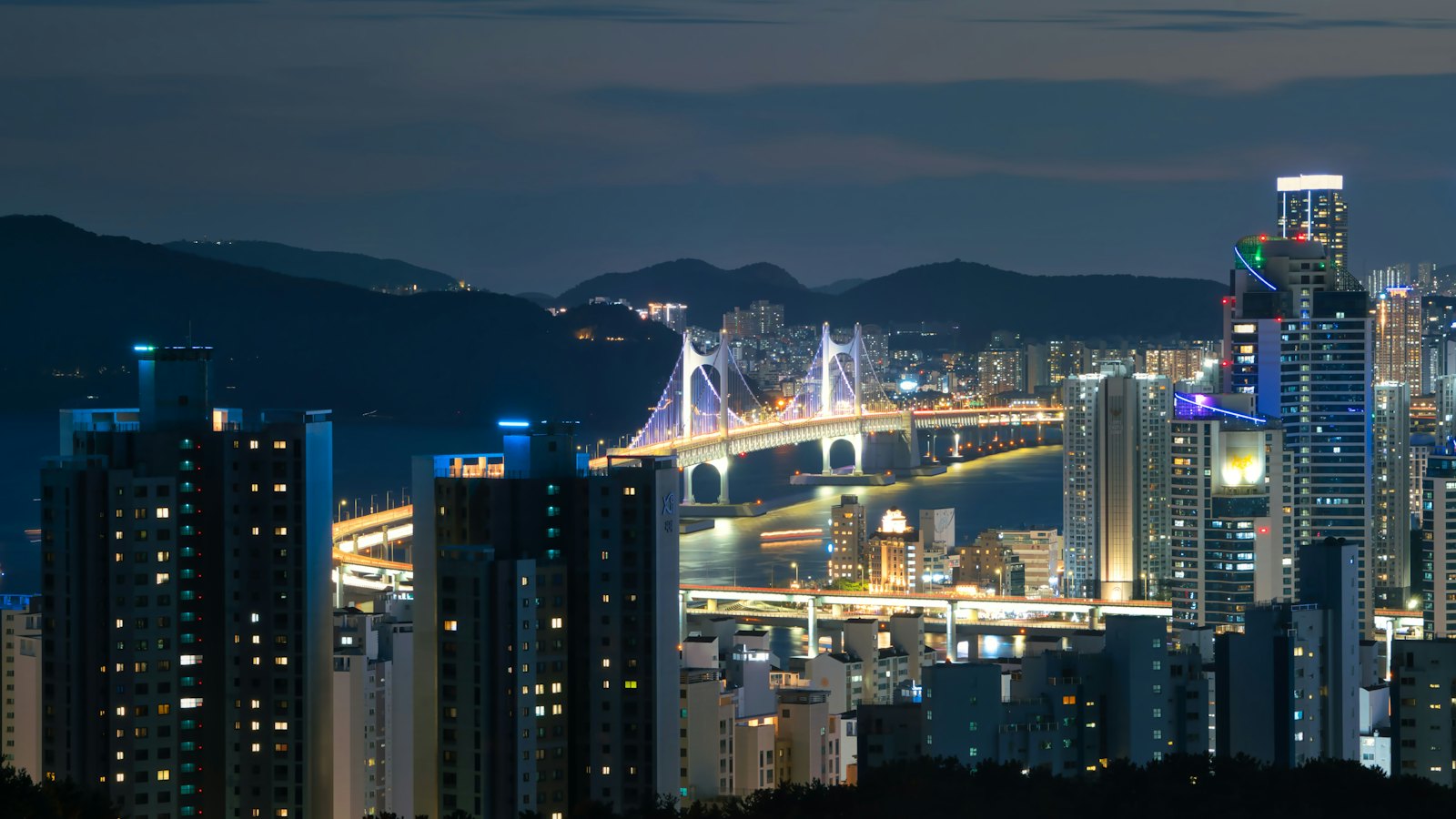
- Gwangalli: a smaller beach facing the illuminated Gwangan Bridge, lined with cafes. Popular with couples, and the front row for the Saturday drone show and November fireworks, when rooms go months ahead.
For Friday prayers, the mosque is near Dusil Station in the north of the city. Seomyeon and Nampo-dong are on the same line (Line 1), so no change of train is needed.
Things to do in Busan
Sights are split between the old port in the west and the beaches in the east.
- Gamcheon Culture Village: pastel houses, murals and galleries stacked up a steep hillside. Go early, in shoes with grip.
- Haeundae Blueline Park: on the old coastal railway, tiny Sky Capsule pods glide between Mipo and Cheongsapo, while the slow Beach Train runs on to Songjeong. Book sunset slots ahead.
- Haedong Yonggungsa: a Buddhist temple perched on sea rocks in Gijang. Weekday mornings are calmest.
- Jagalchi Market and Nampo-dong: the city's famous fish market, next to BIFF Square's snack carts and the covered lanes of Gukje Market.
- Gwangalli at night: the bridge lights up after dark, and a free drone show runs every Saturday (20:00 and 22:00 from March to September, 19:00 and 21:00 from October to February), weather permitting.
- Yeongdo: the cliffside path at Huinnyeoul Culture Village and the rocky headland of Taejongdae.
- Songdo: a marine cable car across the bay and a short Skywalk over the water.
- Centum City: Shinsegae Centum City, a giant department store with K-beauty, luxury floors and the Spa Land bathhouse. A good rainy-day plan.
What to eat in Busan
Busan is a seafood city first, with a few dishes that taste different here from Seoul. Some local classics use pork or beef, so Muslim readers should see the halal section first.
- Eomuk (fish cake): Busan's best-known food. Have skewers in hot broth at market stalls, or visit the bakery-style fish cake shops in Nampo-dong and Yeongdo.
- Ssiat hotteok: fried pancakes filled with brown sugar and seeds, sold from carts at BIFF Square.
- Hoe (raw fish): pick your fish downstairs at Jagalchi and eat it upstairs, or try the raw fish centres at Millak near Gwangalli.
- Milmyeon: Busan's cold wheat noodles, a summer staple, usually in a meat-based broth.
- Dwaeji gukbap: the city's signature pork and rice soup.
- Nakgopsae: spicy octopus, prawns and beef tripe.
- Dongnae pajeon: a thick spring onion pancake from Dongnae.
A casual sit-down meal is roughly 10,000 to 25,000 won (RM 30 to RM 75). Side dishes (banchan) are free and refilled on request, but some barbecue and hotpot places insist on a two-portion minimum. Malaysian visitors also love the sea-view cafes along the Yeongdo and Gijang coast.
Halal food and prayer spaces
Busan has far fewer halal choices than Seoul, and most certified places are Turkish, Indian, Pakistani or Middle Eastern rather than Korean. The Korea Tourism Organization grades Muslim-friendly restaurants in four tiers:
- Halal certified: approved by a recognised body, usually the Korea Muslim Federation, whose certification JAKIM recognises.
- Self-certified: the Muslim owner vouches for the food.
- Muslim friendly: some halal dishes, and alcohol may be sold.
- Pork free: no pork, but no halal meat either, and alcohol may be served.
The main cluster surrounds the Busan Al-Fatah Mosque (Busan Masjid), opened in 1980 in Namsan-dong, Geumjeong-gu, roughly eight minutes on foot from Exit 8 of Dusil Station on Line 1; Visit Busan has featured Turkish and Moroccan restaurants beside it. Elsewhere, Muslim-friendly places are scattered and change often. Seafood is the usual fallback, but ask about broths and marinades, which may use meat stock or cooking wine.
Visit Busan also lists Islamic centres in several districts and universities, plus a prayer room on the third floor of the passenger terminal at Gimhae Airport. Muslim Pro handles prayer times and qibla, and the VisitKorea website lists restaurants by tier so you can check before crossing town.
Getting around Busan
The metro is cheap, clean and signposted in English, with four numbered lines plus the airport light rail and the coastal Donghae Line. With a transit card a ride costs 1,600 won, or 1,800 won for longer trips (about RM 5). Switch between bus and metro within 30 minutes and you pay only the highest of the fares used, so the transfer costs little or nothing.
- Transit cards: T-money, Cashbee and Busan's Hanaro card all work, sold and topped up at convenience stores; a Seoul T-money card works here too. WOWPASS doubles as a prepaid payment card and reloads with a foreign card in its app.
- Ride-hailing: Grab does not operate in Korea. Kakao T is the main local app, and k.ride, Kakao Mobility's app for visitors, takes overseas cards and even Touch 'n Go eWallet or Boost through Alipay+.
- Taxis: metered, with a 4,800 won flag fall and a late-night surcharge. Have your destination written in Korean.
- Maps: Google Maps has long had gaps in Korea, so install Naver Map or KakaoMap before flying.
Group sights by area to save hours.
Sample itinerary: 4 days in Busan
Four days covers the old port, the islands and the eastern beaches. Shuffle the days around the weather and the Saturday drone show.
- Day 1: Land in the morning and take the light rail to your hotel. Spend the afternoon in Nampo-dong at Jagalchi Market, BIFF Square and Gukje Market, then catch sunset from Busan Tower in Yongdusan Park.
- Day 2: Gamcheon Culture Village before the tour buses, then Yeongdo for the Huinnyeoul cliff path and Taejongdae, finishing on the Songdo cable car at dusk.
- Day 3: Haeundae. Ride the Sky Capsule or Beach Train toward Cheongsapo, continue to Haedong Yonggungsa, then have a seafood dinner under the bridge lights at Gwangalli.
- Day 4: Shopping at Centum City or Seomyeon's underground arcades, snacks and cosmetics for home, then the airport with time to spare. On a Friday, fit in the midday Friday prayers at the Al-Fatah Mosque before the airport run.
A fifth day fits Gyeongju, roughly half an hour away by KTX.
Money, SIM and practical tips
- Currency: Korean won. RM 1 was worth about 330 won when we checked in late September 2026, so 10,000 won is around RM 30.
- Cards and cash: Visa and Mastercard are accepted almost everywhere, taxis and convenience stores included. Carry some cash for market stalls, street food and transit card top-ups, which are often cash-only at station machines.
- E-wallets: South Korea is not on PayNet's DuitNow cross-border QR list. Touch 'n Go eWallet pays at shops showing the Alipay+ sign, useful but not universal.
- SIM and eSIM: set up a tourist eSIM before you fly, or buy a SIM or pocket Wi-Fi at the Gimhae arrivals counters.
- Plugs: 220V with round two-pin sockets (types C and F). Bring an adapter for Malaysian three-pin plugs.
- Tipping: not expected.
- Tax refunds: Tax Free stores refund tax on eligible purchases; carry your passport.
- Safety: Busan is very safe, even at night. Mind summer typhoons and strong currents, follow beach flags, and use the official taxi rank with the meter running.
- Help: 112 for police, 119 for fire or ambulance, and the 1330 travel hotline in English.
Adding Seoul, Gyeongju or cherry blossoms
Plenty of Malaysians pair Busan with Seoul. The fastest KTX trains take about 2 hours 15 minutes between Seoul Station and Busan Station (others nearer 2 hours 40 minutes), and a standard one-way seat is around 59,800 won (about RM 180). Book on the Korail website or app a few days ahead for weekends and Korean holidays. For a single Seoul and Busan return, a Korail Pass only pays off if you add more long train rides.
Once direct flights return, an open-jaw ticket (into Seoul, out of Busan) saves backtracking.
Two easy day trips:
- Gyeongju: the old Silla capital, with royal tombs, temples and a relaxed historic core. KTX trains from Busan Station reach Gyeongju Station in roughly half an hour, but the station sits well outside the old town, so allow time for a bus or taxi.
- Jinhae: the Jinhae Gunhangje festival, usually held from late March into early April, is one of Korea's best-known cherry blossom events. Bloom dates shift with the weather, so stay flexible and pick a weekday.
Before you go
- Best time to go
- Aim for April to early June or late September to November, when Busan is mild and dry enough for long coastal walks. Cherry blossoms come in late March and early April, the season of the nearby Jinhae festival. Summer is hot and humid, with a rainy season from late June through most of July and typhoon risk from July to early October, but Haeundae was open for swimming from 26 June to 15 September in 2026. The Busan International Film Festival runs 6 to 15 October 2026, and the fireworks festival fills Gwangalli on 7 November 2026, when nearby hotels sell out. Winter is cold, windy and dry but rarely snowy, and good value. Malaysian year-end school holidays (5 to 31 December 2026 for most states) push fares up, so book early.
- Visa for Malaysians
- Malaysians do not need a visa for South Korea as of September 2026 and can stay up to 90 days, but anyone aged 18 to 64 must hold an approved K-ETA (Korea Electronic Travel Authorization) before boarding. Apply only at k-eta.go.kr (look-alike agent sites charge extra): the fee is 10,000 won, results usually arrive within 72 hours, approval lasts three years, and holders skip the arrival card. The Korean Embassy in Malaysia suggests applying a month ahead. Children aged 17 and under and seniors aged 65 and over are exempt from K-ETA but need an arrival card; the free online e-Arrival Card can be filed within three days before departure. Malaysia is not on Korea's temporary K-ETA exemption list, which runs to 31 December 2026. Korea only asks that your passport cover your stay, but the embassy notes Malaysian passports must have over six months' validity for overseas travel. Confirm the latest rules on k-eta.go.kr before flying.
- Honest budget guide
- Expect to spend roughly RM 220 to RM 500 per person per day on the ground in Busan, excluding flights, depending mostly on your room. Flights: Amaboxly's KL fare scan found one-way fares from about RM 622 (Vietjet, one stop) at the time of writing, so two one-way tickets come to around RM 1,250 to RM 1,400. A simple guesthouse or motel room costs about 50,000 to 80,000 won (RM 150 to RM 240) a night, and a well-rated mid-range hotel 90,000 to 160,000 won (RM 270 to RM 480). Food runs RM 90 to RM 180 a day and the metro RM 15 to RM 30. Five days and four nights, mid-range, sharing a room, comes to roughly RM 3,000 to RM 4,000 per person with flights. All figures are indicative.
Frequently asked questions
Do Malaysians need a visa to visit Busan?
No visa is needed for tourist stays of up to 90 days, but Malaysians aged 18 to 64 must have an approved K-ETA before boarding. Apply on the official k-eta.go.kr site; it costs 10,000 won and lasts three years. Travellers aged 17 and under or 65 and over are exempt from K-ETA but fill in an arrival card, which can be done online.
Is there a direct flight from KL to Busan?
Not in September 2026. AirAsia X plans to restart non-stop flights from KLIA Terminal 2 in late October 2026 (a date that has slipped before), and Malaysia Airlines plans four weekly flights from KLIA Terminal 1 from 2 December 2026. Until those take off, the cheapest choices connect once, such as Vietjet via Ho Chi Minh City or Hanoi, which our fare scan priced from about RM 622 one-way.
Is Busan Muslim-friendly?
Busan is welcoming, but halal food takes planning. There is one mosque, the Busan Al-Fatah Mosque near Dusil Station, several smaller Islamic centres, and a prayer room at Gimhae Airport. Certified halal restaurants are few and mostly Turkish, Indian, Pakistani or Middle Eastern, with the main cluster beside the mosque. Remember that pork free does not mean halal.
How many days in Busan is enough?
Three to four days covers the essentials: Nampo-dong, Gamcheon, Yeongdo, Haeundae with the Sky Capsule, Haedong Yonggungsa and Gwangalli at night. Add a fifth day for Gyeongju or a slow beach day. On a one-week trip with Seoul, three nights in Busan and four in Seoul is a comfortable split.
What is the best month to visit Busan?
April and October are the safest bets, with mild temperatures, clearer skies and less rain. Late March to early April brings cherry blossoms, while July and August suit beach lovers who can handle heat, humidity and possible typhoons. For events, the film festival is in early October and the Gwangalli fireworks are on 7 November 2026.
How much should I budget for 5 days in Busan?
For a mid-range trip, set aside roughly RM 3,000 to RM 4,000 per person including flights, assuming a shared room, casual restaurants and the metro. Backpackers in guesthouses can spend less, while beachfront hotels and big shopping days push it up. Keep some won in cash for markets and transit card top-ups.
Can I use Grab in Busan?
No, Grab does not operate in South Korea. Use Kakao T, the main local taxi app, or k.ride, Kakao Mobility's app for visitors, which accepts overseas cards and Touch 'n Go eWallet through Alipay+. Metered taxis are easy to find, and the metro reaches most sights for 1,600 to 1,800 won a ride.
How do I get from Gimhae Airport to Haeundae?
The cheapest way is the Busan-Gimhae Light Rail to Sasang, then Metro Line 2 to Haeundae, for around 2,800 won (about RM 8.50) and roughly an hour. Limousine Bus 1 goes direct for 9,500 won (about RM 29), but Busan City puts the full run at 90 to 110 minutes. A taxi costs roughly 30,000 to 45,000 won (RM 90 to RM 135) and suits heavy luggage.
Jom pergi
Ready to go Busan? Find the cheapest fares and stays across the whole year, then travel in style with an Amaboxly bag.


