




On this page13 sections
- Overview
- Getting there from KL: flights and fares
- Airport to the city: LRT, buses, shuttles and taxis
- Where to stay in Macau
- Things to do in Macau
- What to eat in Macau
- Halal food and prayer spaces
- Getting around Macau
- Sample itinerary: 4 days in Macau
- Money, SIM and practical tips
- Adding Hong Kong, Zhuhai or Hengqin
- Before you go
- FAQ
Macau squeezes Portuguese squares, Cantonese noodle shops, temples and Cotai's giant resorts into about 33 square kilometres, so a morning in a UNESCO-listed old town can end with a cable car ride over a Cotai resort lake. For Malaysians it is one of the easiest short breaks in East Asia: AirAsia flies non-stop from KLIA Terminal 2 in about four hours, there is no time difference, entry is visa-free, and the tourism office even publishes a halal travel guide in Bahasa Malaysia. Read on for fares from KL, getting into town, the best base, halal meals and mosque details, plus a ringgit budget.
Getting there from KL: flights and fares
Right now AirAsia is the sole carrier with non-stop flights on the KL to Macau route, departing from KLIA Terminal 2. Macau airport's October 2026 timetable shows one daily rotation, plus a second flight on selected days (Fridays and Sundays in early October). The flight takes about four hours, and there is no time difference.
Air Macau, which used to fly the route four times a week, has suspended it, with bookings closed until late March 2027 at the time of writing. The Macau timetable also shows AirAsia flights to and from Tawau on Tuesdays and Fridays, but these are listed as charters, so Sabahans should check whether seats are sold to the public.
At the time of writing, in our own KL fare scan (updated 21 September 2026), the lowest AirAsia one-way price was around RM 464, mostly on March to July 2027 dates, and the typical price sat near RM 550. October and November 2026 departures cost about RM 525 to RM 612. On the December dates we checked, the cheapest seat was Scoot via Singapore at roughly RM 680 to RM 860, so book year-end trips early. Prices move daily.
Or fly to Hong Kong and cross by ferry or bus (see the last section).
Airport to the city: LRT, buses, shuttles and taxis
Macau International Airport (MFM) is in Taipa, a short drive from Taipa Village and roughly 15 to 20 minutes by car from the peninsula. Prices are indicative (roughly MOP 2 to RM 1).
- LRT: Airport Station on Avenida Wai Long links to the terminal's north exit. The Taipa Line crosses Cotai and the water to Barra, beside A-Ma Temple, in under half an hour. Tokens cost MOP 6 to MOP 12 (RM 3 to RM 6), half on a stored-value card. Trains run from 06:30 until 23:15, or 23:59 from Friday to Sunday.
- Buses: MOP 6 (RM 3) in cash, with no change given. AP1 and MT4 go to the Border Gate, route 26 continues to Coloane, and N2 runs overnight.
- Hotel shuttles: free resort buses leave from the car park outside the north exit every 15 to 20 minutes, roughly 11:00 to 21:00, the airport says, though it gives the times for reference only. Check with your hotel.
- Taxi: MOP 21 for the first 1.6 km, then MOP 2 per 220 m, plus an MOP 8 airport surcharge and MOP 3 per bag in the boot. From that tariff we estimate about MOP 50 to MOP 75 (RM 25 to RM 38) to Cotai and MOP 100 to MOP 130 (RM 50 to RM 65) to the old town.
Where to stay in Macau
Macau is small, but your base still shapes the trip, and room rates swing hard between weekdays and weekends.
- Macau Peninsula (Senado Square and the Outer Harbour): best for first-timers who want to walk the old town, eat at the certified halal restaurants and reach the mosque easily. Hotels are older and often cheaper than Cotai.
- Taipa: quieter and close to the airport, with Taipa Village's lanes and snack shops nearby, plus two halal spots from the official guide.
- Cotai: the resort strip on land reclaimed between Taipa and Coloane, with linked malls, pools, shows and family attractions. Ideal for families wanting everything under one roof, but casino floors are part of most complexes and weekend prices soar.
- Coloane: green, slow and by the sea, with Coloane Village and Hac Sa Beach. Suits a restful stay, and the halal guide lists a resort there with a halal-certified cafe.
The tourism office's halal guide names Muslim-friendly hotels in all four areas, many offering prayer mats and qibla direction on request. Ask the hotel directly before booking.
Things to do in Macau
Old-town sights are walkable; the resorts cluster in Cotai.
- Historic Centre: Senado Square, the steps up to the facade of the Ruins of St. Paul's, then Mount Fortress and the Macao Museum for the Chinese and Portuguese story.
- A-Ma Temple and Barra: a temple at the southern tip of the peninsula near Barra LRT station, near Lilau Square and the Moorish Barracks, a yellow and white building in Mughal style built for troops from Goa.
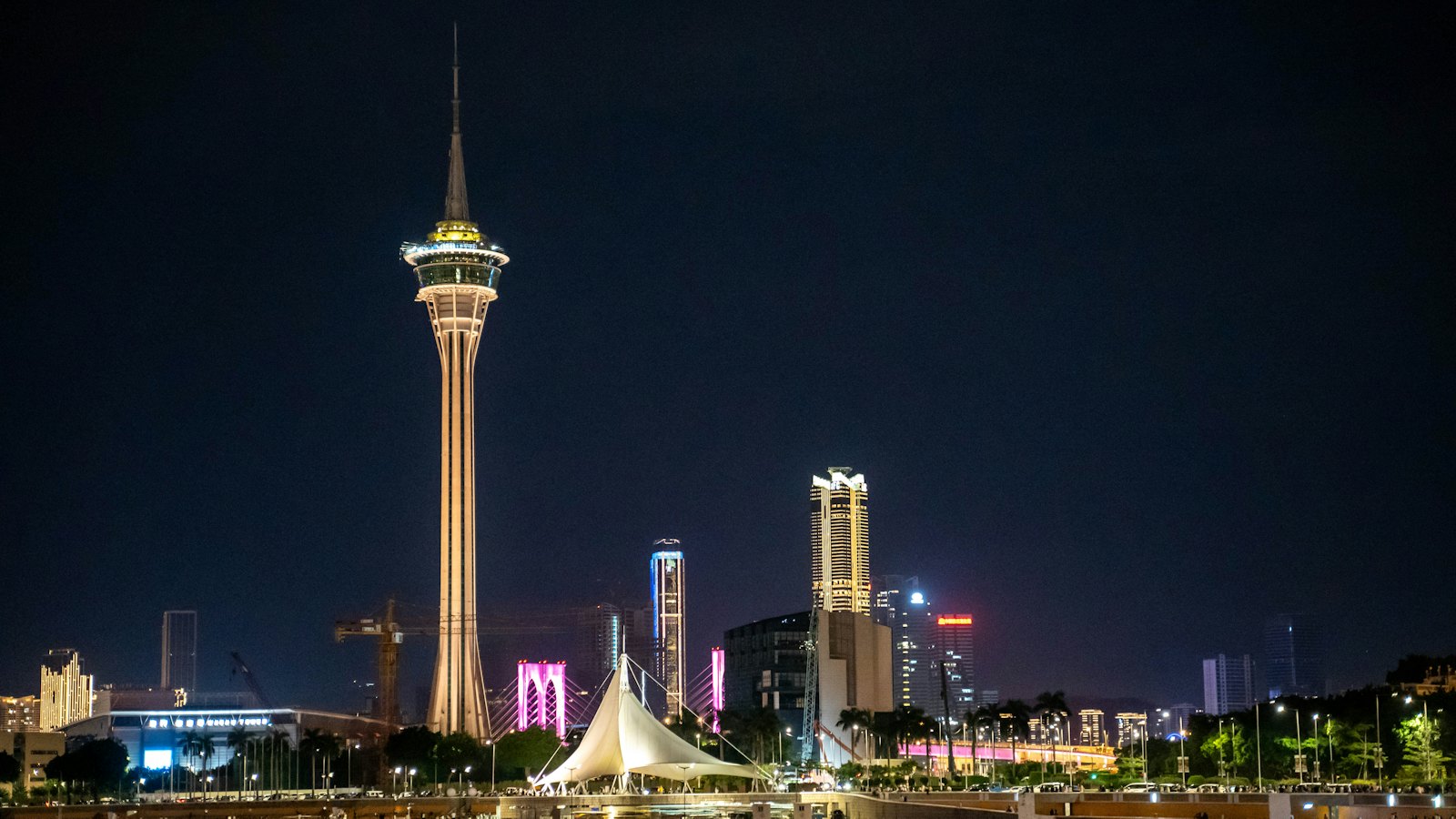
- Macau Tower: views over the Pearl River Delta from the observation deck, or a bungee jump from 233 metres.
- Taipa Village: the pastel Taipa Houses, murals and Rua do Cunha's snack and souvenir shops.
- Cotai resorts: the SkyCab at Wynn Palace, the half-scale Eiffel Tower replica at The Parisian and the Changing of the Guard at The Londoner, no gambling required.
- Coloane: pastel buildings and murals in Coloane Village, the Giant Panda Pavilion and Hac Sa Beach.
- Macao Grand Prix Museum: race cars and motorbikes from the street circuit, popular with kids.
- St. Lazarus' District: colourful streets with small galleries and cafes.
- Seasonal shows: the fireworks contest (September and October), the Grand Prix (November) and Light Up Macao (December into January).
What to eat in Macau
Macau's food blends Cantonese comfort cooking with Macanese dishes shaped by Portuguese contact. Several local favourites contain pork, so Muslim travellers should check the halal section below.
- Egg tarts: flaky Portuguese-style custard tarts, best eaten warm, perhaps after a walk in Coloane.
- Almond cookies and egg puffs: the cookies are a favourite souvenir to carry home; egg puffs are crisp, bubbly street waffles.
- Macanese plates: African chicken, bacalhau (salted cod) fritters, shrimp curry sauce and serradura, a chilled cream and biscuit pudding. The tourism office says selected restaurants make Muslim-friendly versions on request.
- Noodles and congee: wonton noodles, dried shrimp roe noodles and crab congee.
- Skewers: Travessa da Se, the lane from Senado Square to the Cathedral, is known for skewers dipped in chilli oil or curry sauce.
- Pork chop bun: a crusty bun with grilled pork, not halal.
- Jerky: sold in beef, chicken and pork versions, so read labels.
A simple local meal costs around MOP 50 (about RM 25), and a three-course dinner for two at a mid-range restaurant about MOP 450 (RM 225), both indicative. Resort dining costs more.
Halal food and prayer spaces
Halal food in Macau is limited but well signposted. The Macao Government Tourism Office (MGTO) lists certified restaurants online and in a free Halal Travel Guide made with HalalTrip, with a Bahasa Malaysia edition dated April 2025. The certifying body is the Incorporated Trustees of the Islamic Community Fund of Hong Kong, which uses three tiers:
- Halal Restaurant: only halal food is prepared and served.
- Halal Kitchen Restaurant: the kitchen is fully halal, but alcohol or non-halal food may be served in the dining area.
- Halal Friendly Restaurant: halal and non-halal food share a kitchen, with measures against contamination.
The 2025 guide lists Indo Pak Curry House near Senado Square, TAAL (Indian), Lou Lan (Chinese and Uyghur) and Dong Lai Shun (halal hotpot) on the peninsula, Zam Zam at the Regency Art Hotel and Vegetarian Farm in Taipa, and Cafe Panorama at the Grand Coloane Resort. Several offer prayer space on request. Listings change, so check the MGTO halal dining page first; pork-free is not halal.
Macau Mosque is on Ramal dos Mouros in the north of the peninsula, beside a Muslim cemetery dating from 1854. Its prayer hall holds about 100 people. The airport lists halal-certified retail products, but we found no prayer room on its facilities list, so pray at your hotel before leaving. MinM (Made in Macao) Plaza near Senado Square has a dedicated halal corner.
Getting around Macau
Distances are short, but the peninsula's slopes and cobbles are tiring in summer heat.
- Buses: Transmac and TCM cover the peninsula, Taipa and Coloane for a flat MOP 6 (RM 3) in exact cash. A Macau Pass stored-value card, sold at convenience stores, cuts a regular ride to MOP 3 and also works on the LRT.
- LRT: the Taipa Line joins Barra, Cotai, the airport and Taipa Ferry Terminal, the short Seac Pai Van Line runs into Coloane, and the Hengqin Line reaches the mainland border. Rides cost MOP 6 to MOP 12, half with an LRT card.
- Taxis: black with a cream roof and metered from MOP 21. Blue and red radio taxis can be booked by phone or in the Macao Taxi app. Street taxis are scarce at rush hour, so use hotel ranks.
- Ride-hailing: Grab does not operate in Macau.
- Resort shuttles: many big resorts run free buses from the ferry terminals, border crossings and airport, but routes change, so ask your hotel.
- Pedicabs: tricycle rides for hire at the Outer Harbour Ferry Terminal or near Hotel Lisboa. Agree the price first.
The MGTO's Experience Macao app shows bus routes and taxi fare references.
Sample itinerary: 4 days in Macau
Four days suits AirAsia's timings: the daily flight lands around 12:30 and the return leaves about 13:00, so the first and last days are short.
- Day 1: Drop your bags, take the LRT to Barra for A-Ma Temple, Lilau Square and the Moorish Barracks, then wander north through the old streets to Senado Square for a halal dinner nearby.
- Day 2: The Ruins of St. Paul's early, before the tour groups, then Mount Fortress, the Macao Museum and halal snacks at MinM Plaza near Senado Square. Visit the mosque on Ramal dos Mouros around Zuhur (ask locally about prayer times), then go up Macau Tower in the late afternoon.
- Day 3: Taipa Village in the morning for Rua do Cunha and the Taipa Houses, Cotai after lunch for the SkyCab and The Parisian's tower, then a late-afternoon walk and an egg tart at Hac Sa Beach in Coloane.
- Day 4: A slow breakfast, almond cookies for the office, and the airport by late morning.
With a fifth day, add Coloane Village and the Giant Panda Pavilion, or a Hengqin day trip. On a Friday, ask locally about Jumaat prayer times at the mosque.
Money, SIM and practical tips
- Currency: the Macau pataca (MOP), pegged at MOP 103.20 to HKD 100. In late September 2026 RM 1 bought about MOP 2, so halve a pataca price for a rough ringgit figure.
- Hong Kong dollars: taken almost everywhere at one to one, but since the HKD is worth slightly more you lose about 3 percent, and change may come in patacas.
- Cards and e-wallets: Visa, Mastercard, UnionPay, JCB and American Express are widely accepted, and the tourism office says merchants take Touch 'n Go eWallet and Public Bank's MyPB. DuitNow cross-border QR does not cover Macau; PayNet lists only Singapore, Indonesia, Thailand and Cambodia.
- SIM and cash: set up a Macau or Hong Kong and Macau eSIM before flying, and keep coins for buses.
- Plugs: 230V, with the square three-pin sockets Malaysians know or round-pin ones, so a universal adapter helps.
- Tipping: not expected; full-service restaurants usually add a service charge.
- Safety: crime is low, and the halal guide notes Muslim visitors in hijab are a common sight. Casinos admit only those 21 and over. Insist on the meter and book tours only with licensed agencies.
- Help: 999, 110 or 112 for emergencies; the MGTO tourism hotline, +853 2833 3000, runs 24 hours.
Adding Hong Kong, Zhuhai or Hengqin
Macau pairs easily with its neighbours. At the time of writing Malaysians need no visa for Hong Kong, and mainland China allows them 30 days visa-free; check both before travelling.
- Hong Kong: fast ferries take about an hour between the cities, and shuttle buses cross the Hong Kong-Zhuhai-Macao Bridge. From Hong Kong International Airport, TurboJET's SkyPier ferry sails to Macau's Outer Harbour without you clearing Hong Kong immigration. An open-jaw ticket, into one city and out of the other, saves backtracking.
- Hengqin: the LRT Hengqin Line, opened in December 2024, runs from Lotus station in Cotai to the 24-hour Hengqin border crossing, the gateway to the Chimelong Ocean Kingdom theme park.
- Zhuhai: the Border Gate at the top of the peninsula, open 06:00 to 01:00, leads to Gongbei in Zhuhai.
Each crossing means two immigration checks, and queues swell during mainland holidays.
Before you go
- Best time to go
- October to early December is the sweet spot for Macau, with milder, drier weather for walking; the tourism office calls October and November ideal. May to September is hot, humid and wet, and typhoons can strike from May to November, peaking July to September, when a No. 8 signal can close the cross-sea bridges and halt ferries. December to March is often sunny but chilly, so pack a jacket. Events push hotel prices up: the fireworks contest (its final 2026 nights are tentatively 1 and 4 October), mainland China's National Day holiday from 1 October, the 73rd Macau Grand Prix on 19 to 22 November 2026, and Light Up Macao from 5 December 2026 to 10 January 2027. Malaysian schools break for the year on 4 or 5 December 2026 (depending on the state), so book December fares well ahead.
- Visa for Malaysians
- Malaysians do not need a visa for Macau as of September 2026 and may stay up to 30 days, with no fee, e-visa or online registration. Macau's Public Security Police Force (PSP) requires your passport to be valid for at least 90 days beyond your planned stay, and you should hold an onward or return ticket. Officers may ask for proof of funds: MOP 5,000 for stays of up to seven days, MOP 10,000 for up to 14 days, more for longer. Passports are no longer stamped; instead you get a printed Authorization to Stay slip, so keep it with your passport until you leave. Hong Kong and mainland China (Zhuhai, Hengqin) have separate rules. Confirm the latest requirements on the PSP website (fsm.gov.mo) or the Macao government portal (gov.mo) before you fly.
- Honest budget guide
- Plan on roughly RM 300 to RM 750 per person per day on the ground in Macau, sharing a room. Flights: at the time of writing our scan lists AirAsia one-way seats from about RM 464, so two one-way seats at typical scan prices add up to roughly RM 930 to RM 1,250. Rooms: a budget or 3-star hotel is around RM 300 to RM 450 a night on weekdays and a 4-star or Cotai resort deal roughly RM 450 to RM 700, with Friday and Saturday nights noticeably dearer. Food: RM 80 to RM 150 a day. Local transport: RM 10 to RM 30 a day by bus and LRT. A mid-range trip of four days and three nights, flights included, comes to roughly RM 2,200 to RM 3,400 a head. All figures are indicative.
Frequently asked questions
Do Malaysians need a visa for Macau?
No. As of September 2026, Malaysians can stay up to 30 days visa-free, with no fee or online form. Your passport needs 90 days of validity beyond your stay, and officers may ask for a return ticket and proof of funds. Confirm on fsm.gov.mo before flying.
Is there a direct flight from KL to Macau?
Yes. AirAsia flies non-stop from KLIA Terminal 2 in about four hours, daily, with a second flight on selected days on the current timetable. Our scan found one-way fares from about RM 464 at the time of writing. Air Macau has suspended its KL service, with bookings closed until late March 2027.
Is Macau Muslim-friendly?
More than most people expect. The tourism office lists halal-certified restaurants and publishes a Halal Travel Guide in Bahasa Malaysia too. There is a small mosque on Ramal dos Mouros, some restaurants offer prayer space, and a growing number of hotels offer prayer mats. Alcohol and casinos are common in Cotai, so choose with care.
How many days in Macau is enough?
Three to four days covers the historic centre, A-Ma Temple, Macau Tower, Taipa Village, Cotai and Coloane. Because AirAsia lands around midday and leaves in the early afternoon, four days beats three. Add Hong Kong for a week-long trip.
What is the best month to visit Macau?
October and November, which the tourism office calls ideal for their mild, drier weather. Skip the first week of October if you dislike crowds, as mainland China's National Day holiday fills the city. July to September carries the highest typhoon risk, and December fares rise with Malaysian school holidays.
What does a 4-day trip to Macau cost?
Budget roughly RM 2,200 to RM 3,400 each for a mid-range trip with flights, sharing a room. On the ground, expect about RM 300 to RM 750 a day, driven mostly by your hotel and whether you stay over a weekend.
Can I use Grab in Macau?
No, Grab does not operate in Macau. Take metered taxis from hotel ranks, book a radio taxi in the Macao Taxi app, or ride buses and the LRT for MOP 6 to MOP 12.
Can I use Touch 'n Go eWallet in Macau?
Yes, at merchants that take overseas e-wallets. The Macao Government Tourism Office lists Touch 'n Go eWallet and Public Bank's MyPB among the overseas wallets merchants accept. DuitNow cross-border QR does not cover Macau, so carry a Visa or Mastercard too, plus coins for buses.
Jom pergi
Ready to go Macau? Compare available flights and hotels for your dates. Check baggage, cancellation terms and the final total on the booking provider before paying.






