



On this page12 sections
- Overview
- Getting there from KL: direct flights and fares
- Fukuoka Airport to Hakata and Tenjin
- Where to stay in Fukuoka
- Things to do in Fukuoka
- What to eat in Fukuoka
- Halal food and prayer spaces in Fukuoka
- Getting around Fukuoka
- Sample itinerary: 4 days in Fukuoka
- Money, SIM and practical tips
- Before you go
- FAQ
Fukuoka is the Japan trip for people who want great food, easy logistics and fewer crowds than Tokyo or Osaka. The airport sits minutes from Hakata Station, the centre is compact enough to cross by subway in about a quarter of an hour, and the rest of Kyushu, from Dazaifu to Nagasaki and Kumamoto, is a train or bus ride away. The timing suits Malaysians too: Malaysia Airlines has brought back non-stop flights from KLIA, and Japan stays visa-free for e-passport holders. Below: flights and our own fare scan, the airport transfer, halal food and the city's mosque, costs in ringgit and the tax-free change due on 1 November 2026.
Getting there from KL: direct flights and fares
After a gap of 20 years, Fukuoka has a non-stop link with Kuala Lumpur again. Malaysia Airlines restarted the route on 2 September 2026 with five flights a week on a Boeing 737 MAX 8, and plans to fly daily from 1 December 2026. At the time of writing, MH056 leaves KLIA Terminal 1 at 23:45 and lands at 07:05, and MH057 departs Fukuoka at 10:00, reaching KL at 15:45. That is roughly six and a half hours in the air; Japan is one hour ahead of Malaysia.
Every other airline stops somewhere on the way. At the time of writing, our KL fare scan (updated 22 September 2026) shows one-stop, one-way fares from about RM 622, on AirAsia and Thai AirAsia or on Vietjet via Hanoi. The median one-way fare was about RM 950, and Cebu Pacific via Manila started at about RM 909. Direct Malaysia Airlines fares did not appear in that scan, so price them yourself before deciding a stopover is worth the extra hours.
AirAsia uses KLIA Terminal 2 and Malaysia Airlines Terminal 1; for other airlines, check your ticket. Sabahans can also look at AirAsia's Kota Kinabalu to Fukuoka service with a stop in Taipei, which flew daily in August 2026; check that it still runs on your dates.
Fukuoka Airport to Hakata and Tenjin
Fukuoka Airport (FUK) is so close to the centre that the ride in is shorter than most KL commutes. The catch: international flights use a separate terminal across the runway, while the subway station sits under the domestic terminal. Prices are indicative, at about 38.5 yen to RM 1 in late September 2026.
- Bus to Hakata Station: Nishitetsu local buses run from the international terminal to Hakata Station in about 15 minutes for around 310 yen (RM 8). The easiest choice with luggage.
- Free shuttle plus subway: a free shuttle bus links the two terminals in about 10 minutes, every few minutes through the day. From Fukuoka-kuko Station the Kuko Line reaches Hakata in 5 minutes and Tenjin in about 11, each around 260 yen (RM 7).
- Taxi: roughly 1,500 yen (RM 39) and 10 to 15 minutes to Hakata Station, more for Tenjin. Good value for a family of four with big suitcases.
- Highway buses: coaches from both terminals serve Kumamoto, Nagasaki and other Kyushu towns.
Landing at 07:05 on the Malaysia Airlines flight puts you at your hotel hours before check-in, so ask the front desk to hold your bags or use the airport's coin lockers.
Where to stay in Fukuoka
Three subway lines tie the compact centre together, so choose by mood rather than distance.
- Hakata Station area: the transport hub, with the Shinkansen, JR trains across Kyushu and the long-distance bus terminal. Best for first-timers and anyone planning day trips.
- Tenjin: the shopping heart, with department stores, the underground Tenjin Chikagai arcade and Nishitetsu trains to Dazaifu. Suits shoppers, couples and cafe hoppers.
- Nakasu and Gion: the river island of yatai stalls plus the streets around Canal City and Kushida Shrine, halfway between Hakata and Tenjin. Lively after dark, so light sleepers should avoid the Nakasu nightlife lanes.
- Momochi and Nishijin: west of the centre near Fukuoka Tower and the beach, calmer and good for families.
For Friday prayers, Fukuoka Masjid is in Hakozaki in the north-east, about a 3-minute walk from the west exit of JR Hakozaki Station, two stops from Hakata on the Kagoshima Line. Families who plan to cook their own halal meals should look for an apartment hotel or a room with a kitchenette. Business hotels, the usual mid-range pick, typically charge about 7,000 to 20,000 yen (RM 180 to RM 520) per room, more during festivals and Japanese holidays.
Things to do in Fukuoka
Fukuoka's sights are relaxed rather than grand; mix parks, shrines, food streets and a day out of town.
- Ohori Park: a former castle moat turned lake, with a walking loop of just over 2 km, stone bridges linking three islands and a small Japanese garden (around 250 yen).
- Fukuoka Castle ruins: free to wander, and the city's favourite cherry blossom spot in Maizuru Park from late March to early April.
- Dazaifu Tenmangu: the grand shrine to the scholar Sugawara Michizane, with about 6,000 plum trees (late February to mid March) and a main hall reopened in May 2026 after renovation. Nishitetsu trains from Tenjin take about 25 to 40 minutes with a change at Futsukaichi, for around 480 yen.
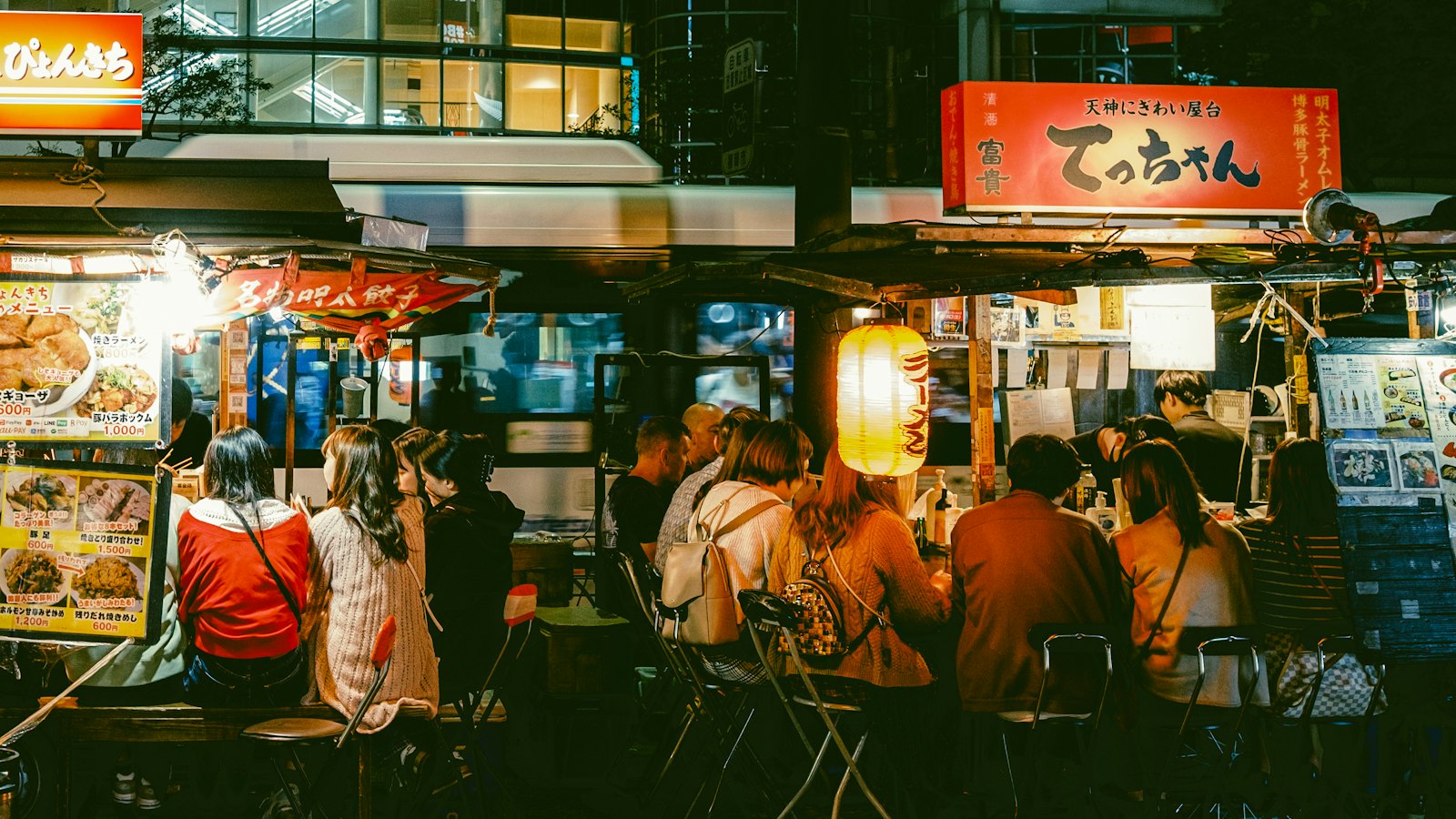
- Nakasu yatai: roughly 20 open-air stalls along the river at the southern tip of Nakasu, usually open from about 6pm to 2am. Worth a stroll even if you eat elsewhere.
- Canal City Hakata: a shopping complex with a canal running through it and fountain shows every 30 minutes from 10:00 to 22:00.
- Momochi Seaside: the 234 m Fukuoka Tower (adult entry around 800 yen) above a kilometre-long artificial beach.
- Uminonakamichi Seaside Park: seasonal flower fields and a zoo, 40 minutes by JR from Hakata (560 yen) or 20 minutes by ferry from Momochi (1,200 yen).
- Day trips: JR trains and highway buses put Kumamoto, Nagasaki and the retro port of Mojiko within easy reach.
What to eat in Fukuoka
Fukuoka is one of Japan's great food cities, but several signature dishes are built on pork or alcohol-based seasonings, so Muslim readers should pair this with the halal section below.
- Hakata ramen: thin, firm noodles in a milky tonkotsu (pork bone) broth, usually 500 to 1,500 yen a bowl. Many shops let you order extra noodles (kaedama) for the leftover broth.
- Mentaiko: spicy marinated pollock roe, the classic Fukuoka souvenir, eaten over rice, in onigiri or with pasta. Marinades can include alcohol, so check labels.
- Motsunabe: a hotpot of offal simmered with cabbage and chives, a cold-weather favourite.
- Mizutaki: chicken cooked in a cloudy broth at the table, finished with rice or noodles.
- Yakitori and bite-size gyoza: the staples of yatai counters and izakaya.
- Seafood: fish from Hakata Bay and the Genkai Sea fills the city's sushi counters, and conveyor-belt sushi typically costs 1,000 to 3,000 yen a person.
The yatai on Nakasu and elsewhere in the centre are the traditional setting for these dishes, while the food floors around Hakata Station and Canal City suit a quick family lunch. If you fall back on seafood or noodles, ask about dashi, mirin and sake in broths and sauces.
Halal food and prayer spaces in Fukuoka
Halal food exists in Fukuoka but is thinner on the ground than in Tokyo or Osaka, so plan meals ahead.
- What the labels mean: Japan has no single national halal authority, so certificates come from several private bodies, and Fukuoka Masjid has issued its own certifications to some local eateries. Muslim-owned places (often Indian, Pakistani or Turkish) may use halal meat without a certificate, while "Muslim-friendly" or "pork-free" menus often share a kitchen with other food and alcohol may be sold. For the strictest assurance, check the certifier against JAKIM's published list of recognised foreign halal bodies.
- Where to look: the Halal Gourmet Japan app lists Fukuoka places, including an Indian restaurant that describes all its ingredients as halal and has a branch on Kyushu University's Ito campus, a Pakistani restaurant with a prayer space, a halal-certified Turkish kebab shop, a Muslim-owned Turkish restaurant and a sushi restaurant serving a Muslim-friendly Hakata ramen set at lunch. Check opening days first.
- Mosque: Fukuoka Masjid Al Nour in Hakozaki, Higashi-ku, opened in 2009 as the first mosque in Kyushu. It is about 3 minutes on foot from JR Hakozaki Station. At the time of writing, the mosque lists Jumu'ah at 12:30 on Fridays, in English with a short Japanese summary.
- Prayer rooms: the airport's international terminal has two, on the 4th floor before security and on the 3rd floor after it. The Pakistani and Indian restaurants mentioned above also have their own prayer space. Muslim Pro covers prayer times and qibla.
Getting around Fukuoka
Fukuoka is one of the simplest Japanese cities to navigate on foot, subway and bus.
- Subway: three lines link the airport, Hakata, Tenjin, Nakasu-Kawabata, Ohori Park and Nishijin. Short rides start at 210 yen, and the adult 1-Day Pass costs 640 yen (about RM 17) from any station ticket machine.
- IC cards: the local Hayakaken, nimoca and SUGOCA cards work on subways, trains and buses, and so do Suica and other big-city cards. Hayakaken is sold at subway ticket machines with a 500 yen deposit included; iPhone users can add Suica to Apple Wallet instead.
- Buses: Nishitetsu runs most city buses, the easiest way to Momochi and Fukuoka Tower. Tap your IC card when you board and again when you get off.
- Passes: the Fukuoka Tourist City Pass (2,500 yen, or 2,800 yen with Dazaifu) gives foreign tourists a day of unlimited trains, buses and subways, but rarely beats an IC card. The JR Fukuoka Wide Pass (3,500 yen, two days) covers JR trains around the Fukuoka area, but not the Shinkansen.
- Taxis and Grab: Grab does not run its own ride service in Japan, so do not count on it here. Install GO, the Japanese taxi app, instead: it covers Fukuoka, has an English version for visitors and accepts international credit cards and Apple Pay. Taxis are metered.
Sample itinerary: 4 days in Fukuoka
This plan assumes the overnight Malaysia Airlines flight that lands at 07:05, with the flight home on the morning of day five. Connecting via Bangkok or Hanoi usually means a later arrival, so trim day one.
- Day 1: Bus to Hakata Station, drop your bags and ease in around Kushida Shrine and Canal City. Rest in the afternoon after the red-eye, then walk the Nakasu riverbank at dusk when the yatai light up.
- Day 2: Nishitetsu train from Tenjin to Dazaifu for the shrine, the snack stalls on the approach street and the Kyushu National Museum. Back in Tenjin, browse the underground arcade and department stores, then catch sunset at Ohori Park and the castle ruins.
- Day 3: Morning at Fukuoka Tower and Momochi beach, then the ferry across the bay to Uminonakamichi for the flower fields. On a Friday, skip the tower: pray Jumu'ah at Fukuoka Masjid in Hakozaki, then carry on by JR to Uminonakamichi, changing at Kashii.
- Day 4: Day trip by JR or highway bus to Kumamoto or Nagasaki, or stay local and shop around Hakata Station for mentaiko and souvenirs. Pack tonight: MH057 leaves at 10:00, so reach the international terminal by about 08:00.
In plum season, put Dazaifu on the first clear day.
Money, SIM and practical tips
- Currency: the Japanese yen. In late September 2026, RM 1 bought about 38.5 yen, so 1,000 yen is roughly RM 26.
- Cash and cards: hotels, department stores, convenience stores and bigger restaurants take cards, but yatai, small eateries, shrines and coin lockers often want cash. Many Japanese ATMs reject foreign cards, so carry some yen.
- E-wallets: Touch 'n Go eWallet's overseas QR payment works in Japan through Alipay+, and TNG says it is accepted at over 2 million Japanese merchants, including big convenience store chains. Look for the Alipay+ sign at the till, and carry a card as backup.
- SIM: buy a Japan eSIM before you fly, or use your telco's roaming plan.
- Plugs: Japan uses two flat-pin Type A sockets at 100 volts, so bring an adapter for Malaysian Type G plugs.
- Tipping: not expected.
- Rules: carry your passport at all times; you will be fingerprinted and photographed at immigration.
- Tax-free shopping: from 1 November 2026 you pay the full tax-inclusive price in the shop (at least 5,000 yen before tax, same store, same day) and get the tax back when you leave. Before check-in, have your purchases confirmed at a customs terminal or through Visit Japan Web; the shop then refunds you by its own method. Every item on the receipt must leave with you.
- Safety: Fukuoka is very safe, but ignore touts steering people into Nakasu bars at night, where bills climb fast. Get travel insurance that covers typhoon delays.
Before you go
- Best time to go
- For most Malaysians the best months in Fukuoka are late March to May and October to November, when days are mild and dry enough for long walks. Plum blossoms fill Dazaifu from late February, and cherry blossoms reach Maizuru Park in late March or early April. Hakata Dontaku draws huge crowds on 3 and 4 May during Golden Week. The rainy season covers roughly June and July, August highs average about 32°C, and the Hakata Gion Yamakasa festival runs from 1 to 15 July. Typhoons peak in August and September, and January highs sit near 10°C. Year-end holidays push fares up: at the time of writing our fare scan showed about RM 1,478 one-way for 24 December against about RM 622 in mid-January.
- Visa for Malaysians
- As of September 2026, Malaysians holding a chip-enabled e-passport can enter Japan visa-free for up to 90 days as temporary visitors. That covers tourism, family visits and short business trips, but not paid work. Japan's Ministry of Foreign Affairs says the exemption applies to ICAO-standard e-passports; travellers without one are advised to get a visa first. Your passport must be valid for the whole stay, and you will be fingerprinted and photographed on arrival. Visit Japan Web is optional but replaces paper immigration and customs forms with QR codes. JESTA, Japan's planned online travel authorisation, was not yet in force at the time of writing. Confirm the current rules on the Ministry of Foreign Affairs of Japan website or with the Embassy of Japan in Malaysia before you book.
- Honest budget guide
- Plan on roughly RM 250 to RM 600 per person per day in Fukuoka, before flights, depending on your room and how you eat. At the time of writing our KL fare scan shows one-stop, one-way fares from about RM 622, with a median of about RM 950; price the direct Malaysia Airlines flight too. A hostel or capsule bed costs about 2,000 to 5,000 yen (RM 50 to RM 130) a night, and a business hotel room about 7,000 to 20,000 yen (RM 180 to RM 520). Food runs about RM 80 to RM 150 a day; a subway day pass is about RM 17. A five-day trip for one, with return flights and a shared mid-range room, typically totals RM 2,800 to RM 4,500. All figures are indicative.
Frequently asked questions
Do Malaysians need a visa for Fukuoka, Japan?
No, if you hold a chip-enabled Malaysian e-passport. As of September 2026, Malaysians can stay in Japan visa-free for up to 90 days for tourism, family visits or short business, but not paid work. Your passport should be valid for the whole stay. Confirm on the Ministry of Foreign Affairs of Japan website before flying.
Is there a direct flight from KL to Fukuoka?
Yes. Malaysia Airlines resumed non-stop flights from KLIA Terminal 1 on 2 September 2026, five times a week, with daily flights planned from 1 December 2026. At the time of writing, one-stop tickets on AirAsia, Thai AirAsia or Vietjet started from about RM 622 one-way in our fare scan.
Is Fukuoka Muslim-friendly?
It is manageable with planning. Fukuoka Masjid Al Nour in Hakozaki holds Friday prayers, the airport's international terminal has two prayer rooms, and the Halal Gourmet Japan app lists Indian, Pakistani and Turkish restaurants plus a few Japanese options. Most ramen, yatai food and many sauces contain pork or alcohol.
How many days in Fukuoka is enough?
Three to four full days covers the city well: Hakata and Nakasu, Tenjin and Ohori Park, Momochi and half a day in Dazaifu. Add a day or two for Kumamoto, Nagasaki or Kitakyushu. The Malaysia Airlines flight arrives early morning and leaves mid-morning, so four nights gives you four useful days.
What is the best month to visit Fukuoka?
April and November are the easiest picks: mild temperatures, little rain, and blossoms or autumn colour. Late February to mid March suits plum blossoms at Dazaifu. Avoid Golden Week in early May if you dislike crowds, and remember that June and July are rainy while August and September can bring typhoons.
What does a 5-day Fukuoka trip cost from Malaysia?
Allow an indicative RM 2,800 to RM 4,500 per person for five days, including return flights and a shared mid-range room. On the ground most travellers spend RM 250 to RM 600 a day. At the time of writing, one-stop tickets in our KL fare scan start from about RM 622 one-way, so your travel dates matter most.
Can I use Grab in Fukuoka?
Not the way you use it at home, because Grab does not run its own ride service in Japan. Download GO, the Japanese taxi app, before you land: it covers Fukuoka, has an English version for visitors and accepts international credit cards and Apple Pay. Taxis are metered and reliable, though the subway is usually quicker and far cheaper.
How do I get from Fukuoka Airport to Hakata Station?
From the international terminal, take the Nishitetsu bus to Hakata Station, about 15 minutes for around 310 yen (RM 8). Or ride the free shuttle to the domestic terminal and take the subway two stops to Hakata for about 260 yen. A taxi costs roughly 1,500 yen (RM 39).
Jom pergi
Ready to go Fukuoka? Compare available flights and hotels for your dates. Check baggage, cancellation terms and the final total on the booking provider before paying.