




On this page13 sections
- Overview
- Getting there from KL: non-stop flights and fares
- Incheon Airport to the city
- Where to stay in Seoul
- Things to do in Seoul
- What to eat in Seoul
- Halal food and prayer spaces
- Getting around Seoul
- Sample itinerary: 4 days in Seoul
- Money, SIM and practical tips
- Shopping in Seoul: K-beauty, fashion and tax refunds
- Before you go
- FAQ
Seoul is the Korea most Malaysians picture before they go: Joseon palaces under granite peaks, Olive Young baskets filling up in Myeongdong, and the cafe streets of Seongsu and Hongdae. It also works well for Muslim travellers by North Asian standards, with Seoul Central Mosque in Itaewon and halal kitchens around it. Overnight flights from KLIA touch down at Incheon in time for breakfast. This guide covers what to sort out before booking: the K-ETA, which airlines fly non-stop, the train into town, where to eat halal, how to get around without Grab, and the cost in ringgit.
Getting there from KL: non-stop flights and fares
Incheon Airport's timetable for the season ending in late October 2026 lists four airlines flying non-stop from Kuala Lumpur:
- Malaysia Airlines: a daily overnight flight plus a daytime one five days a week, from KLIA Terminal 1.
- Korean Air: daily from KLIA Terminal 1.
- Batik Air Malaysia: most days, also from Terminal 1.
- AirAsia X: four weekly flights from KLIA Terminal 2 until 23 October 2026, after which AirAsia takes over with daily A321LR flights from 25 October, so bookings may show either name.
The overnight flights leave KLIA between about 11.20 and 11.35 pm and reach Incheon between about 6 and 7 am local time, so move your watch one hour forward. Timetables allow roughly five and a half to six and three quarter hours, depending on the airline. The Malaysia Airlines daytime flight lands around 9.15 pm. At the time of writing Korean Air uses Incheon Terminal 2 and the others Terminal 1, worth remembering on the train back.
At the time of writing, Amaboxly's KL fare scan puts the cheapest one-way ticket at about RM 609 on Scoot, changing in Singapore, then RM 622 on Vietjet through Ho Chi Minh City or Hanoi. The median fare was also about RM 622, and the dearest we saw was about RM 945. Those are connecting fares; non-stop seats were not among the cheapest, so compare both.
Incheon Airport to the city
Incheon sits on an island west of Seoul, about an hour from the centre by any method, and the airport suggests allowing one to two hours after landing for immigration before any booked onward transport. Prices are indicative, at roughly 333 won to RM 1.
- AREX Express: non-stop to Seoul Station in 43 minutes from Terminal 1 or 51 from Terminal 2, for 13,000 won (about RM 39), with reserved seats.
- AREX all-stop: the commuter train, 4,750 won from Terminal 1 or 5,350 won from Terminal 2 (about RM 14 to RM 16) with a transit card, and roughly an hour to Seoul Station. It also stops at Hongik University for Hongdae. Buy a T-money card at an arrivals convenience store first.
- Limousine buses: coaches serving hotels in Myeongdong, Dongdaemun, Gangnam and beyond, for 17,000 to 18,000 won (about RM 51 to RM 54) on the central Seoul routes. Buy tickets at the arrivals counters and allow at least an hour.
- Taxi: very roughly 60,000 to 100,000 won (RM 180 to RM 300) on the meter to most of Seoul, about an hour's drive, with 20 to 40 percent extra between 10 pm and 4 am. The airport's International Taxi has foreign-language drivers and flat fares of 70,000 to 95,000 won for a standard car, depending on the Seoul zone; book it ahead. Use only official ranks, since call vans posing as taxis overcharge.
With toddlers or heavy suitcases, the bus or a taxi beats subway stairs.
Where to stay in Seoul
Seoul spreads across both banks of the Han River, so pick a base on a useful subway line.
- Myeongdong and Jung-gu: the classic first-timer choice, close to K-beauty shops, evening snack stalls, Namsan and many airport bus stops. Rooms at every budget, though crowds last until late.
- Hongdae (Mapo): younger, cheaper and louder, with indie boutiques, buskers and cafes. The airport train stops here, which keeps arrival day simple for backpackers and groups of friends.
- Jongno and Insadong: the old royal quarter, with palaces, tea houses and hanok guesthouses near Gyeongbokgung, Bukchon and Gwangjang Market. Calmer evenings suit parents and older relatives.
- Itaewon (Yongsan): the most practical base for Muslim families, with Seoul Central Mosque and the largest group of halal restaurants within walking distance. Streets are steep and some blocks become nightlife strips at weekends, so choose a quieter lane.
For the quickest airport link or a KTX run to Busan, stay near Seoul Station; Gangnam and neighbouring Jamsil suit trips centred on COEX and Lotte World.
Things to do in Seoul
- Gyeongbokgung Palace: the first royal palace of the Joseon dynasty, founded in 1395, with a changing of the guard ceremony twice a day. Visitors in hanbok enter free.
- Bukchon Hanok Village: tiled-roof homes on the slope above the palace. Residents still live here, so since November 2024 tourists may enter the core lanes only from 10 am to 5 pm, and quietly.
- Changdeokgung: a UNESCO-listed palace whose Secret Garden is partly seen on booked tours.
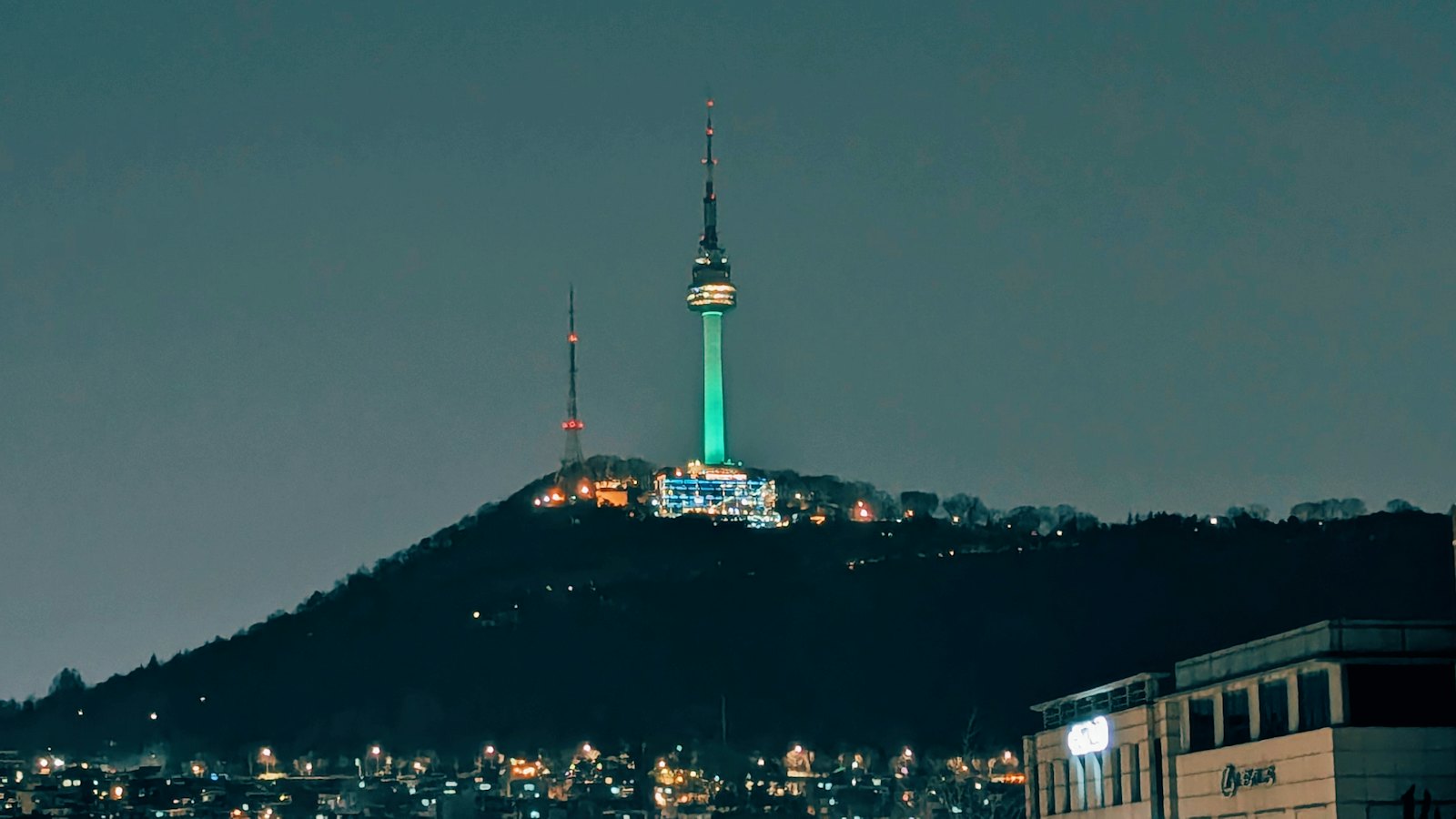
- N Seoul Tower: ride the cable car or walk up Namsan for the city lights at dusk.
- Gwangjang Market: stalls frying bindaetteok (mung bean pancakes) and rolling mayak gimbap. Fillings often include pork, so Muslim travellers should ask.
- Seongsu-dong: former factories turned into cafes, plus the pop-up stores Korean brands use for launches.
- Hongdae after dark: buskers, photo booths and small fashion shops.
- Lotte World Tower: 555 m and 123 storeys, with an observation deck, beside the Lotte World theme park.
- Han River parks: ride a Ttareungyi public bike or picnic at Yeouido.
- Nami Island: the Winter Sonata island near Gapyeong, an easy day trip for K-drama fans, with a zip line over the water.
What to eat in Seoul
Seoul eats late and spicy. Many headline dishes involve pork or non-halal meat, so Muslim readers should also see the halal section.
- Korean barbecue: samgyeopsal (pork belly) is the icon, but beef and dak-galbi (spicy stir-fried chicken) are everywhere. Grill houses often insist on at least two portions.
- Bibimbap: rice with vegetables and gochujang, best in a sizzling stone bowl.
- Tteokbokki and eomuk: chewy rice cakes in red sauce and fish cake skewers from Myeongdong carts and markets.
- Samgyetang: a small whole chicken stuffed with rice and ginseng, traditionally eaten on the hottest days.
- Naengmyeon: cold buckwheat noodles in icy broth.
- Korean fried chicken: crunchy, glazed and made for sharing.
- Hotteok: syrupy stuffed pancakes from street carts once the weather cools.
Gwangjang Market is the classic makan stop for eating on your feet, while Myeongdong's evening stalls cost more but are handy. A simple neighbourhood lunch is roughly 10,000 to 15,000 won (RM 30 to RM 45), barbecue more. Banchan side dishes are free and usually refilled on request.
Halal food and prayer spaces
Seoul has more halal choice than anywhere else in Korea, yet eating outside Itaewon takes homework. The labels you will meet fall into four rough levels:
- Halal certified: approved by a recognised body, mainly the Korea Muslim Federation (KMF), whose certification JAKIM recognises.
- Self-certified: a Muslim owner vouches for the kitchen.
- Muslim friendly: some halal dishes, but alcohol may be sold.
- Pork free: no pork, yet the meat is not halal.
Most halal dining clusters around Seoul Central Mosque in Hannam-dong, Itaewon, uphill from Itaewon Station on Line 6. Middle Eastern and other halal restaurants line the nearby lanes of Usadan-ro, and a few cook halal Korean food. Elsewhere, a handful of Muslim-friendly places have opened in tourist districts such as Myeongdong and Hongdae, but they come and go, so check recent reviews first.
The mosque holds Friday prayers. Incheon Airport lists 24-hour prayer rooms airside near Gate 24 and in the west transfer lounge of Terminal 1, and near Gates 231 and 268 in Terminal 2. In the city, a few large malls and attractions set aside prayer space, so ask at the information desk. Muslim Pro handles prayer times and qibla. Seafood and vegetable dishes are the usual fallback, but ask about meat stock and cooking wine.
Getting around Seoul
The subway is frequent, spotless and signposted in English. Since June 2025 a ride of up to 10 km costs 1,550 won (about RM 4.70) with a transit card, slightly more for longer journeys.
- T-money: sold at convenience stores and station machines, usually recharged with cash, and valid on buses and many taxis too. Seoul has been adding machines at major stations that accept overseas cards.
- Climate Card for visitors: unlimited Seoul subway and city bus rides for 1 day (5,000 won), 2 days (8,000), 3 days (10,000), 5 days (15,000) or 7 days (20,000). It excludes the Shinbundang Line and airport buses, and you cannot board with it at the Incheon Airport AREX stations, so pay separately for the ride into town.
- Ride-hailing: forget Grab, which has no service in Korea. Koreans book through Kakao T, and visitors can use k.ride from the same company, Kakao Mobility, paying by foreign card, Touch 'n Go eWallet or Boost via Alipay+.
- Taxis: a standard Seoul taxi starts at 4,800 won, more after 10 pm.
- Maps: install Naver Map or KakaoMap, which locals trust for walking and transit routes.
Seoul has begun a gradual switch to tapping foreign contactless cards on buses and at subway gates, a rollout planned to run until 2030, so keep a T-money card for now.
Sample itinerary: 4 days in Seoul
This plan assumes a dawn arrival and a late-night flight home; on an afternoon flight, trim Day 4. Shuffle days around the weather.
- Day 1: Drop bags at the hotel and ease in with Myeongdong, browsing K-beauty stores until the snack stalls open in the evening. End with the cable car up Namsan and the night view from N Seoul Tower.
- Day 2: Rent hanbok near Gyeongbokgung and walk in free, then wander Bukchon before the 5 pm cut-off. Tea in Insadong, then dinner at Gwangjang Market, or halal Korean food in Itaewon.
- Day 3: Day trip to Nami Island, back in time for Hongdae's buskers and late shopping. City lovers can swap in Seongsu-dong cafes and Seoul Forest.
- Day 4: Morning at Lotte World Tower or COEX, where the mall holds the Starfield Library, then lunch in Itaewon (on a Friday, join Friday prayers at Seoul Central Mosque). Reach Incheon at least three hours before departure.
A fifth day fits the Secret Garden at Changdeokgung, a guided DMZ tour or a KTX day in Busan.
Money, SIM and practical tips
- Currency: the Korean won. At the end of September 2026 one ringgit bought about 333 won, making a 10,000 won note worth about RM 30.
- Paying: Visa and Mastercard work in most shops, restaurants and taxis. Carry some won for market stalls, street snacks and T-money top-ups.
- E-wallets: at the time of writing DuitNow QR does not work in Korea (PayNet's cross-border list is Singapore, Indonesia, Thailand and Cambodia). Touch 'n Go eWallet pays at some Alipay+ merchants.
- SIM and eSIM: install a Korean data eSIM before you fly, or collect a SIM or pocket Wi-Fi at Incheon arrivals.
- Electricity: 220V, and sockets take European-style round pins (types C and F), so pack a converter for Malaysian three-pin chargers.
- Tipping: not customary.
- Safety: Seoul is very safe at any hour. The traps are unofficial K-ETA websites charging extra fees and unlicensed call vans touting rides at the airport.
- Emergencies: 112 for police, 119 for fire and ambulance, 1330 for the multilingual travel hotline.
Shopping in Seoul: K-beauty, fashion and tax refunds
For many Malaysians, the suitcase home matters as much as the sights.
- K-beauty: Olive Young, the Korean health and beauty chain, has stores across Seoul including Myeongdong. Sunscreen, sheet masks and skincare sets are the usual hauls.
- Fashion: Hongdae and Seongsu suit young Korean labels and pop-ups. Dongdaemun's malls trade into the small hours, and some wholesale buildings open only at night for traders, with no fitting rooms.
- Department stores: luxury floors and food halls, useful on a rainy day.
- Tax refunds: shops with a Tax Free or Tax Refund sign return VAT on eligible purchases. Carry your passport; some shops refund on the spot, otherwise claim it at Incheon when you leave and allow extra time.
Prebook extra baggage rather than paying at the counter. On a heavy last day, the T-Luggage service carries bags the same day from staffed counters at Seoul Station, Hongik University, Myeongdong and Gimpo Airport stations to Incheon.
Before you go
- Best time to go
- The most comfortable months for Seoul are April to early June and September to early November, when days are mild and mostly dry. Cherry blossoms usually bloom in early April along the Han River and at Yeouido, and autumn leaves colour the palaces and Namsan from late October into mid November. Summer is hot and sticky: the monsoon rains usually set in from late June, and heavy downpours are possible into September. Winter, December to February, is properly cold: the average January low is about minus 5.5 degrees Celsius, and many Malaysians come precisely for the snow. Chuseok and Seollal holidays bring packed trains. At home, the year-end school break runs from 5 to 31 December 2026 in most states (from 4 December in Kedah, Kelantan and Terengganu), so book December seats early.
- Visa for Malaysians
- As of September 2026, South Korea admits Malaysians without a visa for up to three months, but travellers aged 18 to 64 must first secure an approved K-ETA. Use only the official portal, k-eta.go.kr, as copycat agent sites add fees. The charge is 10,000 won, most decisions arrive within 72 hours, and approval covers three years, though a renewed passport needs a fresh application. The Korean Embassy in Malaysia advises applying at least a month before departure. K-ETA holders need no arrival card. Children aged 17 and below and seniors aged 65 and above are exempt from the K-ETA and can fill in the free e-Arrival Card online up to three days before arrival. Korea's temporary K-ETA waiver, valid until 31 December 2026, does not cover Malaysia. Korea sets no minimum passport validity of its own, but the embassy reminds Malaysians to have more than six months left for overseas travel. Confirm everything on k-eta.go.kr before you fly.
- Honest budget guide
- Plan on roughly RM 250 to RM 650 per person per day in Seoul, excluding flights, depending mostly on your room. Flights: at the time of writing our scan's one-way fares ran from about RM 609 to RM 945, so a connecting return lands around RM 1,250 to RM 1,900. A guesthouse or basic hotel room costs about 60,000 to 100,000 won (RM 180 to RM 300) a night, and a comfortable mid-range hotel 130,000 to 250,000 won (RM 390 to RM 750). Food runs RM 100 to RM 200 a day and subway or bus fares about RM 20. A five-day, four-night trip with a shared mid-range room adds up to roughly RM 2,800 to RM 4,700 per person including flights, before shopping. All figures are indicative.
Frequently asked questions
Do Malaysians need a visa to visit Seoul?
No. Malaysians can stay visa-free for up to three months, but everyone aged 18 to 64 needs an approved K-ETA before the flight. It costs 10,000 won on k-eta.go.kr and lasts three years. Children aged 17 and below and travellers aged 65 or above are exempt and can use the free online e-Arrival Card instead.
Is there a direct flight from KL to Seoul?
Yes. At the time of writing, Malaysia Airlines, Korean Air and Batik Air Malaysia all run non-stop services out of KLIA Terminal 1, while AirAsia X flies from Terminal 2 until AirAsia takes the route over on 25 October 2026. Timetables allow roughly five and a half to six and three quarter hours. Connecting tickets can be cheaper; our scan's lowest one-way fare was about RM 609 via Singapore.
Is Seoul Muslim-friendly?
More than most of Korea. Seoul Central Mosque in Itaewon holds Friday prayers, and the lanes around it have the city's widest choice of halal restaurants, including some serving halal Korean food. Incheon Airport has 24-hour prayer rooms, and a few large malls and attractions set aside prayer space. Outside Itaewon, check each restaurant's status, because a pork-free kitchen is not the same as a halal one.
How many days in Seoul is enough?
Four days covers the palaces, Bukchon, Myeongdong, Namsan, a food market and one district such as Hongdae or Seongsu. Five or six days lets you add Nami Island, the DMZ or Busan by KTX, plus unhurried shopping. Overnight flights from KL land early, so arrival day is a usable half day.
What is the best month to visit Seoul?
April and October are the most reliable, with comfortable temperatures, little rain and either cherry blossoms in early April or autumn colours from late October. December to February suits travellers chasing snow and winter fashion. July and August are usually the least pleasant months, with heat, humidity and heavy rain.
What does a 5-day trip to Seoul cost?
A comfortable mid-range trip comes to roughly RM 2,800 to RM 4,700 per person including flights, assuming a shared hotel room, casual restaurants and the subway. Backpackers in guesthouses spend less. Shopping is extra, so keep a separate amount for Olive Young or Dongdaemun.
Can I use Grab in Seoul?
No. Grab has no service in Korea, so download Kakao T, the app most Koreans use, or k.ride, its sister app built for tourists, which takes foreign cards as well as Touch 'n Go eWallet and Boost via Alipay+. Street taxis are easy to flag, and the subway covers almost every sight.
How do I get from Incheon Airport to Myeongdong?
The limousine bus is simplest: route 6015 to Myeongdong costs 17,000 won (about RM 51) and stops near the main hotels; allow at least an hour. By train, ride AREX to Seoul Station (13,000 won express, or 4,750 to 5,350 won all-stop) and change to subway Line 4 for Myeongdong. A taxi costs roughly 60,000 to 100,000 won.
Jom pergi
Ready to go Seoul? Compare available flights and hotels for your dates. Check baggage, cancellation terms and the final total on the booking provider before paying.






